C-Series UPS or C-Labelled Battery Cabinet? Identify Each Quotation Line
By Highidea Power Engineering Team · 19 October 2026 · 4 min read
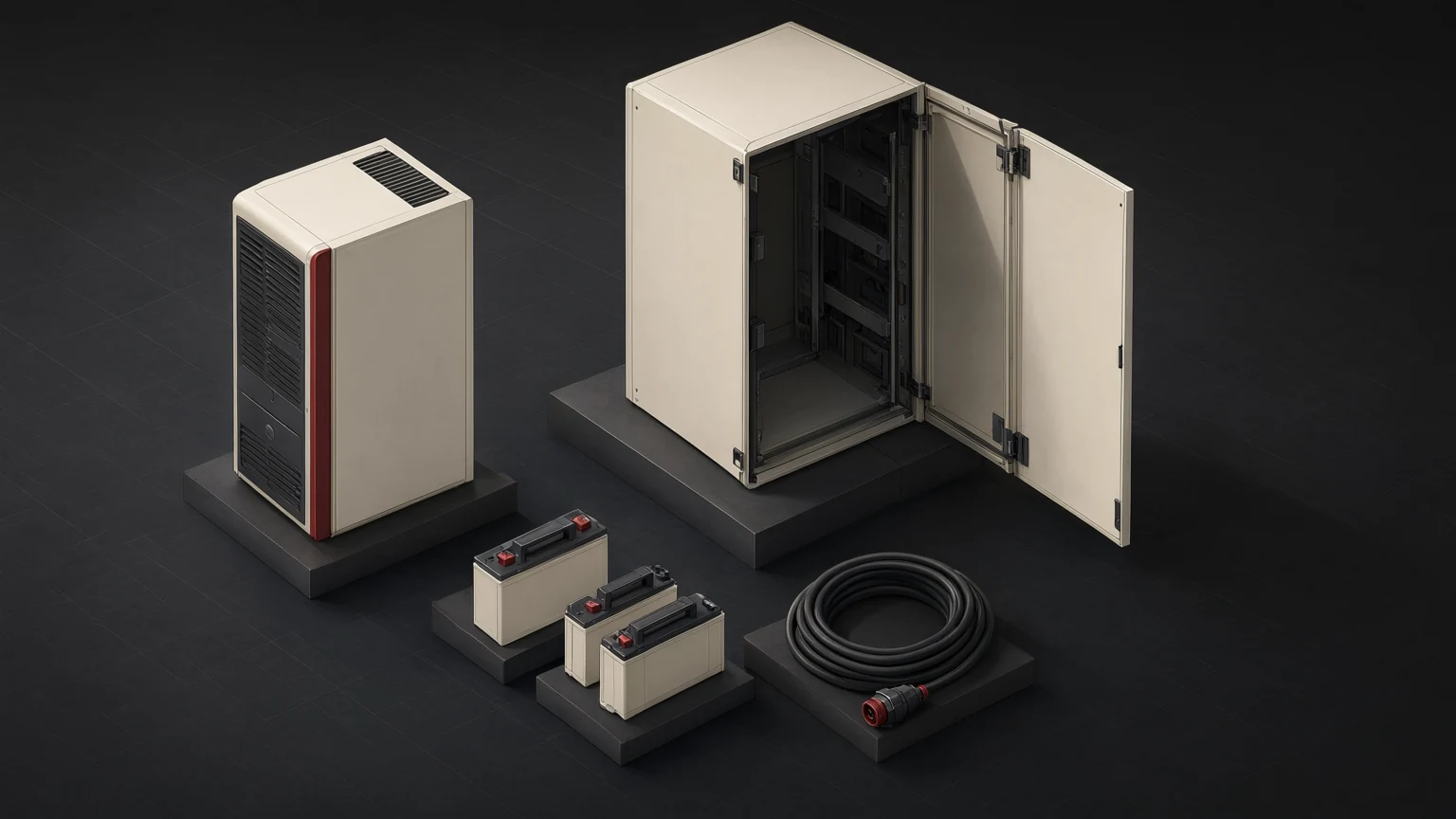
Highidea's C1K–C10K online UPS family and C-labelled UPS battery cabinets are different equipment categories. A shared letter does not establish that a cabinet belongs with a particular UPS. Identify the host, cabinet, batteries and connection/protection equipment separately, then require the supplier to confirm the complete compatible assembly.
Why the model name is not enough
A request for “a C-series unit” can mean a power-conversion host or a battery enclosure. The practical consequences extend beyond delivery of the wrong cabinet: an order can omit the inverter, omit batteries, include the wrong battery voltage or leave connecting and protective parts outside the price. A photograph and a short label do not settle those questions.
Highidea documents C1K, C2K, C3K, C6K and C10K as tower online double-conversion UPS models with internal VRLA lead-acid batteries. Its separate battery-product listing includes C-labelled UPS battery cabinets, B-series rack battery packs and NP-series lead-acid batteries. That listing does not establish which cabinet is compatible with each C host.
Separate four equipment identities
Use a bill of materials with one row for each function. Keep “included,” “optional” and “supplied by others” visible so a quotation cannot appear complete merely because all items share a product-family label.
Do not assume the cabinet is empty, or that it includes batteries. Both interpretations need an explicit quotation answer. Nor should “cabinet supplied” be interpreted as “complete installation supplied” unless the required connections and protection are listed.
Item | Details and decision |
|---|---|
UPS host | Function: Converts and conditions power; supplies the protected AC output; Identity to obtain: Full host model, VA/W rating, input/output and battery architecture |
Battery cabinet | Function: Houses battery equipment and associated fittings as quoted; Identity to obtain: Cabinet code, dimensions, contents and installation scope |
Batteries | Function: Store energy; Identity to obtain: Chemistry, individual rating, quantity and approved arrangement |
Connection/protection equipment | Function: Connects and protects the approved assembly; Identity to obtain: Cable, connector, isolator/protection and responsibility schedule |
Read the host battery architecture before asking for expansion
The C-family specification lists internal 12 V VRLA batteries with quantities varying by model: C1K has two, C2K four, C3K six, C6K twelve and C10K sixteen. These are documented internal configurations. They are not permission to connect an external string, a wiring instruction or a compatibility table for a separately named cabinet.
For an external-battery proposal, request written confirmation of the exact host variant, permitted battery arrangement, charging capability and manufacturer-approved connection method. A physically matching connector or a plausible total voltage is not enough to establish compatibility. This review belongs to the supplier and qualified installer, particularly where batteries can deliver high fault current.
A useful quotation comparison
Consider two hypothetical offers. Offer A lists a C3K UPS. Offer B lists a C-labelled battery cabinet and a battery quantity. The names sound related, but these offers do not yet provide the same function. Ask B to identify the host and ask A to state whether the internal battery system alone meets the required runtime. Then compare complete configurations against the same load.
This example illustrates document comparison only. It does not propose assembling a C3K with a particular cabinet or selecting batteries by arithmetic alone.
Quotation field | Details and decision |
|---|---|
Equipment category | Answer that closes the issue: UPS host; populated cabinet; or empty enclosure, stated separately; Answer that leaves a risk: “C series” |
Included storage | Answer that closes the issue: Exact battery type, quantity and approved arrangement; Answer that leaves a risk: “Battery cabinet included” |
Host compatibility | Answer that closes the issue: Named host and manufacturer-approved configuration; Answer that leaves a risk: “Suitable for UPS” |
Runtime | Answer that closes the issue: Result for the stated load and complete configuration; Answer that leaves a risk: Cabinet capacity without a load |
Installation scope | Answer that closes the issue: Named connection/protection items and responsible installer; Answer that leaves a risk: “Standard accessories” |
Keep capacity and runtime in different columns
Host power rating limits the load it can support. Battery energy and operating conditions influence how long it can support that load. A larger enclosure does not increase the inverter's watts rating. More nominal ampere-hours also do not establish runtime without the battery voltage, discharge behavior, conversion losses and the host's permitted configuration.
Write the required runtime at a stated watt load, including the operational task that must fit within it. Request the supplier's matching runtime evidence and recharge conditions. If the offered battery arrangement changes, review the result again; do not carry forward a runtime statement for the previous assembly.
Accept the delivered assembly against the approved list
Before shipment, compare the final packing list, host label, battery identifiers, cabinet contents, drawings and manuals with the approved quotation. Keep each item traceable without energizing equipment to identify it. Any discrepancy should be resolved before installation rather than treated as a harmless naming variation.
Ask Highidea for a complete host-and-storage proposal if your runtime target exceeds the internal-battery configuration. Provide the real load, autonomy requirement, installation space and service constraints. The correct next step is an approved compatible configuration with clear inclusions—not an assumption that products carrying the same letter are automatically a matched set.
Sources and product context
The following primary references support the industry context. They do not establish conformity, compatibility or performance of every Highidea product. Model-specific product statements in this guide follow the cited Highidea product and application records.
IEC: IEC 62040-3:2021 — UPS performance and test requirements
FAQ
Frequently asked questions
Does a C-labelled cabinet automatically fit a C1K–C10K UPS?
No. Shared naming does not establish electrical or mechanical compatibility. Obtain the exact host and manufacturer-approved battery and connection configuration.
Does a battery cabinet always include batteries?
The quotation must say whether it is an empty enclosure or a populated assembly, identify the contents and state which connection and protection items are included.
Do more batteries increase the UPS watts rating?
No. Host power capability and storage autonomy are separate limits. Any storage change must also comply with the host’s approved battery and charging arrangement.
Related
Products, solutions & further reading.
Put this into practice
Need help specifying the right unit?
Share the load, voltage, runtime, environment and destination for a configuration review.