UPS Maintenance at Remote Marine and Mining Sites
By Highidea Power Engineering Team · 12 October 2026 · 4 min read
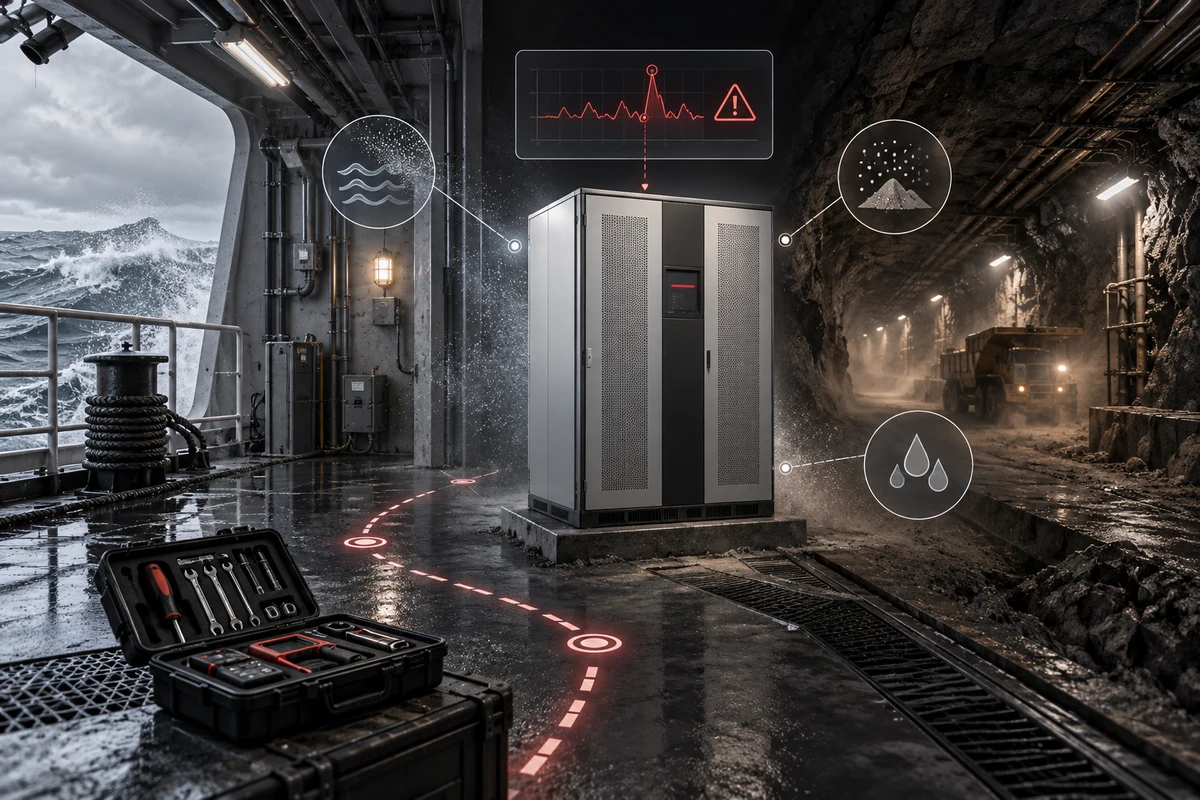
At a remote marine or mining site, maintenance must prevent avoidable travel and unsafe improvisation. Build the plan from the exact UPS configuration, site hazards, access interval and critical-load consequence. Capture trend and alarm evidence remotely, inspect environment and connections during every visit, carry only approved spares, and define who may isolate, test and return the system to service.
Start with the maintenance constraint, not a calendar interval
A remote site is different because a missed tool, unknown alarm or inaccessible battery can turn a short visit into another mobilization. Record how often qualified people can reach the equipment, which weather or operating windows restrict access, what permits are required and how long the protected load can tolerate reduced redundancy. The result should be a site-specific work package, not a generic annual checklist.
Separate what can be observed remotely from what requires physical inspection. Status and alarm history can reveal recurring input failures or temperature events, while corrosion, loosened terminations, blocked airflow, contamination and damaged seals require trained eyes at the cabinet. Neither view replaces the other.
Use one evidence plan for every visit
Photographs should identify the inspected component and condition without exposing site-sensitive information. Name each file against the equipment identifier and visit date so the next technician can compare like with like.
Workstream | Evidence before travel | Evidence captured on site |
|---|---|---|
Operating history | Alarm and event log, load trend, source interruptions | Timestamped functional checks and unresolved events |
Environment | Temperature or enclosure alarms, recent weather or process changes | Air path, dust, moisture, salt deposit and corrosion observations |
Battery system | State, alarms and last test record available for the model | Approved inspection and test results under defined conditions |
Connections | Current one-line and termination schedule | Torque or condition record where the manufacturer and site procedure require it |
Build a controlled remote-site kit
- Carry the current manual, approved one-line diagram, lockout or isolation procedure and contact list offline.
- List model-specific consumables and replaceable modules; do not treat a physically similar battery, fan, card or breaker as interchangeable.
- Bring the instruments, leads, personal protective equipment and environmental protection required by the site owner.
- Include clean packaging and labels for removed parts so serial, position and failure evidence are preserved.
- Define a fallback state if the planned task cannot be completed safely during the access window.
Control hazards and return to service
Marine equipment may be exposed to humidity, salt and motion; underground work can involve dust, moisture, vibration and site-specific hazardous-area rules. Those conditions must be defined by the owner and qualified safety personnel. A UPS product page cannot decide whether a location is classified or whether a particular enclosure is acceptable.
Before energization, reconcile the actual wiring with the approved drawing, confirm guards and covers, clear temporary tools, restore monitoring and verify the intended source-loss and alarm response under an authorized test. Record deviations, responsible owners and the next action rather than closing the visit with an informal “working” note.
Where Highidea can support the plan
Highidea documents specialty-voltage D, DT and LT families for marine and underground applications, with remote-monitoring options on compatible configurations. Exact voltage, topology, environmental treatment, monitoring interface and replaceable parts must be confirmed for the ordered model.
Send the model and serial information, current one-line, protected-load list, site environment, recent alarms and access constraints when requesting support. Overseas spare logistics and service responsibilities should be written into the purchase or service agreement for the project.
Remote-site maintenance handover checklist
- Equipment identity and approved configuration match the site record.
- Alarm, load and source-event evidence has been saved before clearing anything.
- Environmental observations and corrective actions are assigned.
- Battery and functional tests state load, condition, method and result.
- Monitoring, notification and escalation paths have been retested.
- Open risks, temporary states and the next access date are visible to operations.
The decision record to retain
Use a visit sheet with four columns: observed condition, evidence, decision and owner. “Battery checked” is too vague; the record should identify the battery or module, inspection or test method, relevant operating condition and result. When a value cannot be collected safely, record that limitation and the follow-up method instead of filling the gap with an assumption.
The closeout should also distinguish work completed from temporary risk controls. If a redundant path is unavailable, an alarm remains suppressed or a replacement part is pending, operations needs an expiry time and escalation trigger. This discipline lets the next remote review detect deterioration and prevents an incomplete visit from being mistaken for full restoration.
Before the team leaves, hold a short operational handover using the same sheet. The technician explains the current state, operations confirms alarm visibility, and the responsible manager accepts any open restriction. Store the signed record where the remote support team can retrieve it during the next event; a report locked in a contractor inbox cannot support fast diagnosis.
Authoritative references and scope
These sources define industry, regulatory or planning context. They do not prove that every Highidea model meets every cited requirement; approve the exact product, configuration and document scope for the project.
IEC: IEC 60945:2002 — Maritime navigation and radiocommunication equipment
FAQ
Frequently asked questions
Can remote monitoring replace physical UPS maintenance?
No. Remote data can expose alarms, trends and communication failures, but it cannot reliably confirm corrosion, contamination, loose hardware, blocked airflow or physical damage. Use it to prepare and prioritize the visit.
Which spares should a remote site hold?
Only parts approved for the exact model and maintenance level. Rank them by failure consequence, replacement competence, shelf conditions, transport time and the site’s ability to operate while waiting.
Does a marine or mining application automatically prove hazardous-area suitability?
No. The site owner must define the environmental and hazardous-area classification. Confirm the exact equipment approvals, enclosure and installation method against that requirement before use.
Related
Products, solutions & further reading.
Put this into practice
Need help specifying the right unit?
Share the load, voltage, runtime, environment and destination for a configuration review.