Choosing a UPS for High-Altitude Sites
By Highidea Power · 23 October 2026 · 4 min read
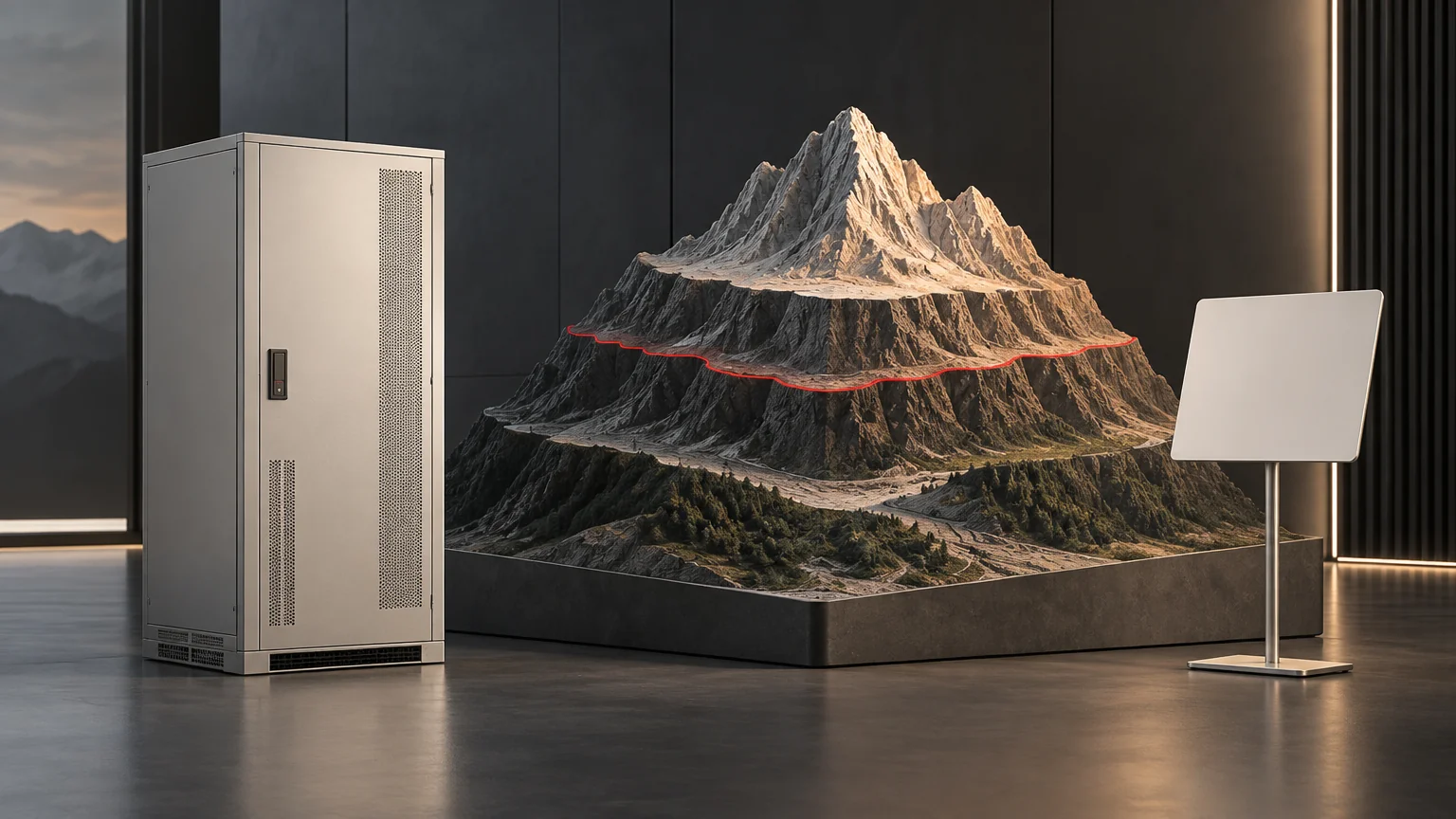
For a high-altitude installation, establish the selected UPS’s full-rating range, any permitted derating range and its maximum operating altitude. Apply only the manufacturer’s conditions for that configuration, temperature and mode. Highidea can discuss rack, three-phase and industrial UPS requirements using your site information; a generic percentage taken from another product cannot establish the available capacity.
Start with the equipment location
Give the supplier the altitude where the UPS will actually operate, together with expected ambient conditions, enclosure arrangement and load. Distinguish that site from a shipping destination, warehouse or office address. For equipment moved between sites, identify the intended operating locations rather than supplying one convenient reference point.
Separate operation from storage and transport. A published storage range concerns equipment in a different state; it does not authorize powering the UPS at that altitude. The UPS and battery may also have separate environmental conditions that need to remain in the configuration review.
Altitude matters to equipment suitability beyond a simple capacity label. Cooling and electrical design conditions must be addressed through the manufacturer’s applicable documentation. Selecting a larger nameplate cannot by itself establish that the complete equipment remains suitable for the site.
Read the complete operating envelope
A useful specification distinguishes three regions: operation at full declared rating, operation with a stated reduction or other conditions, and locations beyond the documented operating range. Each region leads to a different procurement decision.
Within a permitted derating range, obtain the applicable output limits and compare them with the load requirement. Outside the documented range, do not extrapolate the last section of a curve. Ask for a configuration-specific response before treating the product as a candidate.
Where temperature, altitude, output setting or mode impose multiple conditions, request the combined rule. Independently multiplying reductions assumes a relationship that may not be documented. The supplier should identify which limits apply simultaneously and whether additional conditions change the result.
Compare what manufacturers actually disclose
Legrand’s UPSaver datasheet provides a full-rating altitude and a stated derating rule up to a maximum altitude. Eaton’s 93E G2 datasheet gives an altitude without derating and a maximum. These are useful examples of different disclosure detail; neither supplies a universal rule for other UPS ranges.
A quotation that gives only a maximum altitude still leaves a capacity question open. Request the permitted output at the actual location, the temperature condition and applicable operating states. “Can operate” and “can deliver the required W and VA there” need to be answered together.
Specification item | Question to close | Procurement result |
|---|---|---|
Actual site | Where and under what ambient conditions will it operate? | Correct environmental input |
Full-rating region | Is the site within the stated no-derating range? | Whether nominal output applies |
Derating region | What output is permitted at this site? | Available configuration capacity |
Maximum altitude | Is the site within the documented limit? | Whether the product remains a candidate |
Combined conditions | How do temperature, mode and other settings interact? | Applicable operating envelope |
Battery and enclosure | What separate conditions apply? | Complete system review |
Compare usable output with the actual task
Record both load W and VA, their simultaneous requirement and relevant operating conditions. A permitted output reduction must be applied to the rating the manufacturer actually defines. Do not assume that every limitation changes every electrical rating in the same way.
In a hypothetical comparison, two UPSs have the same nameplate capacity but different documented site envelopes. One may remain at full rating while the other requires a reduced output at the project location. The better candidate follows from documented available capacity and complete suitability, not from the shared nameplate alone.
If the information needed to make that comparison is absent, label the quotation “capacity at site awaiting clarification.” This is a useful buying decision: the candidate remains unresolved rather than being silently accepted or rejected using an invented curve.
Prepare a site-specific Highidea request
Our three-phase 33ET and industrial-frequency GD ranges address different power configurations. Provide the site altitude, temperature conditions, required output, W and VA, battery arrangement and intended modes to Highidea. Ask for the selected model’s applicable operating conditions and any capacity adjustment required at that location.
Combine the altitude record with the industrial site-condition guide and the W and VA selection guide. Keep the system’s installation and protection review with the responsible project designer. An altitude statement is one input to that review, not blanket approval for every environmental or electrical condition.
Primary references
- Legrand: UPSaver datasheet, product-specific altitude conditions.
- Eaton: 93E G2 datasheet, operating altitude declaration.
FAQ
Frequently asked questions
Can a larger UPS avoid all altitude restrictions?
No. Additional nominal capacity does not remove the manufacturer’s operating limits or other site conditions.
Does a maximum altitude imply full rated output up to that point?
No. Check whether a separate derating rule or other condition applies below the maximum.
Can I use a neighboring model’s derating curve?
Use it only when the manufacturer explicitly makes it applicable to the proposed configuration. Similar appearance or series naming is insufficient.
Related
Products, solutions & further reading.
Put this into practice
Need help specifying the right unit?
Share the load, voltage, runtime, environment and destination for a configuration review.