How to Choose a Lithium UPS for Your Data Center
By Highidea Power Engineering Team · 20 May 2026 · 8 min read
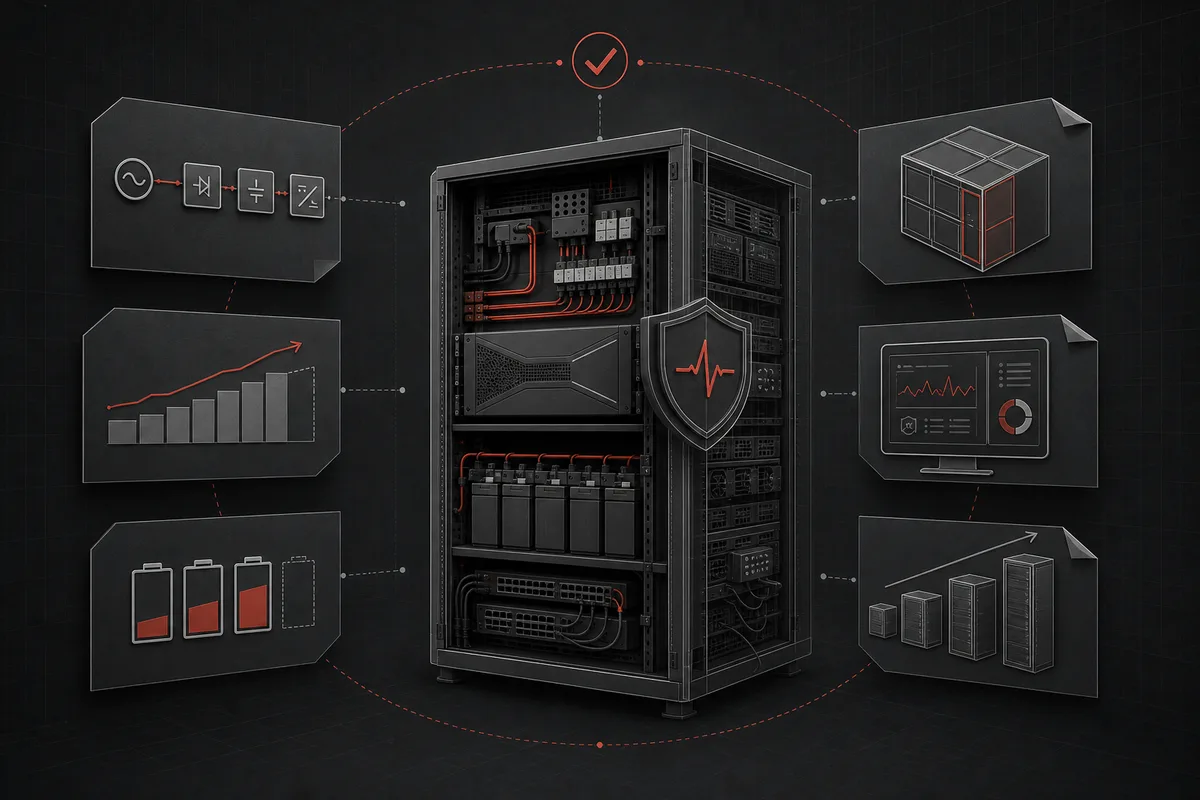
To choose a lithium UPS for a data centre, work through seven factors: (1) topology — use online double-conversion for 0 ms transfer on sensitive compute; (2) capacity — size kVA to your load with headroom; (3) runtime — minutes for a graceful shutdown or hours to bridge to a genset; (4) form factor — 19-inch rack where cabinet space matters; (5) monitoring — SNMP/cloud for automatic server, VM and NAS shutdown; (6) scalability — external-battery models for configurable runtime; and (7) evidence — match CE-LVD and lithium transport documents to the exact host and battery. Match these to your SLA and rack constraints.
Start from the load and the SLA
Every good UPS specification starts with two questions: what am I protecting, and how long must it survive an outage? In a data centre the answer determines topology, capacity and runtime — the three decisions that drive everything else. The seven factors below take you from those questions to a configuration you can put to a supplier.
The seven factors
1. Topology: why online double-conversion
Online double-conversion (VFI) continuously rebuilds the output from the DC stage, so there is zero transfer time between mains, battery and bypass and the output is fully regulated. For servers, storage and networking — loads with no tolerance for a power dip — this is the right choice. Line-interactive UPS, which switch to battery on failure with a small transfer time, are best reserved for less-critical loads where cost matters more than absolute power quality.
2–3. Capacity and runtime
Size capacity to the real, measured load (not nameplate sums), with headroom for growth and for inrush from power supplies. Then decide runtime by intent: a few minutes is enough if your goal is an orderly, automated shutdown; you need tens of minutes to hours if you must ride through short outages or bridge to a generator. With external-battery lithium UPS you can set runtime precisely by adding packs.
4. Form factor: rack space and weight
Class-A LiFePO4 is roughly half the size and weight of equivalent lead-acid, so a rack lithium UPS reclaims rack units and cabinet weight budget while delivering longer runtime. A 19-inch rack model such as the ET1-3KR drops straight into a cabinet; the external-battery ET 1~10KRS scales to 1–10 kVA and hours of autonomy.
| Need | Recommended model | Why |
|---|---|---|
| Compact rack backup, fixed runtime | ET1-3KR (1–3 kVA) | Built-in Class-A LiFePO4, 0 ms transfer, ≥30 min, 19-inch rack |
| Long-duration / scalable runtime | ET 1~10KRS (1–10 kVA) | External LiFePO4 packs scale autonomy from minutes to hours |
5–7. Monitoring, scalability and certification
- Monitoring: an SNMP/cloud card adds a mobile APP, dashboard and dry contacts, and triggers automatic shutdown of Windows/Linux servers, virtual machines and NAS — integrating with NMS/DCIM.
- Scalability: external-battery models let you add runtime without changing the host; online platforms support N+1 redundancy and capacity expansion.
- Evidence: verify the host against the relevant CE-LVD model list and match UN 38.3 / transport reports to the selected battery or cell. Do not assume one report covers every configuration.
FAQ
Frequently asked questions
Should a data-centre UPS be online or line-interactive?
Use online double-conversion (VFI) for servers, storage and networking — it gives 0 ms transfer and fully regulated output. Line-interactive UPS suit only less-critical loads where cost outweighs absolute power quality.
How do I size UPS runtime for a data centre?
Decide by intent: a few minutes is enough for an automated, orderly shutdown; tens of minutes to hours if you must ride through outages or bridge to a generator. External-battery lithium UPS let you set runtime precisely by adding packs.
How much rack space does a lithium UPS save?
Class-A LiFePO4 is roughly half the size and weight of equivalent lead-acid, so a rack lithium UPS reclaims rack units and cabinet weight while delivering longer runtime (≥30 min built-in versus 5–10 min for comparable VRLA).
Which certifications should a data-centre UPS have for export?
Check the exact host against its CE-LVD model list, and match UN 38.3 and other transport documents to the selected battery or cell. Ask separately for the supporting ISO 9001 certificate details because a company statement is not the same as a model-scoped report.
Related
Products, solutions & further reading.
Put this into practice
Need help specifying the right unit?
Share the load, voltage, runtime, environment and destination for a configuration review.