Lithium UPS vs Lead-Acid: TCO, Lifespan & When to Switch (2026)
By Highidea Power Engineering Team · 12 May 2026 · 7 min read
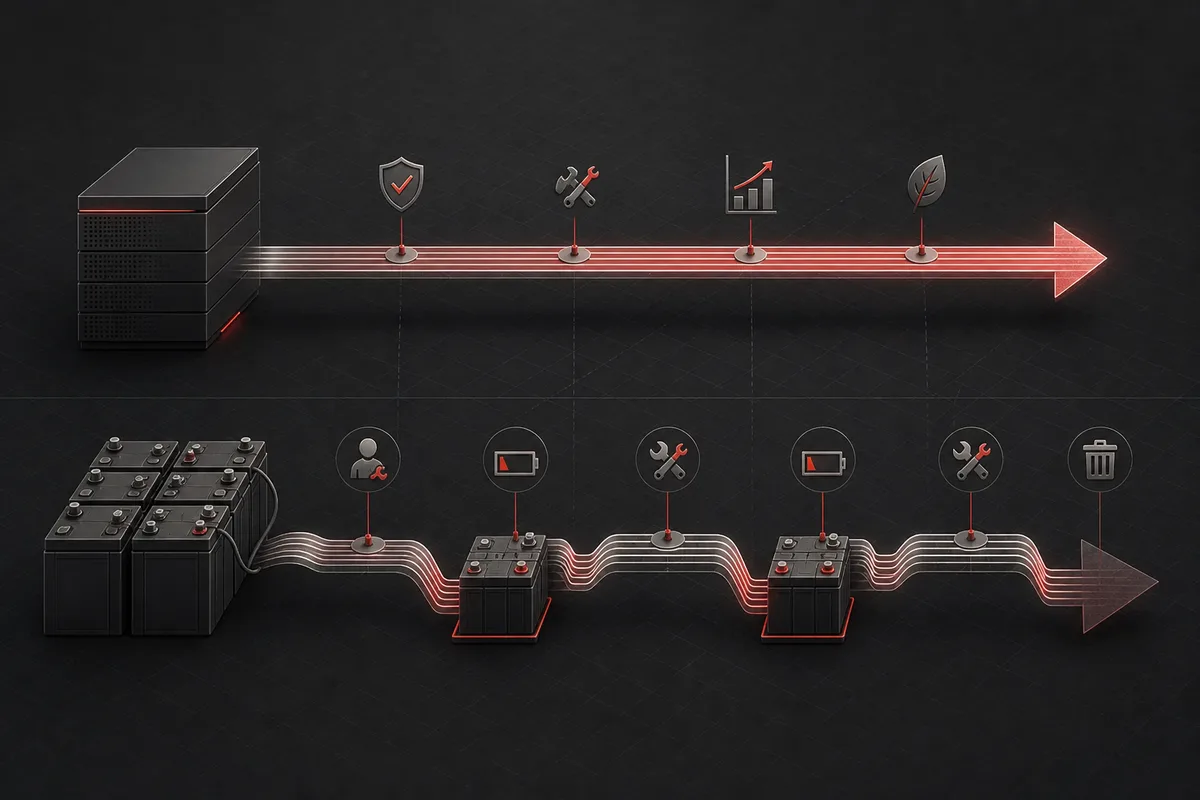
Lithium (LiFePO4) UPS batteries cost more upfront than lead-acid (VRLA) but win decisively on total cost of ownership for most always-on sites. Class-A LiFePO4 delivers more than 1,200 cycles and over 10 years of float life versus roughly 200–500 cycles and 3–5 years for VRLA, at about half the size and weight, with longer runtime (≥30 min vs 5–10 min full-load on built-in models) and maintenance-free operation. Switch when your site is space- or weight-constrained, runs many discharge cycles, needs long runtime, or where battery replacements and maintenance over a 10-year horizon outweigh the higher purchase price.
The short version
Lead-acid (VRLA) is cheaper to buy; lithium iron phosphate (LiFePO4) is cheaper to own. Because a UPS battery is replaced several times over a facility’s life, the right comparison is not sticker price but total cost of ownership (TCO) across the deployment horizon — typically 10 years. On that basis, LiFePO4 usually wins for always-on, space-constrained or cycle-heavy sites.
LiFePO4 vs lead-acid at a glance
| Dimension | Class-A LiFePO4 | Lead-acid (VRLA) |
|---|---|---|
| Cycle life | >1,200 cycles (built-in models) | ~200–500 cycles |
| Float / design life | >10 years | 3–5 years |
| Size & weight | ~half | Bulky / heavy |
| Full-load runtime (built-in UPS) | ≥30 min | ~5–10 min |
| Maintenance | Maintenance-free | Periodic |
| Recharge speed | Faster | Slower |
| Temperature range | Wider | Narrower |
Why the TCO gap is wider than it looks
Three factors compound in lithium’s favour over a 10-year horizon. First, replacement count: at 3–5 years of service life, a lead-acid string is typically replaced two or three times where one LiFePO4 pack lasts the whole period. Second, maintenance: VRLA needs periodic checks and eventual swap-outs; Class-A LiFePO4 is maintenance-free. Third, the hidden costs of weight and space — heavier, bulkier batteries consume rack units, cabinet weight budget and floor loading that have real value in a data centre or vehicle.
When lead-acid can still make sense
- Very short, infrequent backup needs where the battery rarely cycles.
- Tight upfront budgets where the deployment will be retired or relocated before lithium’s lifespan advantage is realised.
- Legacy installations where the existing charger/cabinet is sized strictly for VRLA.
Highidea Power uses brand-new Class-A LiFePO4 cells — never recycled or second-life — across the ET-series UPS, so the cycle-life and float-life figures above reflect the chemistry actually shipped. Lead-acid is offered as an option where a project specifically requires it.
A simple decision framework
- Set your horizon. How many years will this UPS serve? (Use 10 if unsure.)
- Count replacements. Divide the horizon by each chemistry’s service life to estimate battery replacements.
- Add the hidden costs. Factor space, weight, maintenance visits and downtime risk of more frequent swaps.
- Compare lifetime cost, not sticker price. If LiFePO4’s longer life and lower maintenance offset its premium, switch.
FAQ
Frequently asked questions
Is a lithium UPS really cheaper than lead-acid over its life?
For most always-on sites, yes. LiFePO4 lasts more than 10 years and 1,200+ cycles versus 3–5 years and 200–500 cycles for lead-acid, so you avoid two or three battery replacements and the associated maintenance, which usually outweighs the higher purchase price over a 10-year horizon.
How much smaller and lighter is a LiFePO4 UPS battery?
A Class-A LiFePO4 battery is roughly half the size and weight of an equivalent lead-acid battery, which reclaims rack units, cabinet weight budget and floor loading — valuable in data centres, ships and vehicles.
Does LiFePO4 give longer runtime than lead-acid?
Yes. On comparable built-in UPS, Class-A LiFePO4 delivers at least 30 minutes at full load versus the typical 5–10 minutes of a lead-acid system, and external-battery models scale runtime further by adding packs.
Does Highidea use new or recycled cells?
Brand-new Class-A LiFePO4 cells only — never recycled or second-life. This is what gives the >10-year float life and >1,200-cycle figures.
Related
Products, solutions & further reading.
Put this into practice
Need help specifying the right unit?
Share the load, voltage, runtime, environment and destination for a configuration review.