Rack-Mount Inverter or Rack UPS? Start with the Power Source
By Highidea Power · 7 September 2026 · 5 min read
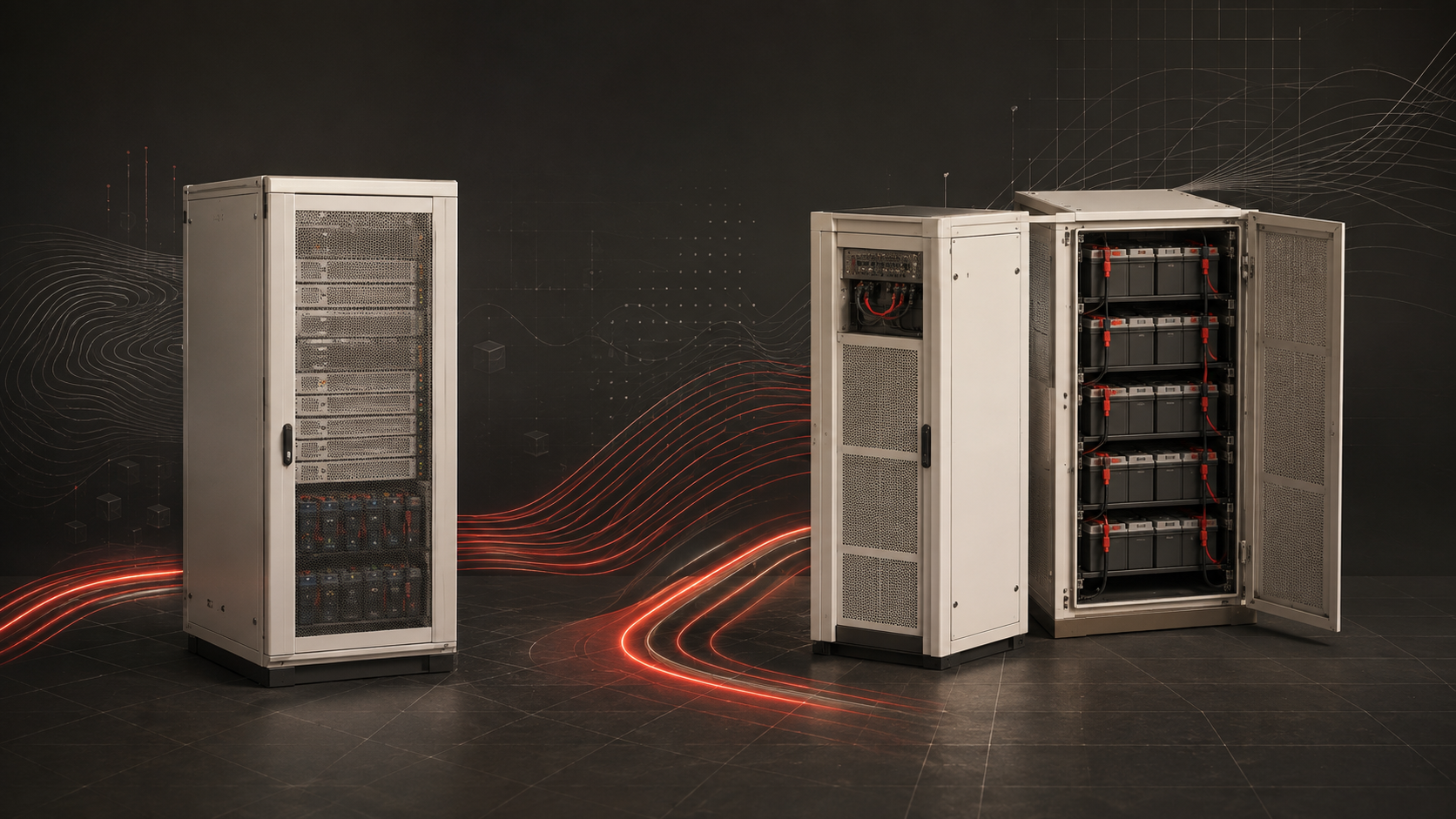
Choose a rack-mount inverter when the project needs AC power from an existing, suitable DC plant. Choose a rack UPS when the protected load needs a UPS system with an approved AC-input and battery arrangement. Similar rack enclosures do not make the two interchangeable: source voltage, charging, storage ownership and transfer paths determine the architecture.
The first drawing should show where the energy comes from
A rack drawing can make very different power products look alike. Both may have a front display, ventilation and mounting ears, yet one expects an existing station battery system while the other includes its own battery arrangement. Before comparing price or rack height, draw the source, converter, storage and protected load as separate blocks.
In a DC-fed design, identify who owns the rectifier, battery, distribution protection and inverter. In a UPS design, identify the host and the approved internal or external battery system. This simple ownership map prevents an inverter order from being mistaken for a complete backup installation, or a new UPS from being added without considering a DC plant already on site.
Compare functions rather than front panels
Decision | Rack-mount inverter proposal | Rack UPS proposal |
|---|---|---|
Main source question | Which DC bus and operating range? | Which AC input and bypass supply? |
Stored energy | Usually provided by the specified upstream DC plant | Internal or approved external UPS battery arrangement |
Battery charging | Identify the separate charger or rectifier; do not assume inverter charging | Confirm the UPS charger and battery pairing |
Output requirement | AC voltage, waveform, load and source priority | AC voltage, waveform, load and UPS operating modes |
Physical fit | Depth, supports, DC cabling and service clearance | Host plus battery space, supports and service clearance |
Keep DC input and AC output unmistakably separate
Highidea’s H1-10K is a 19-inch rack-mounted DC-to-AC inverter family. Its documented input options include 24, 48, 110, 220 and 240 VDC, with 220 VAC output. These are input variants to select, not a promise that one ordered unit accepts every listed DC voltage.
A request for a “110 V rack inverter” is therefore ambiguous. It may mean 110 VDC input or 110 VAC output. If the load requires a 110V UPS or 120V UPS, a 110 VDC-to-220 VAC inverter does not satisfy that output requirement. For lower AC-voltage UPS applications, Highidea’s D/DT families offer a different starting point. Write both sides of the conversion, including AC or DC, on the inquiry.
Two rack projects, two different decisions
Example A is an equipment room with a maintained 48 VDC plant and a small group of AC loads. The engineer evaluates a suitable inverter input variant, the permitted bus range and polarity, available DC capacity and the required AC output. Battery runtime belongs to the combined DC plant and all loads drawing from it; the inverter’s kVA rating alone does not provide an autonomy figure.
Example B is a branch rack with only an AC supply and no DC battery plant. A rack-mounted UPS with an approved lithium battery arrangement may be the simpler candidate. Highidea ET1-3KR provides a built-in LiFePO4 rack architecture with 208/220/230/240 VAC output options; DT should be considered separately when low AC output voltage is needed. These examples illustrate selection routes, not completed customer installations.
Evaluate the failure sequence and the cabinet together
Ask the supplier what happens on source loss, low battery or DC undervoltage, overload and restoration. If the proposed inverter includes an AC alternate source, show that input and its priority on the drawing. Do not infer zero interruption in every path from an online product description. The protected load’s interruption tolerance must be compared with the exact transition being proposed.
For DC-fed equipment, request the current demand at the lowest permitted bus voltage as well as nominal operation. A qualified engineer should select protection and cabling for the actual installation. Include terminal access, bending space, airflow and support rails in the rack review. A standard 19-inch mounting width says little about usable depth or the room needed behind heavy power cables.
ITU-T K.152 addresses EMC requirements for power equipment in telecommunications facilities. It is useful context for asking how a converter interacts with the site, not proof that a particular inverter meets the recommendation. Request applicable model-specific evidence where the project requires it.
What to send with an inverter or UPS inquiry
Start with the source-to-load drawing and a short load list. This lets Highidea respond with the correct product family before either side invests in a detailed mechanical layout. Keep the existing DC plant and its other loads visible throughout the review; dedicated AC conversion does not necessarily mean dedicated stored energy.
- Required DC or AC input, full operating range and grounding/polarity information.
- Required AC output, frequency, real and apparent power, and startup demand.
- Storage and charging owner, runtime target and any shared battery loads.
- Permitted interruption and expected source-priority/restoration behavior.
- Cabinet drawing, terminal clearance, monitoring interfaces and required evidence.
Sources and further reading
These references explain the technical context. Product selection and acceptance remain specific to the proposed equipment and installation.
ITU: ITU-T K.152 — EMC requirements for power equipment in telecommunication facilities
FAQ
Frequently asked questions
Does a rack-mount inverter include backup batteries?
Do not assume it does. Identify the DC source, battery and charger explicitly. An inverter capacity rating describes conversion capability, not a complete stored-energy system.
Is 110 VDC input the same as a 110V UPS output?
No. One is a DC source specification and the other describes an AC output requirement. Highidea H1-10K documents 220 VAC output for its listed DC input variants.
Can either unit be installed in any 19-inch rack?
Mounting width is only one check. Confirm usable depth, support rails, load rating, cable clearance, ventilation and service access for the exact configuration.
Related
Products, solutions & further reading.
Put this into practice
Need help specifying the right unit?
Share the load, voltage, runtime, environment and destination for a configuration review.