Upgrading a Rack UPS to Lithium: Replace the System or Retrofit?
By Highidea Power · 7 September 2026 · 5 min read
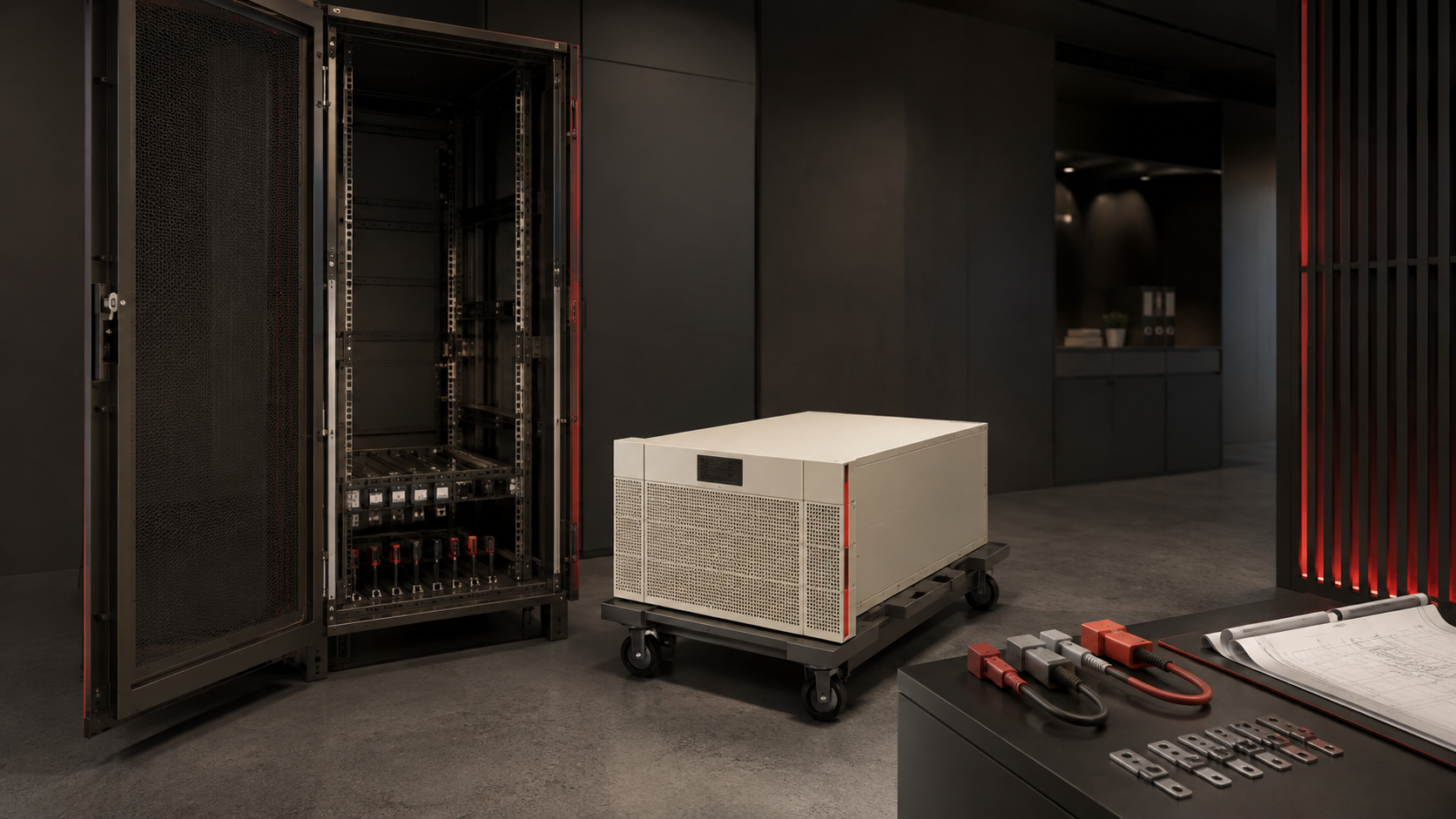
A lithium battery UPS upgrade should use a purpose-designed lithium UPS or a retrofit explicitly approved for the existing host. Matching battery voltage or physical size is not enough. Check charging, battery management, operating limits, rack installation and the load-transfer plan before deciding what can be retained.
Define what the upgrade is meant to solve
A worn-out battery creates a purchasing deadline, but the replacement decision should also revisit the rack. Has the load grown? Is the required runtime different? Can the team still obtain the correct replacement parts? Record the present host model, battery arrangement, monitored load and shutdown procedure before deciding whether to retain the installation.
Set a measurable objective such as supporting a defined shutdown sequence or fitting an approved battery arrangement into the available cabinet. Avoid making the project depend on a generic claim of longer life or lower cost. Those outcomes depend on the selected system, environment, use and service assumptions.
Choose one of three upgrade routes
Eaton’s lithium UPS guidance warns against substituting lithium batteries into a lead-acid UPS without a compatible design. Lithium systems need suitable charging and battery management. This supports a general compatibility boundary; it does not establish that a Highidea product can retrofit another manufacturer’s host.
Route | Evidence needed before approval | What not to assume |
|---|---|---|
Retain host with its approved replacement battery | Exact approved battery part and service procedure | A different chemistry is an equivalent replacement |
Manufacturer-approved lithium retrofit | Named host compatibility, kit, firmware and test scope | A same-voltage battery is an approved kit |
Replace with a purpose-designed lithium rack UPS | Output, runtime, rack fit and cutover plan | The old rails, connectors or shutdown integration will carry over |
Check electrical compatibility before space savings
Keep the load-side voltage unchanged unless the equipment manufacturer and project engineer approve a change. Highidea ET1-3KR offers a built-in LiFePO4 rack architecture with selectable 208/220/230/240 VAC output. It is not a 120V UPS merely because a specification mentions a broad input range. For low-voltage loads, review the DT family’s documented 100/110/120/127 VAC options separately.
For external batteries, obtain the approved host/pack combination, charging limits, battery-management interfaces and maximum arrangement. A matching nominal voltage does not establish compatibility. Ask how the system reports battery alarms and low-energy conditions, and how those events reach the shutdown software. Do not reuse old battery strings or cables by default.
A rack-fit check with real product dimensions
The ET1-3KR product sheet lists the ET1KR equipment body as 440 × 88 × 300 mm and the ET2KR/ET3KR bodies as 440 × 88 × 540 mm, in width × height × depth order. Both larger models therefore need 240 mm more body depth than ET1KR. The same family name and equipment height do not mean the same cabinet fit.
Suppose a cabinet has 500 mm of usable depth between the relevant obstructions. A 540 mm equipment body cannot fit within that space even before rear cables are considered. A 300 mm body still needs rail, connector and airflow checks; this example does not establish that it will fit. Ask for an installation drawing, not just a rack-unit label. Include any external battery pack in the space and support calculation.
Plan the cutover as an operating change
A new UPS is not useful if the migration interrupts the very load it is meant to protect. Agree a maintenance window and a load-transfer or shutdown procedure with the site owner. Identify who authorizes the change, how the old configuration can be restored and which observations would stop the cutover. Do not assume the existing installation provides a safe hot-swap path.
A qualified team should verify the new unit before transferring production loads. After installation, check load readings, expected runtime at the agreed load, alarms, remote notification and the shutdown sequence. If a network card or monitoring protocol changes, treat that integration as a new acceptance item rather than copying old settings and assuming success.
When to request a custom rack UPS
A standard configuration may meet the requirement once the correct voltage and battery architecture are selected. Consider a custom UPS inquiry when mandatory enclosure, connection, runtime or monitoring needs remain unmet. Highidea offers OEM/ODM work around capacity, battery arrangement, voltage, enclosure and communication options; the exact engineering scope must be agreed for the project.
Send a marked-up cabinet drawing and distinguish fixed constraints from preferences. For example, cabinet depth may be fixed while the number of battery positions can change. This gives the supplier a useful design problem to evaluate. Ask which changes affect validation, documentation, maintenance and delivery before commissioning a custom sample.
- Keep: load requirements and the operating outcome the site needs.
- Verify before reuse: rack supports, connectors, cabling and software integration.
- Replace or redesign: anything without confirmed compatibility.
- Approve: the complete configuration, cutover plan and rollback decision.
Sources and further reading
These references explain the technical context. Product selection and acceptance remain specific to the proposed equipment and installation.
FAQ
Frequently asked questions
Can I replace lead-acid batteries with lithium batteries in the same UPS?
Only use a retrofit explicitly approved for the host and configuration. Voltage and size alone do not prove charging, management, protection or firmware compatibility.
Will a lithium rack UPS always fit the old space?
No. Check the complete dimensions, rails, weight, cable clearance, airflow and battery arrangement. Even models within one family can have substantially different depths.
Does choosing a lithium UPS automatically require customization?
No. First evaluate a standard system against the mandatory requirements. Request customization only for specific unmet constraints, with an agreed validation and documentation scope.
Related
Products, solutions & further reading.
Put this into practice
Need help specifying the right unit?
Share the load, voltage, runtime, environment and destination for a configuration review.