Sizing a Rectifier for DC Loads and Battery Recharge
By Highidea Power Engineering Team · 20 October 2026 · 4 min read
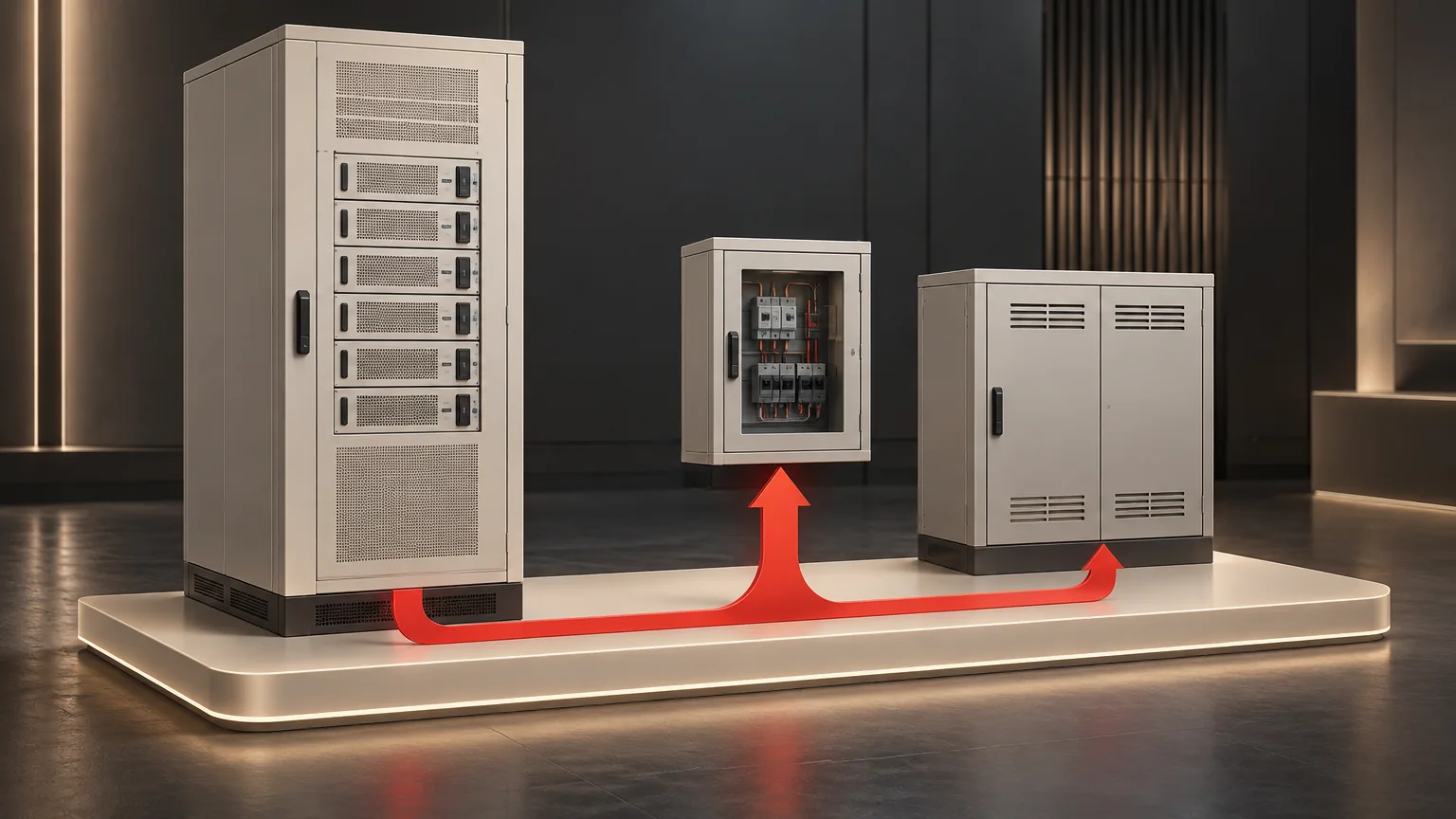
Budget the continuous DC load and the battery's approved recharge demand at the same time, under the conditions in which the plant must operate. Check the available rectifier output after applicable derating and required module-loss assumptions. A nominal ampere rating alone does not establish recharge capacity, battery compatibility or redundancy.
Start with a plant, not an isolated current number
A battery-backed DC plant combines conversion, charge control, distribution and battery protection. A generic AC/DC supply is not automatically an approved battery charger. Identify which supplier is responsible for charging behavior and which controller limits the battery current.
Highidea lists RT rectifier and switching-supply products in its portfolio. The catalogue establishes that product context, not every model's charge algorithm, derating curve or battery approval. Obtain the exact model and plant configuration before treating it as a candidate for a particular battery.
Vertiv's NetSure 502NGFB System Application Guide provides a useful manufacturer example: its rectifiers supply load power, float current and recharge current. It also describes output reductions outside specified input and temperature conditions. Those details support the budgeting principle; their numerical ratings do not apply to Highidea RT products.
Make a state-based current schedule
List the relevant operating states before adding reserve. Normal operation, recovery after an outage, a high-load period and an agreed module-unavailable condition can produce different margins.
Use current and power consistently at the actual bus voltage. Where a rating is power-limited, a current value at one voltage may not describe the whole operating range. Ask for the supplier's available-output evidence at each required state rather than converting a catalogue maximum into an unconditional plant rating.
Budget entry | Required basis |
|---|---|
Load demand | Continuous and relevant simultaneous demand at the stated bus conditions. |
Battery charging | Battery-approved current and charging conditions, including controller limitations. |
Available conversion | Rectifier output at the actual input voltage, temperature and configuration. |
Unavailable module | Remaining supported capacity for the agreed outage or maintenance scenario. |
Distribution | Ratings and engineering approval for the complete current path. |
Recovery objective | Required recovery condition and the evidence used to estimate it. |
Work the simultaneous-demand arithmetic
Consider a hypothetical plant with 120 A of verified available output under the design conditions. The agreed DC load is 80 A and the battery supplier permits a 30 A recharge allocation in that state. The arithmetic demand is 110 A, leaving 10 A before any additional design allowances. These are illustrative values, not RT specifications or a recommended margin.
If the agreed module-loss condition leaves only 90 A available, the same 110 A demand no longer fits. The engineer must decide how that state is handled: a different plant configuration, an approved charge allocation or another documented design change. Do not assume the battery will simply receive the desired current while the load remains unaffected.
Retain the state comparison as an explicit budget, rather than a single total. For the hypothetical conditions above, the two rows are:
State | Available output and simultaneous-demand decision |
|---|---|
Recovery, all required modules available | Available 120 A; load 80 A; proposed approved charge allocation 30 A; total 110 A; arithmetic margin 10 A before further allowances. |
Agreed module-loss case | Available 90 A; load 80 A; same proposed charge allocation 30 A; total 110 A; shortfall 20 A; not approved as proposed. |
Other required state | Bus voltage: __ V; input/temperature: __; available: __ A; load: __ A; battery-approved allocation: __ A; margin: __ A; evidence/reviewer: __. |
Record the controller's approved response beside any shortfall; the subtraction itself does not implement a safe allocation.
This example does not establish recharge time. A battery's charging profile, initial condition, temperature and end-of-charge behavior can change the result. Dividing nominal amp-hours by an assumed current is not a complete recovery guarantee.
Keep charging responsibility visible
Ask the battery supplier to confirm permissible charge conditions and the plant supplier to confirm how they are enforced. Retain the controller configuration reference and the evidence that the selected battery, rectifier and protection arrangement are compatible.
The budget is not permission to alter current limits, bypass battery protection or connect an unapproved chemistry. A numerical shortfall calls for an engineering decision. It should not be hidden by changing an operational setting without the responsible parties' approval.
Also distinguish a planned capacity loss from a redundant design claim. Sufficient remaining conversion capacity does not by itself remove shared controller, source or distribution dependencies.
Attach a budget to the quotation
Give Highidea the load schedule, source range, environmental conditions, battery requirements and module-availability assumptions. Request an explicit response for each operating state, with unresolved items assigned to a responsible supplier.
Retain the selected configuration, calculation assumptions and supporting documents together. The purchase decision should identify which states are supported and which remain conditional, rather than accepting a single current rating as proof of the complete recovery design.
Primary references
The references support the specific distinctions stated above. Manufacturer examples apply to their documented products; they do not establish the same capability in a Highidea model. Proposed worksheets and hypothetical examples are editorial decision tools, not approved installation or operating procedures.
Vertiv: NetSure 502NGFB System Application Guide SAG582136700
FAQ
Frequently asked questions
Can all spare rectifier capacity be assigned to charging?
Only within the approved battery, controller, rectifier and distribution limits for that operating state.
Does one extra module guarantee N+1 operation?
No. Define the required surviving load and charging behavior, then assess remaining capacity and shared dependencies.
Is a larger amp-hour battery enough to improve repeated-outage performance?
Not by itself. Its approved charging demand and available recovery time must also fit the plant's simultaneous-load budget.
Related
Products, solutions & further reading.
Put this into practice
Need help specifying the right unit?
Share the load, voltage, runtime, environment and destination for a configuration review.