Single-Rack UPS vs Room-Level UPS: Where Should Backup Be Centralized?
By Highidea Power Engineering Team · 26 November 2025 · 4 min read
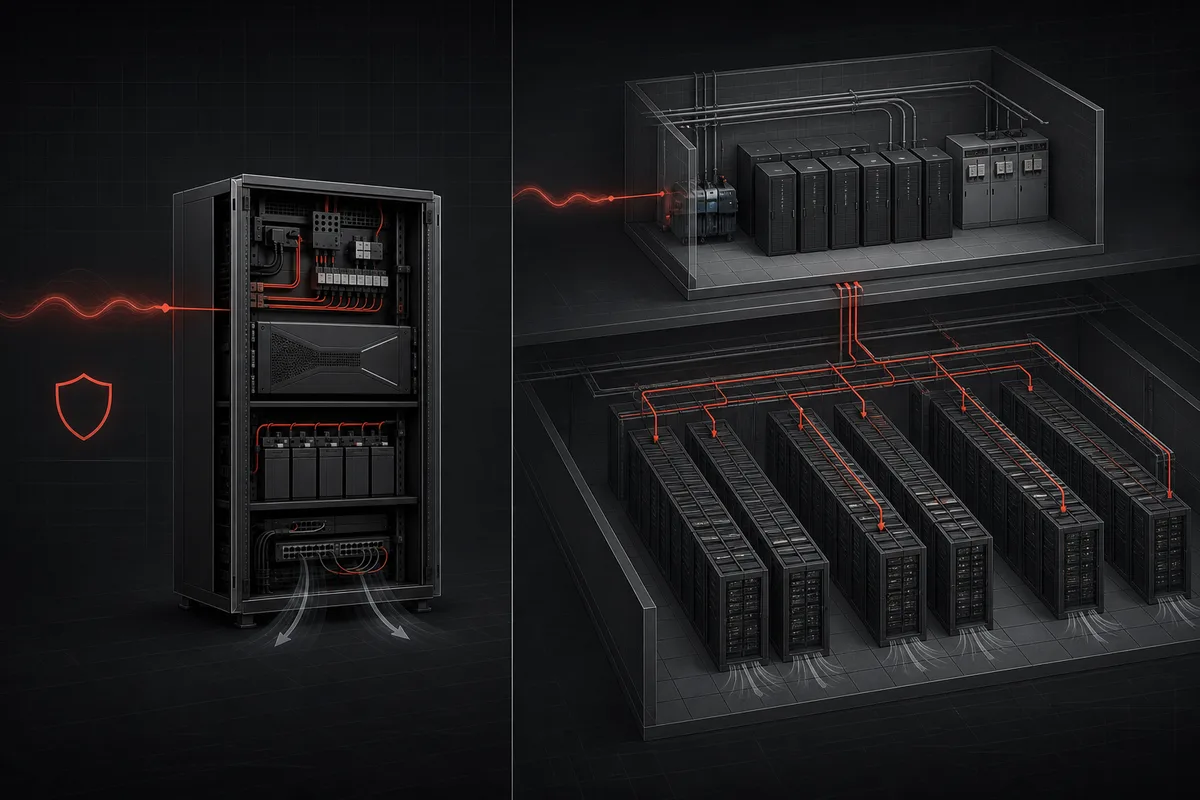
Distributed rack UPS systems localize protection and can simplify incremental deployment; a room-level system centralizes equipment and maintenance. The right boundary depends on fault domains, cabling, load diversity, service model, expansion and required redundancy.
The decision in practical terms
IT resilience joins electrical continuity with an operating procedure. The UPS must support the defined load long enough for alternate power, continued operation or an orderly shutdown, while monitoring must deliver an alarm to someone who owns the response. The practical question here is: “When is distributed rack backup preferable to a centralized UPS plant?” The result is a decision record that engineering, procurement and the supplier can all verify.
For “When is distributed rack backup preferable to a centralized UPS plant?” Before discussing a model, close the source and load facts, define acceptable operation, and decide what evidence will count as acceptance. The first three items to close are: Draw which loads fail together under each architecture and identify unacceptable common points. Compare battery service, monitoring and bypass procedures across many small units versus one central plant. Include distribution losses, rack space and phased growth in the lifecycle decision. Once these are controlled, differences between proposals become visible and testable.
Five checks that change the recommendation
Draw which loads fail together under each architecture and identify unacceptable common points. Link the requirement to the exact drawing, measurement, report or supplier declaration used to close it. Keep revisions visible when the configuration changes.
Compare battery service, monitoring and bypass procedures across many small units versus one central plant. Describe the acceptable result before testing or document review begins. Evidence is easier to judge when pass, deviation and rework outcomes are already defined.
Include distribution losses, rack space and phased growth in the lifecycle decision. Check the boundary of the answer: model, option, load, environment, market and date. A correct statement can become misleading when any of those changes.
Define SNMP, RS485, dry-contact, server-shutdown and escalation requirements before choosing a monitoring card. Preserve the decision in the purchase file so engineering, procurement, commissioning and service teams work from the same approved condition.
Measure load at representative demand and document redundancy, growth and part-load operation. Put the value and its source in the technical schedule. A supplier should be able to point to the exact model, operating mode and condition used for the recommendation.
Make supplier proposals comparable
Require line-by-line responses to a single project brief. A compliant offer should expose assumptions and exceptions instead of burying them in general literature. For “Single-Rack UPS vs Room-Level UPS: Where Should Backup Be Centralized?,” reject any response that silently changes a material project condition or evidence scope.
Keep materially different configurations as separate alternatives; combining them in one price table can conceal technical risk.
Review item | Requirement to state | Decision record |
|---|---|---|
Technical check 1 | Draw which loads fail together under each architecture and identify unacceptable common points. | Record the evidence, responsible approver and effect on the comparison decision. |
Technical check 2 | Compare battery service, monitoring and bypass procedures across many small units versus one central plant. | Record the evidence, responsible approver and effect on the comparison decision. |
Technical check 3 | Include distribution losses, rack space and phased growth in the lifecycle decision. | Record the evidence, responsible approver and effect on the comparison decision. |
Technical check 4 | Define SNMP, RS485, dry-contact, server-shutdown and escalation requirements before choosing a monitoring card. | Record the evidence, responsible approver and effect on the comparison decision. |
Verify the approved requirement
Turn the agreed requirement into a verification record. Identify the exact supplied item and configuration, the evidence or test method, the applicable condition and the expected result for the question “When is distributed rack backup preferable to a centralized UPS plant?” For performance tests, retain instruments, readings, alarms and timestamps; for document reviews, retain the issuer, scope and revision.
Retain the test data or document review with the serialised or otherwise identifiable delivered configuration. A successful verification applies only to the delivered configuration and stated conditions; it is not a blanket guarantee for a different load, site, document scope or operating mode.
Common failure modes in this decision
These common approaches can make an apparently complete specification impossible to approve with confidence.
- Putting every IT load in one runtime tier
- Oversizing without checking part-load efficiency
- Installing monitoring without testing the alert path
- Answering “When is distributed rack backup preferable to a centralized UPS plant?” without naming the exact configuration and evidence
Where Highidea fits
Highidea offers rack-oriented ET architectures and optional monitoring on compatible configurations. Interface availability and automated shutdown support must be confirmed for the exact host and card.
Share the completed schedule with Highidea and request a configuration-specific response covering the host, energy storage, interfaces, options and evidence.
Copy this into your RFQ
The list below is ready for an RFQ once project-specific limits and commercial terms have been added.
- Confirm in the quotation: Draw which loads fail together under each architecture and identify unacceptable common points.
- Confirm in the quotation: Compare battery service, monitoring and bypass procedures across many small units versus one central plant.
- Confirm in the quotation: Include distribution losses, rack space and phased growth in the lifecycle decision.
- Confirm in the quotation: Define SNMP, RS485, dry-contact, server-shutdown and escalation requirements before choosing a monitoring card.
- Confirm in the quotation: Measure load at representative demand and document redundancy, growth and part-load operation.
Authoritative references and scope
The cited material is authoritative background, not automatic proof of conformity or performance for a particular product.
U.S. Department of Energy: Best Practices Guide for Energy-Efficient Data Center Design
FAQ
Frequently asked questions
When is distributed rack backup preferable to a centralized UPS plant?
Distributed rack UPS systems localize protection and can simplify incremental deployment; a room-level system centralizes equipment and maintenance. The right boundary depends on fault domains, cabling, load diversity, service model, expansion and required redundancy.
How can buyers make supplier answers easier to compare?
Send the exact load and source data, required operating outcome, site conditions, interfaces, target market and evidence requirements. For this decision, include: Draw which loads fail together under each architecture and identify unacceptable common points. Compare battery service, monitoring and bypass procedures across many small units versus one central plant. Include distribution losses, rack space and phased growth in the lifecycle decision.
Can one datasheet establish the complete project scope?
Use family information to shortlist an architecture, but confirm the exact model, configuration, operating mode, test conditions and document scope in the quotation or approved technical schedule.
Related
Products, solutions & further reading.
Put this into practice
Need help specifying the right unit?
Share the load, voltage, runtime, environment and destination for a configuration review.