Remote Power Monitoring for Unattended Telecom Sites
By Highidea Power Engineering Team · 12 January 2026 · 4 min read
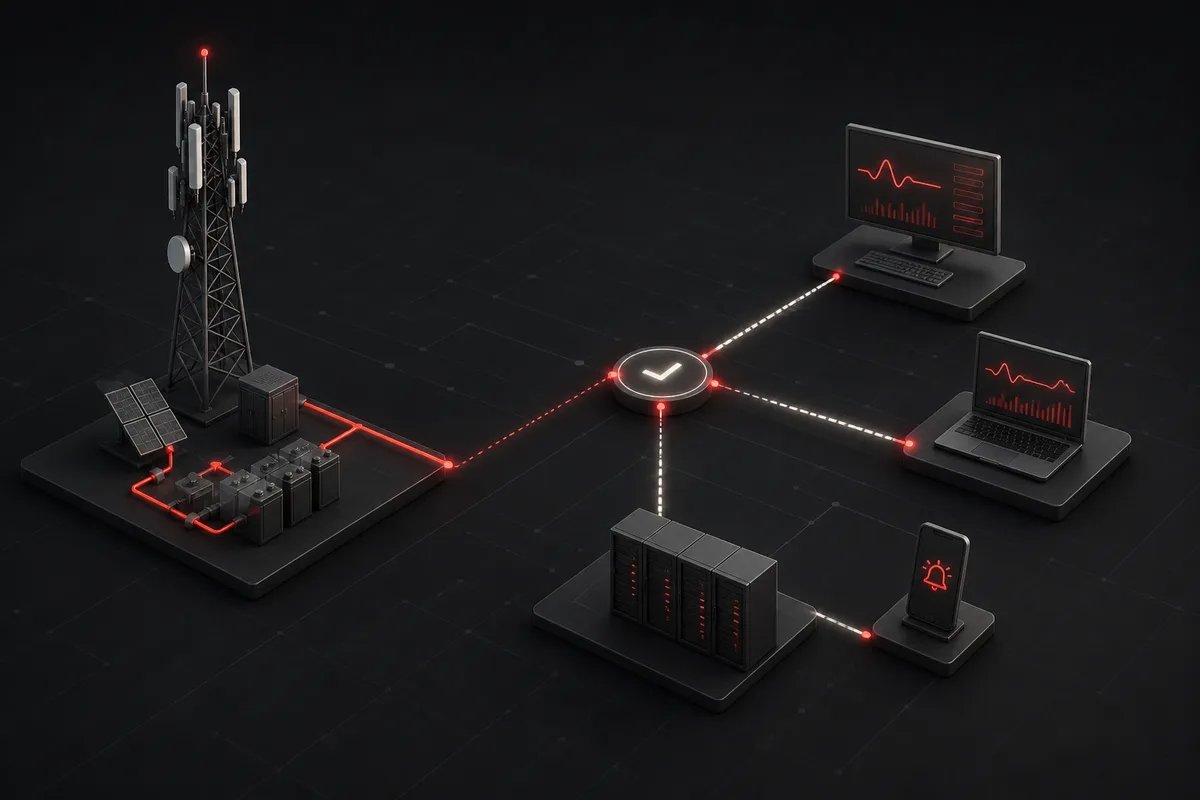
Remote monitoring for an unattended telecom site needs meaningful alarms, a reliable communications path and an escalation process. A dashboard alone does not create resilience unless someone can interpret and act on the event.
The decision in practical terms
Telecom power designs often combine an AC source, a DC plant, energy storage and protected AC loads. A DC-to-AC inverter is one element in that chain, so its input window, source priority, transfer behavior, output quality and monitoring interfaces must match the site architecture. The practical question here is: “Which power alarms and control paths matter at a remote base station?” It focuses the discussion on project conditions, configuration scope and evidence rather than catalogue shorthand.
For “Which power alarms and control paths matter at a remote base station?” Treat the buyer question as a controlled engineering decision: establish evidence for the inputs, write the intended outcome and ask how the offered system will be verified. The first three items to close are: Define high-priority events such as source loss, bypass, overload, battery abnormality and overtemperature. Choose the interface that the existing NMS or site controller can support and secure. Test alarm delivery, acknowledgement and recovery records before handover. Once these are controlled, differences between proposals become visible and testable.
Five checks that change the recommendation
Define high-priority events such as source loss, bypass, overload, battery abnormality and overtemperature. Check the boundary of the answer: model, option, load, environment, market and date. A correct statement can become misleading when any of those changes.
Choose the interface that the existing NMS or site controller can support and secure. Preserve the decision in the purchase file so engineering, procurement, commissioning and service teams work from the same approved condition.
Test alarm delivery, acknowledgement and recovery records before handover. Put the value and its source in the technical schedule. A supplier should be able to point to the exact model, operating mode and condition used for the recommendation.
Confirm the real DC-bus nominal and operating range, polarity, grounding and protection scheme. Treat this as an acceptance input, not a conversation note. If it changes after quotation, record the effect on capacity, battery, interfaces, evidence and delivery.
Define source priority and the expected behavior during AC loss, DC abnormality, bypass and restoration. Verify it with a measurement, drawing, nameplate, manufacturer requirement or approved project document. An unstated assumption here can invalidate the rest of the selection.
Make supplier proposals comparable
Use a common response format for every supplier, including requirement, offered value, evidence, deviation and responsible approver. For “Remote Power Monitoring for Unattended Telecom Sites,” reject any response that silently changes a material project condition or evidence scope.
A lower price is meaningful only after the response format confirms that the configuration and obligations are comparable.
Review item | Requirement to state | Decision record |
|---|---|---|
Technical check 1 | Define high-priority events such as source loss, bypass, overload, battery abnormality and overtemperature. | Record the evidence, responsible approver and effect on the application decision. |
Technical check 2 | Choose the interface that the existing NMS or site controller can support and secure. | Record the evidence, responsible approver and effect on the application decision. |
Technical check 3 | Test alarm delivery, acknowledgement and recovery records before handover. | Record the evidence, responsible approver and effect on the application decision. |
Technical check 4 | Confirm the real DC-bus nominal and operating range, polarity, grounding and protection scheme. | Record the evidence, responsible approver and effect on the application decision. |
Verify the approved requirement
Turn the agreed requirement into a verification record. Identify the exact supplied item and configuration, the evidence or test method, the applicable condition and the expected result for the question “Which power alarms and control paths matter at a remote base station?” For performance tests, retain instruments, readings, alarms and timestamps; for document reviews, retain the issuer, scope and revision.
Verification supports one defined application and condition; record when a design or evidence revision triggers re-approval. A successful verification applies only to the delivered configuration and stated conditions; it is not a blanket guarantee for a different load, site, document scope or operating mode.
Common failure modes in this decision
Clarify the points below whenever they appear in a quotation, datasheet or project discussion.
- Ordering from the label “−48 V” without the operating range
- Ignoring DC-side current and cable loss
- Assuming every interface is standard on every model
- Answering “Which power alarms and control paths matter at a remote base station?” without naming the exact configuration and evidence
Where Highidea fits
Highidea documents dedicated power and telecom inverter families, including isolated DC-to-AC applications. Exact DC input, AC output, transfer path and parallel capability remain model-specific.
Provide Highidea with the resolved inputs and ask that the quotation state the exact equipment, battery configuration, interfaces and document scope.
Copy this into your RFQ
Tailor these requirements to the site, then keep the supplier’s answers with the approved order.
- Confirm in the quotation: Define high-priority events such as source loss, bypass, overload, battery abnormality and overtemperature.
- Confirm in the quotation: Choose the interface that the existing NMS or site controller can support and secure.
- Confirm in the quotation: Test alarm delivery, acknowledgement and recovery records before handover.
- Confirm in the quotation: Confirm the real DC-bus nominal and operating range, polarity, grounding and protection scheme.
- Confirm in the quotation: Define source priority and the expected behavior during AC loss, DC abnormality, bypass and restoration.
Authoritative references and scope
The links below support the buyer’s evaluation framework. The quoted model needs its own applicable evidence and conditions.
ITU: ITU-T L.1210 — Sustainable power-feeding solutions for IMT-2020 networks
ITU: ITU-T K.152 — EMC requirements for telecom-facility power equipment
FAQ
Frequently asked questions
Which power alarms and control paths matter at a remote base station?
Remote monitoring for an unattended telecom site needs meaningful alarms, a reliable communications path and an escalation process. A dashboard alone does not create resilience unless someone can interpret and act on the event.
What evidence should accompany this requirement?
Send the exact load and source data, required operating outcome, site conditions, interfaces, target market and evidence requirements. For this decision, include: Define high-priority events such as source loss, bypass, overload, battery abnormality and overtemperature. Choose the interface that the existing NMS or site controller can support and secure. Test alarm delivery, acknowledgement and recovery records before handover.
How should a catalogue claim be used?
Use family information to shortlist an architecture, but confirm the exact model, configuration, operating mode, test conditions and document scope in the quotation or approved technical schedule.
Related
Products, solutions & further reading.
Put this into practice
Need help specifying the right unit?
Share the load, voltage, runtime, environment and destination for a configuration review.