UPS Battery Alarm: What Information to Capture for Technical Support
By Highidea Power Engineering Team · 20 September 2026 · 5 min read
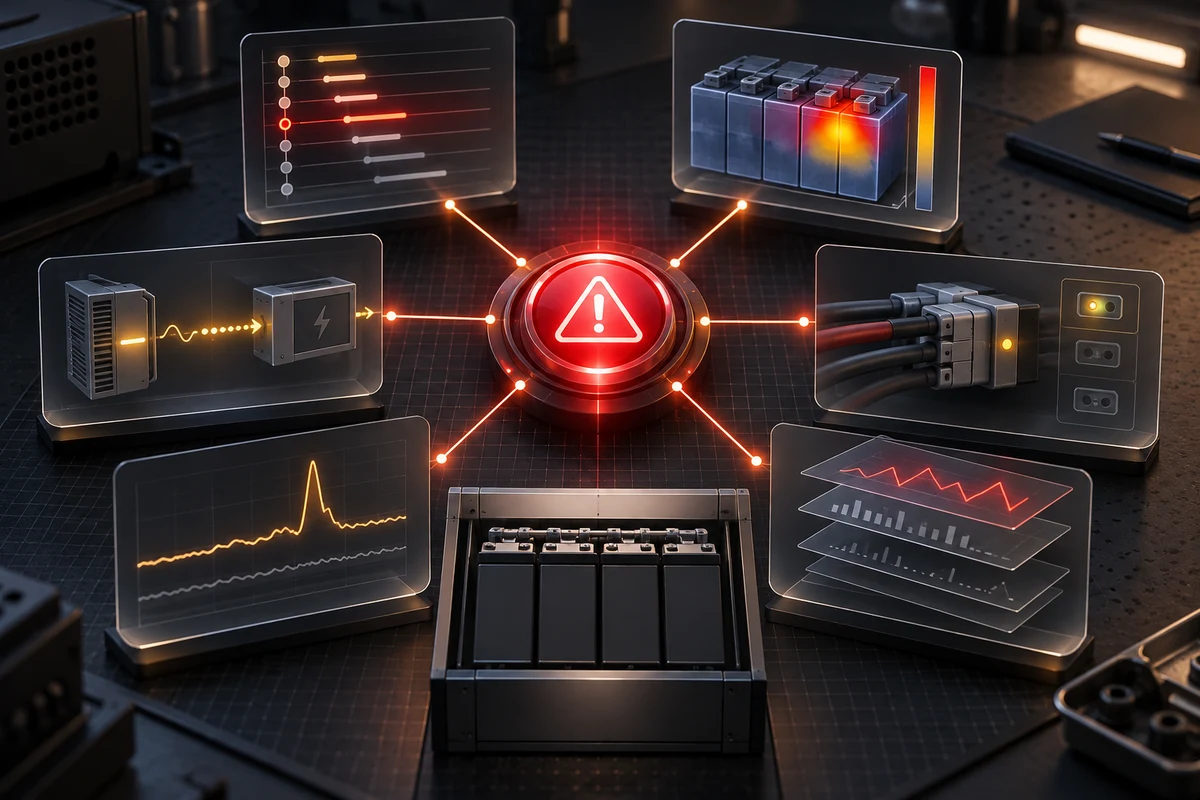
Before acting on a UPS battery alarm, protect the load and preserve evidence that can separate battery state, charger behavior, temperature, connection and configuration causes. Capture the exact message, event sequence, operating mode, load, battery indicators, recent work and environmental conditions, then use the model manual and qualified support.
The decision in practical terms
A monitoring feature creates value only when signals are configured, tested, routed to an owner and tied to a safe response. Troubleshooting should begin with evidence capture and load protection, not a model-agnostic reset sequence. The practical question here is: “Which logs and observations help distinguish battery, charger, temperature or connection issues?” The following engineering and procurement checks make the answer measurable before an order is placed.
For “Which logs and observations help distinguish battery, charger, temperature or connection issues?” Separate measured facts from assumptions, agree the required site outcome, and then compare configurations against one written baseline. The first three items to close are: Export logs and photograph the display before resetting anything; note source events, bypass or overload alarms and the time since the last outage or test. Record battery type and approved configuration, pack count, visible damage, temperature, charger indication and accessible voltage or status readings without opening energized equipment. Describe recent battery, firmware, cabling, load and maintenance changes so support can compare the alarm with the system’s actual configuration and history. Once these are controlled, differences between proposals become visible and testable.
Five checks that change the recommendation
Export logs and photograph the display before resetting anything; note source events, bypass or overload alarms and the time since the last outage or test. Verify it with a measurement, drawing, nameplate, manufacturer requirement or approved project document. An unstated assumption here can invalidate the rest of the selection.
Record battery type and approved configuration, pack count, visible damage, temperature, charger indication and accessible voltage or status readings without opening energized equipment. Ask competing suppliers to answer this item with the same scope, condition and evidence format. That makes the proposals technically comparable before price is considered.
Describe recent battery, firmware, cabling, load and maintenance changes so support can compare the alarm with the system’s actual configuration and history. Assign an owner to confirm this point before sample or commissioning tests. The final record should show both the required value and the evidence that the delivered system meets it.
Capture alarm text or code, timestamps, event sequence, photos, logs and recent electrical or maintenance changes. State who supplies the input, who approves it and when it becomes frozen. This prevents an unresolved assumption from moving into production or installation.
Use the model manual and qualified support for switching, bypass, battery, wiring and internal-service procedures. Link the requirement to the exact drawing, measurement, report or supplier declaration used to close it. Keep revisions visible when the configuration changes.
Make supplier proposals comparable
Give all suppliers one requirement schedule. Their replies should identify the proposed value, supporting evidence, assumptions, exclusions and deviations in the same place. For “UPS Battery Alarm: What Information to Capture for Technical Support,” reject any response that silently changes a material project condition or evidence scope.
Where assumptions differ, normalize them or retain clearly labelled alternatives before making a commercial ranking.
Review item | Requirement to state | Decision record |
|---|---|---|
Technical check 1 | Export logs and photograph the display before resetting anything; note source events, bypass or overload alarms and the time since the last outage or test. | Record the evidence, responsible approver and effect on the guide decision. |
Technical check 2 | Record battery type and approved configuration, pack count, visible damage, temperature, charger indication and accessible voltage or status readings without opening energized equipment. | Record the evidence, responsible approver and effect on the guide decision. |
Technical check 3 | Describe recent battery, firmware, cabling, load and maintenance changes so support can compare the alarm with the system’s actual configuration and history. | Record the evidence, responsible approver and effect on the guide decision. |
Technical check 4 | Capture alarm text or code, timestamps, event sequence, photos, logs and recent electrical or maintenance changes. | Record the evidence, responsible approver and effect on the guide decision. |
Verify the approved requirement
Turn the agreed requirement into a verification record. Identify the exact supplied item and configuration, the evidence or test method, the applicable condition and the expected result for the question “Which logs and observations help distinguish battery, charger, temperature or connection issues?” For performance tests, retain instruments, readings, alarms and timestamps; for document reviews, retain the issuer, scope and revision.
Record the approved result, any deviation and its disposition; a verbal acceptance is difficult to trace during commissioning or service. A successful verification applies only to the delivered configuration and stated conditions; it is not a blanket guarantee for a different load, site, document scope or operating mode.
Common failure modes in this decision
The most expensive mistakes usually begin with an unstated condition or a claim applied beyond its documented scope.
- Resetting before preserving event evidence
- Assuming an alarm name has the same cause on every model
- Collecting telemetry without assigning response ownership
- Answering “Which logs and observations help distinguish battery, charger, temperature or connection issues?” without naming the exact configuration and evidence
Where Highidea fits
Highidea documents RS232 and optional RS485, dry-contact, SNMP or cloud capabilities on compatible products. Availability and supported functions must be verified for the ordered host and card.
Include these confirmed requirements in the Highidea enquiry. The resulting proposal should make the selected configuration and its evidence easy to trace.
Copy this into your RFQ
Use this wording as a base for the technical schedule, adding the project’s safety, regulatory and commercial conditions.
- Confirm in the quotation: Export logs and photograph the display before resetting anything; note source events, bypass or overload alarms and the time since the last outage or test.
- Confirm in the quotation: Record battery type and approved configuration, pack count, visible damage, temperature, charger indication and accessible voltage or status readings without opening energized equipment.
- Confirm in the quotation: Describe recent battery, firmware, cabling, load and maintenance changes so support can compare the alarm with the system’s actual configuration and history.
- Confirm in the quotation: Capture alarm text or code, timestamps, event sequence, photos, logs and recent electrical or maintenance changes.
- Confirm in the quotation: Use the model manual and qualified support for switching, bypass, battery, wiring and internal-service procedures.
Authoritative references and scope
The references below establish industry context. They are not a declaration that every Highidea model meets every cited requirement.
NIST: NIST SP 800-53 Rev. 5 — Security and Privacy Controls
U.S. Department of Energy: Purchasing Energy-Efficient Uninterruptible Power Supplies
FAQ
Frequently asked questions
Which logs and observations help distinguish battery, charger, temperature or connection issues?
Before acting on a UPS battery alarm, protect the load and preserve evidence that can separate battery state, charger behavior, temperature, connection and configuration causes. Capture the exact message, event sequence, operating mode, load, battery indicators, recent work and environmental conditions, then use the model manual and qualified support.
Which project facts belong in the supplier enquiry?
Send the exact load and source data, required operating outcome, site conditions, interfaces, target market and evidence requirements. For this decision, include: Export logs and photograph the display before resetting anything; note source events, bypass or overload alarms and the time since the last outage or test. Record battery type and approved configuration, pack count, visible damage, temperature, charger indication and accessible voltage or status readings without opening energized equipment. Describe recent battery, firmware, cabling, load and maintenance changes so support can compare the alarm with the system’s actual configuration and history.
Is a product-family statement enough for final approval?
Use family information to shortlist an architecture, but confirm the exact model, configuration, operating mode, test conditions and document scope in the quotation or approved technical schedule.
Related
Products, solutions & further reading.
Put this into practice
Need help specifying the right unit?
Share the load, voltage, runtime, environment and destination for a configuration review.