Series vs Parallel Batteries in a UPS Design Review
By Highidea Power · 22 October 2026 · 3 min read
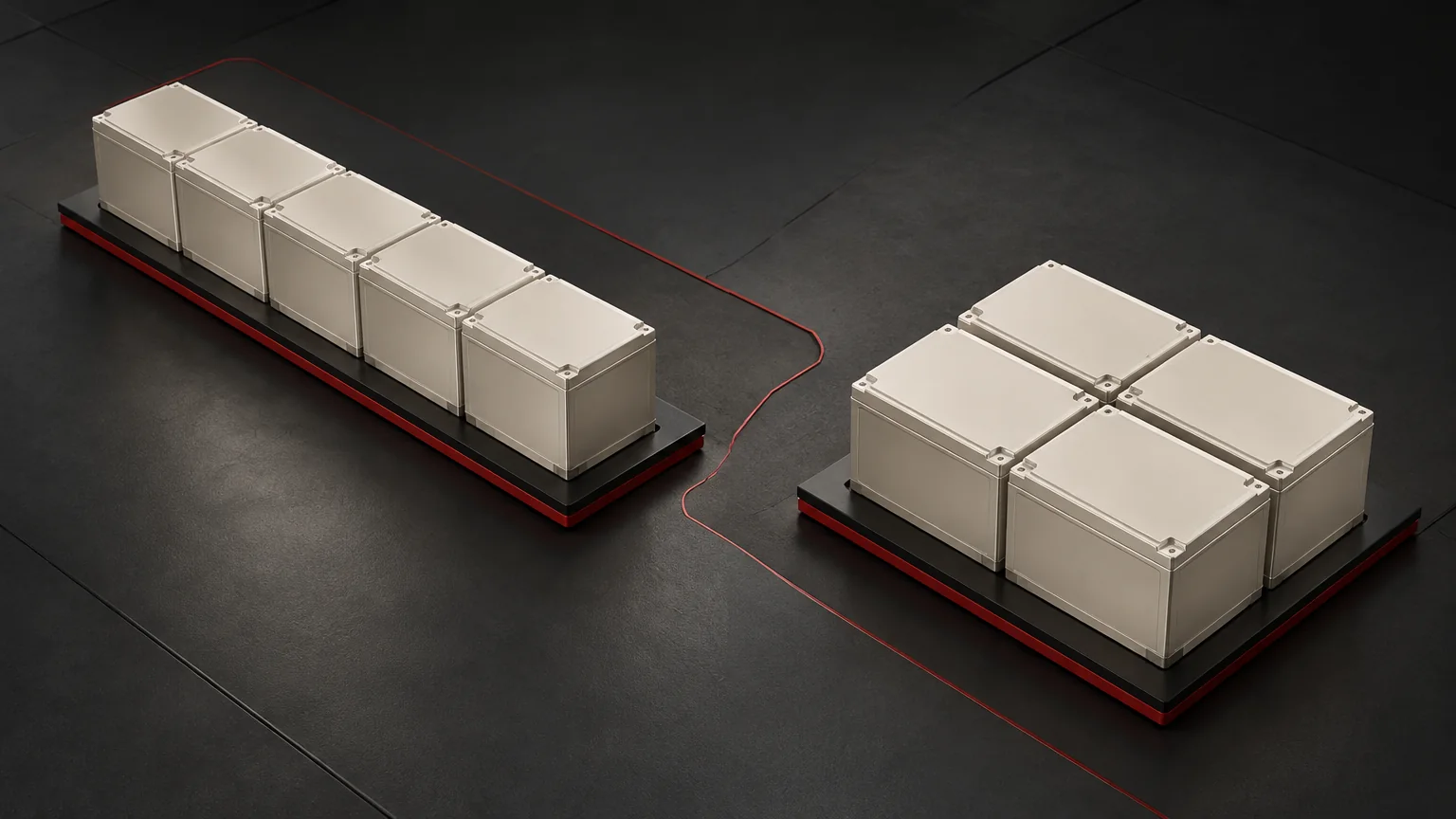
In a simplified model of matched batteries, series arrangements add voltage while parallel arrangements retain the common voltage and add nominal amp-hour capacity. Both increase nominal energy when additional batteries are included. These relationships explain arithmetic; they do not authorize connecting finished UPS battery packs. The host, BMS, charger and protection must support the exact arrangement.
Highidea offers built-in LiFePO4 UPS and external-storage product routes. Choose the route from the required load and autonomy, then specify an approved complete configuration.
Start by naming the battery object
A cell, a module and a finished battery pack are different design objects. A finished pack may contain switching, protection, balancing and communication functions. Its terminals do not make it equivalent to an ideal bare cell.
Likewise, a pack described as modular need not permit either series or parallel connection by the buyer. The approved number, arrangement, control and protection requirements belong to the exact product documentation.
See what V, Ah and Wh describe
For a purely hypothetical arithmetic example, take two identical idealized 12 V, 10 Ah batteries. Ignore losses and operating limits only to explain the units. This is not a proposed UPS battery assembly.
Idealized arrangement | Nominal arithmetic |
|---|---|
One battery | 12 V × 10 Ah = 120 Wh. |
Two in series | 24 V, 10 Ah; nominal energy 24 × 10 = 240 Wh. |
Two in parallel | 12 V, 20 Ah; nominal energy 12 × 20 = 240 Wh. |
The series example does not become 20 Ah merely because it contains two batteries. The parallel example does not become 24 V. Watt-hours help compare nominal energy across the two arrangements, but they do not establish usable AC output energy or runtime.
Amp-hours are a charge quantity under stated conditions, not a discharge-current permission. Parallel capacity arithmetic does not establish an allowed current, equal sharing or a protection rating.
Why the real configuration needs another review
Series construction must be compatible with the resulting voltage and the behavior of every pack and control element. Differences between batteries can affect which limit is reached first. Parallel construction also needs an approved way to handle current sharing, isolation, protection and the consequences of a pack becoming unavailable.
A charger must match the complete arrangement's approved charging requirements. A host must accept the relevant battery operating window and available power. Selecting from nominal voltage and Ah alone leaves these questions open.
Victron's Lithium Battery Smart manual gives different rules for its own series, parallel and mixed arrangements. It illustrates why the construction matters. Its connection instructions, pack limits and compatibility permissions do not carry over to Highidea equipment.
Give the supplier a configuration record
Keep five items together:
- Exact host, finished pack, BMS and charger identities.
- The required W/VA, duration, environment and recharge task.
- The manufacturer's approved arrangement and applicable document revision.
- Power, communication and protection interfaces at the configuration level.
- Service, failure and replacement conditions, including what happens when a pack is unavailable.
Request a configuration drawing from the responsible supplier or design party. Do not turn this arithmetic table into a wiring diagram or connect packs experimentally. Battery systems can deliver hazardous energy even when the UPS input is off.
Discuss storage with Highidea
For an external-battery project, share the load and required backup duration before choosing pack quantities. Our battery expansion guide develops the configuration boundary. Contact Highidea with the host and battery identities to discuss a supported route.
Manufacturer reference
- Victron Lithium Battery Smart Manual, §4.5, for its own arrangement-specific requirements.
FAQ
Frequently asked questions
Does twice the nominal Wh mean exactly twice the runtime?
Runtime depends on usable storage, load, conversion losses, limits and operating conditions. Nominal energy arithmetic alone cannot guarantee that relationship.
Can equal nominal voltage prove two packs can be paralleled?
It is only one comparison input. Finished-pack compatibility, control and protection requirements still need explicit approval.
Can equal nominal energy approve a replacement arrangement?
No. The host, battery management, charger, protection, connectors and permitted architecture must all match the proposed arrangement. Equal arithmetic Wh does not establish electrical or mechanical compatibility. Use the manufacturer-approved configuration and its specified service procedure rather than rearranging existing modules to reproduce a calculated total.
Related
Products, solutions & further reading.
Put this into practice
Need help specifying the right unit?
Share the load, voltage, runtime, environment and destination for a configuration review.