UPS Compliance RFQ Checklist: Model, Market, Battery and Shipment
By Highidea Power Engineering Team · 14 October 2026 · 4 min read
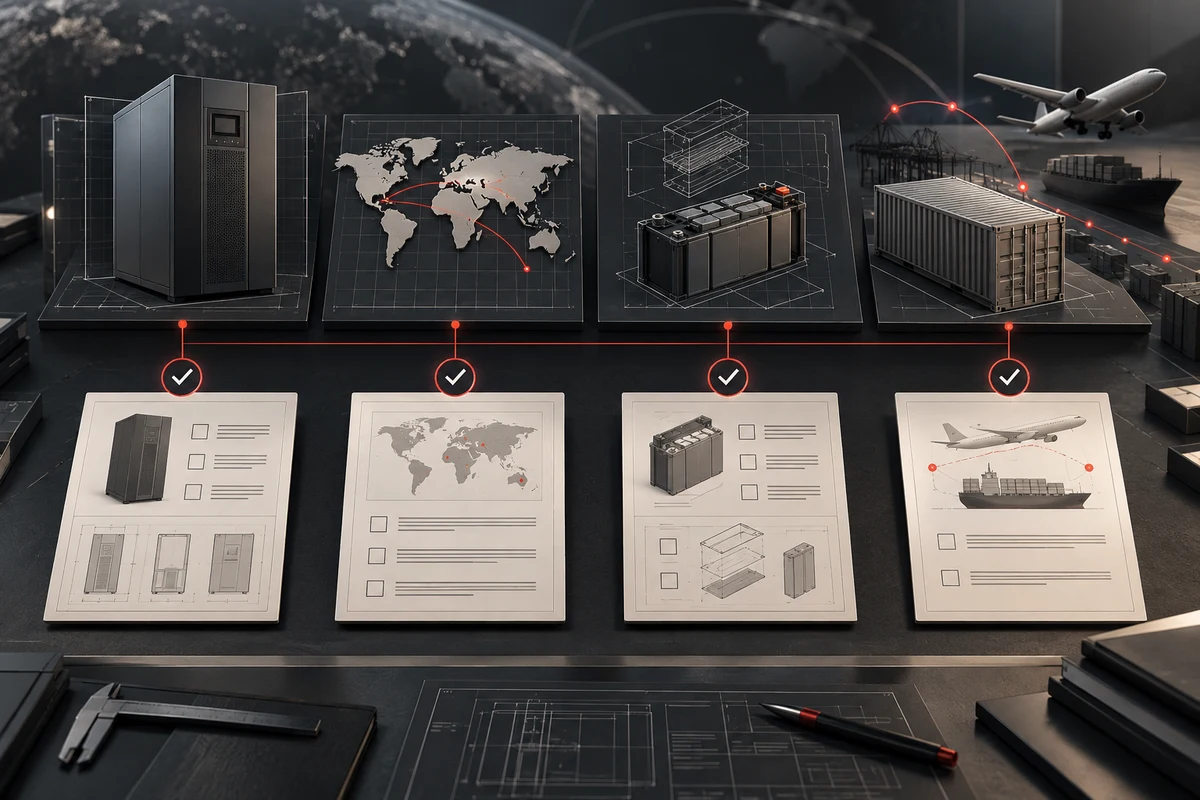
A compliance-ready UPS RFQ names the destination market, importer role, exact host model and suffix, battery or cell identity, intended installation and shipment mode. It asks the supplier to map each declaration, certificate, test report, transport summary, label and instruction set to that configuration. A logo, company certificate or report for a related product family is not enough to approve the order.
Define the compliance object
Start with what will actually cross the border and be placed on the market: UPS host, battery modules or cells, communication cards, bypass or isolation options, labels, manuals and packaging. Record the manufacturer and any importer or private-label role. A change in suffix, battery or brand can change the applicable evidence and responsibilities.
List the destination and intended use separately from the sales region. The buyer or importer should determine applicable laws and local requirements; the supplier should provide the configuration-specific technical evidence needed for that assessment.
Ask for a line-by-line evidence matrix
Assign an owner and due date to each row. A useful response names the supplied file, its model scope, revision and remaining gap; it does not merely say that compliance documents are available.
Evidence area | Configuration-specific request |
|---|---|
Electrical safety | State market, voltage, installation and exact model; request the applicable declaration, standard and model-scoped technical record. |
Substance restrictions | State destination rules and components; request the report or declaration scope, revision and applicable model. |
Battery transport | State battery identity, rating, packing and mode; request its UN 38.3 test summary and mode-specific documents. |
Importer information | Name the responsible economic operator and language; request approved labels, instructions and accompanying documents. |
Keep certificates, standards and reports distinct
A directive defines legal obligations; a standard provides a technical route or test framework; a declaration states responsibility; a certificate or report records a defined assessment. Ask what each document proves and which model, legal entity, date and revision it covers.
ISO 9001 concerns a quality-management system and does not prove product safety or performance. Likewise, UN 38.3 evidence for one cell or battery does not automatically cover a different pack assembled into a UPS.
Treat lithium transport as a configuration decision
- Identify the cell and completed battery, including ratings and manufacturer names used in the reports.
- State whether batteries are installed in equipment, packed with equipment or shipped separately.
- Confirm sea or air mode, packing arrangement, state-of-charge conditions and carrier requirements.
- Ask for the test summary and supporting documents before booking, not after the cargo is ready.
- Have a qualified dangerous-goods professional confirm the final classification and declaration.
Highidea evidence must remain model scoped
Highidea holds six CE-LVD certificates against EN IEC 62040-1 with explicit model lists. UN 38.3 records are available for named LD4850-PRO, SSP 32700 and LT500 items, with related sea or air evidence varying by item. These records must be matched to the quoted host and battery.
Highidea also states ISO 9001 and RoHS status, but the currently available evidence does not establish certificate details or model-scoped RoHS reports. Request current documents for the exact quotation instead of presenting those statements as verified product conformity.
Copyable RFQ compliance checklist
- Destination country, intended use and responsible importer are named.
- Host model, suffix, electrical rating, battery and options are frozen.
- Every document lists its issuer, number, revision, date, legal entity and model scope.
- Labels, manuals and safety information match the destination language and approved branding.
- Transport documents match the battery and shipment mode.
- Deviations and missing items have owners and due dates before order release.
The decision record to retain
Add a compliance register to the quotation with requirement, applicable item, responsible party, promised document, document status and approval owner. “Available on request” is not a closed response. The buyer should be able to see which files exist, which depend on the final battery or label, and which remain outside the supplier’s scope before the purchase order is released.
Recheck the register after any engineering or commercial change. A substitute battery, new private-label model code, different destination, altered input or output rating, or changed shipment method can invalidate earlier matching. Version the approved document pack with the product configuration so receiving, customs, installation and later service teams can identify the evidence that belongs to the delivered units.
Procurement should add documentary hold points to the order: one before design or label approval, one before production release and one before shipment booking. Each hold point names the minimum evidence and approver. This avoids a common late-stage problem in which hardware is complete but a missing model reference, battery test summary or translated instruction prevents the buyer from approving shipment. Record every release decision.
Authoritative references and scope
These sources define industry, regulatory or planning context. They do not prove that every Highidea model meets every cited requirement; approve the exact product, configuration and document scope for the project.
European Commission: Low Voltage Directive 2014/35/EU
European Commission: Restriction of Hazardous Substances Directive
UNECE: UN Manual of Tests and Criteria, Revision 8 and Amendment 1
IATA: 2026 Battery Guidance Document for lithium and sodium-ion batteries
FAQ
Frequently asked questions
Does a CE logo prove that the quoted UPS is covered?
No. Match the declaration or supporting certificate to the exact manufacturer, model and applicable legislation. The importer should also check labels, instructions and technical documentation.
Does UN 38.3 apply to the complete lithium UPS catalogue?
No. UN 38.3 evidence is tied to the tested cell or battery type. Match the report and test summary to the battery in the quoted configuration and then apply the transport rules for the shipment mode.
Can ISO 9001 replace product test evidence?
No. ISO 9001 addresses the supplier’s quality-management system. Product safety, performance, substance and transport requirements need their own applicable documents.
Related
Products, solutions & further reading.
Put this into practice
Need help specifying the right unit?
Share the load, voltage, runtime, environment and destination for a configuration review.