Crest Factor and Inrush Current: Two UPS Sizing Inputs Buyers Often Miss
By Highidea Power Engineering Team · 14 September 2026 · 5 min read
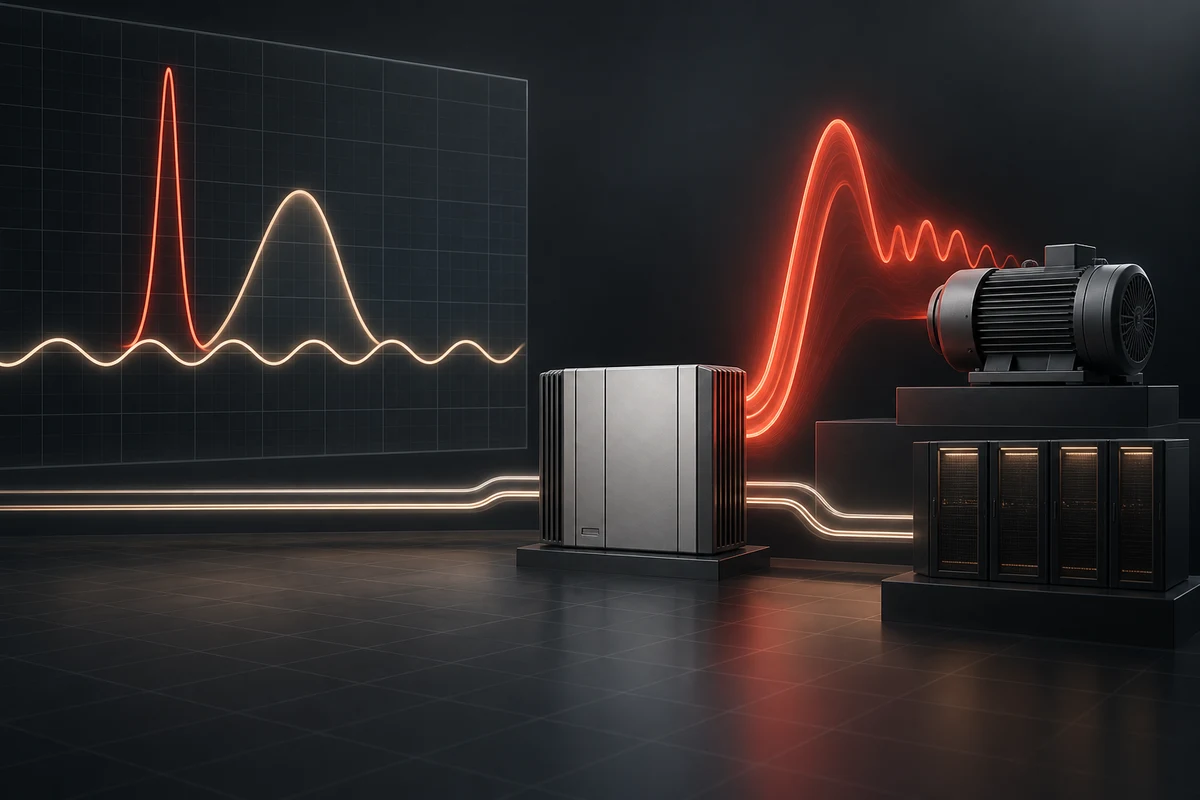
A UPS can carry the steady watts and still fail when a load starts or draws a sharply peaked current. Record continuous kW and kVA separately from inrush magnitude, duration, repetition and crest factor, then compare those events with the exact model’s overload envelope and output-voltage response.
The decision in practical terms
A dependable UPS specification begins with the load and every source-to-load transition, not with a catalogue headline. Buyers should record normal load, transient demand, acceptable interruption, input quality and the operating mode in which each figure was measured. The practical question here is: “Why can a UPS with enough steady-state watts still fail to start my load?” Use the checks below to turn that question into a comparable supplier requirement.
For “Why can a UPS with enough steady-state watts still fail to start my load?” Start with the operating facts, state the outcome the site needs, and require each supplier to map one exact configuration to both. The first three items to close are: Measure or obtain startup traces for motors, transformers, power supplies and other loads that do not start at their running demand. Describe which loads can start together, which can be sequenced and what voltage disturbance the protected equipment can tolerate. Ask the supplier to confirm the proposed configuration against the real event profile rather than applying one generic headroom percentage. Once these are controlled, differences between proposals become visible and testable.
Five checks that change the recommendation
Measure or obtain startup traces for motors, transformers, power supplies and other loads that do not start at their running demand. Put the value and its source in the technical schedule. A supplier should be able to point to the exact model, operating mode and condition used for the recommendation.
Describe which loads can start together, which can be sequenced and what voltage disturbance the protected equipment can tolerate. Treat this as an acceptance input, not a conversation note. If it changes after quotation, record the effect on capacity, battery, interfaces, evidence and delivery.
Ask the supplier to confirm the proposed configuration against the real event profile rather than applying one generic headroom percentage. Verify it with a measurement, drawing, nameplate, manufacturer requirement or approved project document. An unstated assumption here can invalidate the rest of the selection.
List every protected load with real power, apparent power and any starting or peak demand. Ask competing suppliers to answer this item with the same scope, condition and evidence format. That makes the proposals technically comparable before price is considered.
Record nominal voltage, observed input range, frequency behavior, grounding and upstream generator details. Assign an owner to confirm this point before sample or commissioning tests. The final record should show both the required value and the evidence that the delivered system meets it.
Make supplier proposals comparable
Issue the same controlled requirement to every bidder and ask each response to show assumptions, deviations and optional items beside the relevant line. For “Crest Factor and Inrush Current: Two UPS Sizing Inputs Buyers Often Miss,” reject any response that silently changes a material project condition or evidence scope.
Resolve technical differences before comparing price; two offers based on different loads, environments or evidence scopes are not equivalent.
Review item | Requirement to state | Decision record |
|---|---|---|
Technical check 1 | Measure or obtain startup traces for motors, transformers, power supplies and other loads that do not start at their running demand. | Record the evidence, responsible approver and effect on the guide decision. |
Technical check 2 | Describe which loads can start together, which can be sequenced and what voltage disturbance the protected equipment can tolerate. | Record the evidence, responsible approver and effect on the guide decision. |
Technical check 3 | Ask the supplier to confirm the proposed configuration against the real event profile rather than applying one generic headroom percentage. | Record the evidence, responsible approver and effect on the guide decision. |
Technical check 4 | List every protected load with real power, apparent power and any starting or peak demand. | Record the evidence, responsible approver and effect on the guide decision. |
Verify the approved requirement
Turn the agreed requirement into a verification record. Identify the exact supplied item and configuration, the evidence or test method, the applicable condition and the expected result for the question “Why can a UPS with enough steady-state watts still fail to start my load?” For performance tests, retain instruments, readings, alarms and timestamps; for document reviews, retain the issuer, scope and revision.
Keep the verification with the approved configuration so later changes can be assessed against the same baseline. A successful verification applies only to the delivered configuration and stated conditions; it is not a blanket guarantee for a different load, site, document scope or operating mode.
Common failure modes in this decision
A shortcut that hides a boundary or cannot be verified should be clarified before approval.
- Selecting from kVA alone
- Treating every transfer path as identical
- Using a wide input range as a universal generator guarantee
- Answering “Why can a UPS with enough steady-state watts still fail to start my load?” without naming the exact configuration and evidence
Where Highidea fits
Highidea documents online and line-interactive product families with different waveform, transfer and input characteristics. The selected model—not the family name—must carry the final electrical requirement.
Send Highidea the confirmed inputs above so the quotation can identify the applicable host, battery arrangement, interfaces, options and supporting documents.
Copy this into your RFQ
Adapt these lines to the project and replace every unknown with an explicit supplier question.
- Confirm in the quotation: Measure or obtain startup traces for motors, transformers, power supplies and other loads that do not start at their running demand.
- Confirm in the quotation: Describe which loads can start together, which can be sequenced and what voltage disturbance the protected equipment can tolerate.
- Confirm in the quotation: Ask the supplier to confirm the proposed configuration against the real event profile rather than applying one generic headroom percentage.
- Confirm in the quotation: List every protected load with real power, apparent power and any starting or peak demand.
- Confirm in the quotation: Record nominal voltage, observed input range, frequency behavior, grounding and upstream generator details.
Authoritative references and scope
These primary sources support the industry explanation and checklist; product compliance or performance still requires evidence for the quoted model and configuration.
IEC: IEC 62040-1:2017 — UPS safety requirements
IEC: IEC 62040-3:2021 — UPS performance and test requirements
FAQ
Frequently asked questions
Why can a UPS with enough steady-state watts still fail to start my load?
A UPS can carry the steady watts and still fail when a load starts or draws a sharply peaked current. Record continuous kW and kVA separately from inrush magnitude, duration, repetition and crest factor, then compare those events with the exact model’s overload envelope and output-voltage response.
What information should I send to the UPS supplier?
Send the exact load and source data, required operating outcome, site conditions, interfaces, target market and evidence requirements. For this decision, include: Measure or obtain startup traces for motors, transformers, power supplies and other loads that do not start at their running demand. Describe which loads can start together, which can be sequenced and what voltage disturbance the protected equipment can tolerate. Ask the supplier to confirm the proposed configuration against the real event profile rather than applying one generic headroom percentage.
Can a family-level brochure replace model-specific confirmation?
Use family information to shortlist an architecture, but confirm the exact model, configuration, operating mode, test conditions and document scope in the quotation or approved technical schedule.
Related
Products, solutions & further reading.
Put this into practice
Need help specifying the right unit?
Share the load, voltage, runtime, environment and destination for a configuration review.