UPS Daisy Chaining Is Not an Extended-Runtime Design
By Highidea Power · 24 October 2026 · 4 min read
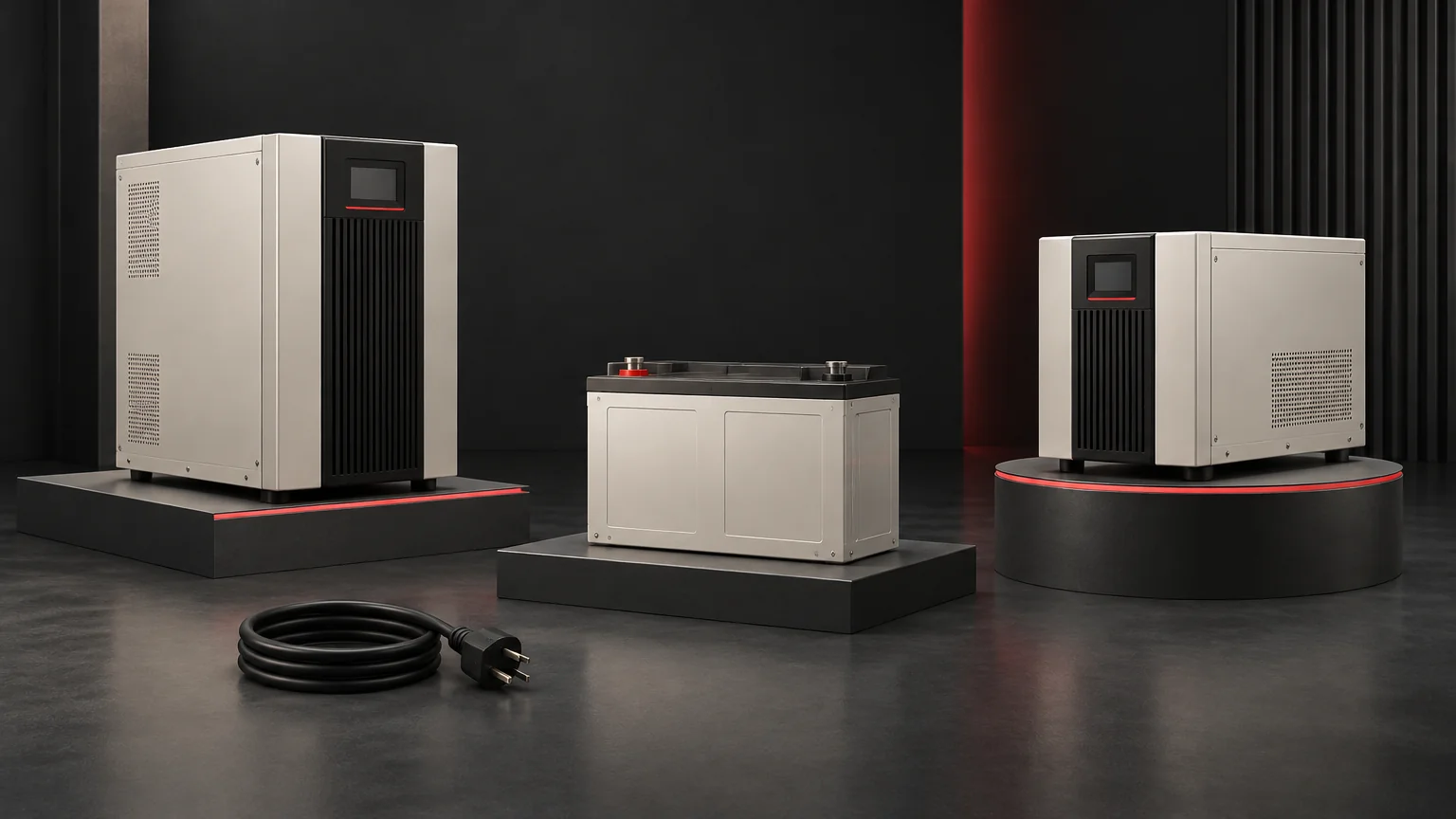
Do not treat plugging one UPS into another as an approved way to add runtime or output capacity. The upstream unit must supply the downstream unit's actual input demand, while waveform, transfer and charging behaviour can interact. For longer backup, specify an appropriate host and its supported battery configuration as one system.
Define the result you actually need
A buyer may have two available UPSs and want more minutes for an existing IT load. Another project may need more output power. These are different requirements: runtime is an energy-and-duty question, while output capacity must satisfy watts, VA and relevant events.
Highidea offers integrated-battery UPS configurations and external-battery routes for suitable applications. Send the actual load and target autonomy so the enquiry can identify a supported configuration. Two complete UPSs placed in a chain do not become one larger host or an automatically coordinated battery system.
Follow the upstream demand
When a downstream UPS is supplied through an upstream unit, the upstream load is the downstream unit's input, not just the final equipment's label. Its conversion losses, charging demand and operating conditions can matter. The downstream output rating cannot be added to the upstream output rating to create more available watts.
For a hypothetical purchasing discussion, a proposed chain includes two hosts with different ratings. Summing those ratings answers no supported capacity question for the final load. The first task is to identify each input/output boundary and the manufacturer's permitted arrangement, not calculate a combined nameplate total.
This explanation is not permission to try the connection. Use the selected manufacturers' instructions and a qualified system design. A matching plug establishes neither compatibility nor an approved protective arrangement.
Understand why batteries may discharge together
Schneider Electric's APC guidance explicitly discourages daisy chaining UPS units. It describes a case in which an upstream step-approximated battery waveform is rejected by the downstream UPS, causing both to use their batteries together. That defeats the assumption that one will wait until the other is exhausted.
The example belongs to the documented products and conditions. It does not establish that every possible UPS pairing behaves identically. It does establish why sequential battery use cannot be assumed from physical order. Source acceptance, waveform, transfer and recovery need the actual supported system answer.
APC's warranty statements also belong to APC. Do not transfer them into a Highidea warranty rule or present a manufacturer's policy as a universal legal prohibition.
Compare supported ways to meet the requirement
Start with the load task, then request a configuration that explicitly supports the required capacity and autonomy. A different host, an approved external-battery arrangement or a revised load/shutdown plan can be evaluated against the same requirement.
Required improvement | Configuration question to resolve |
|---|---|
More running watts or VA | Which supported host meets continuous and relevant transient demand? |
Longer autonomy | Which approved battery arrangement supports the stated load and duration? |
Repeated-outage readiness | How do charger capacity, load and recovery interval fit together? |
Higher continuity | Which defined failure and source-to-load architecture must remain available? |
Easier service | What supported maintenance and replacement arrangement fits the site? |
These are alternatives to assess, not interchangeable benefits. A larger battery does not raise the host's power rating, and two independent supplies do not automatically create a redundant path for a single-input load.
Keep battery expansion within the host design
Highidea's external-battery ET rack route allows runtime configuration with the selected host and compatible LiFePO4 arrangement. The proposed pack count, charging, protection, cabling, rack loading and installation still need to fit that configuration. Do not infer that every integrated-battery model accepts expansion.
Our battery-pack scaling guide develops the complete expansion review. The recharge-planning guide addresses the time available before the next event. Together they help turn a request for more minutes into a defined system duty.
Keep the accepted host, battery identities and applicable instructions with the order. A later extra pack or changed load should receive the appropriate review, not be treated as a simple accessory purchase because the original installation worked.
Prepare a longer-runtime enquiry
Through our contact page, provide load watts and VA, startup requirements, target autonomy, available input, installation constraints and recovery needs. Highidea can discuss the suitable UPS route and the complete battery configuration to be identified in the proposal.
If an existing installation already contains a chain, preserve safely available information and ask qualified support to review it under the site's authorized procedure. Do not unplug live equipment or rearrange connections to test which UPS fails first. Protect the load and people before changing the arrangement.
Reference
FAQ
Frequently asked questions
Do two UPS batteries always give twice the runtime?
No. The complete power paths and operating interactions determine the result; a chain is not a supported battery-capacity addition by arithmetic.
Does pure-sine output automatically approve a chain?
It addresses only one characteristic. Manufacturer support, complete input demand, transfer and protection remain separate requirements.
Can external batteries be added to every UPS instead?
Only use the exact host's approved battery architecture and limits. Request a supported alternative if the existing host does not provide the required expansion.
Related
Products, solutions & further reading.
Put this into practice
Need help specifying the right unit?
Share the load, voltage, runtime, environment and destination for a configuration review.