Aligning UPS, Server and Network Event Clocks
By Highidea Power Engineering Team · 20 October 2026 · 4 min read
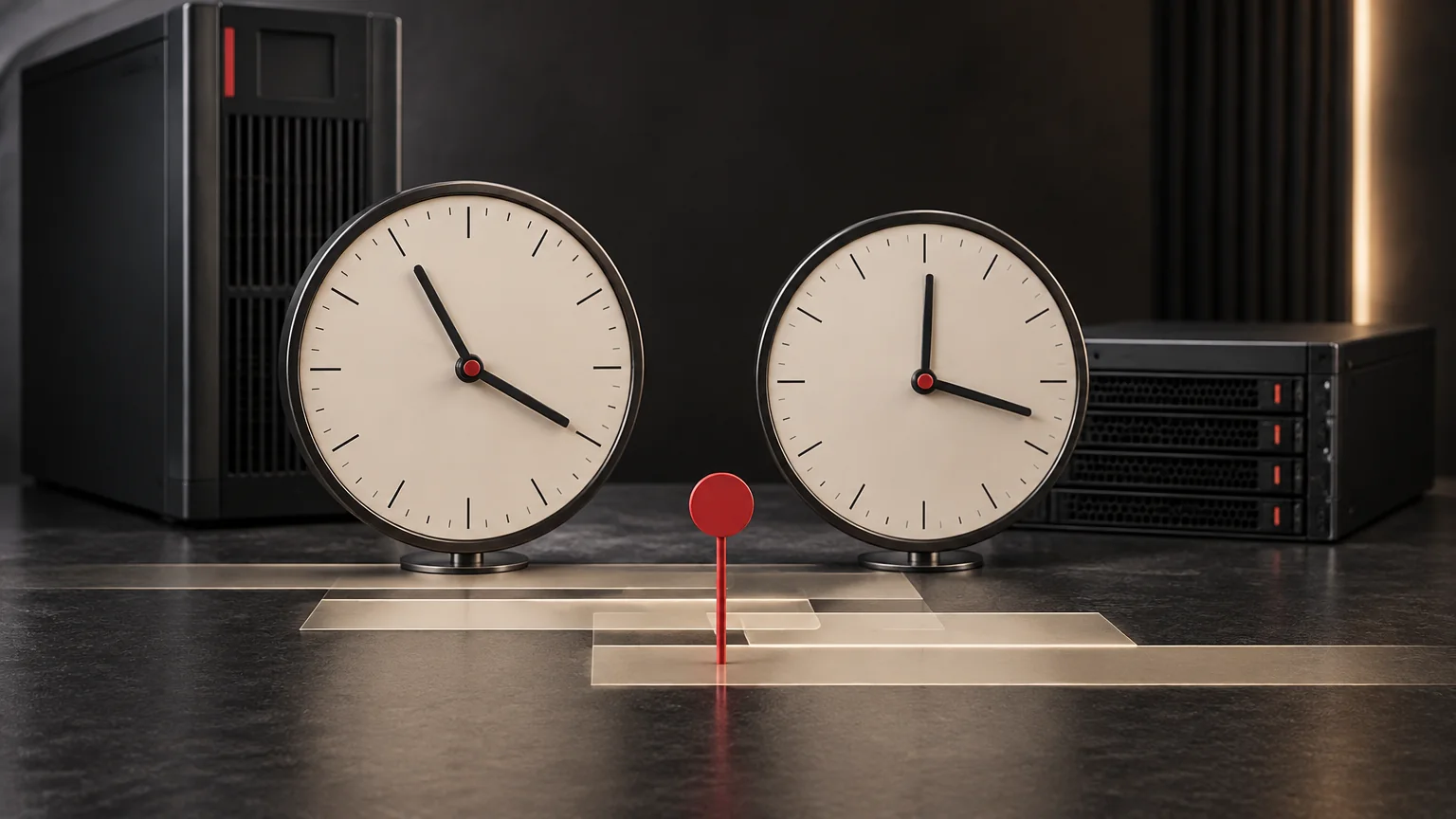
Preserve original timestamps, then normalize them using known time zones, observed clock offsets and uncertainty. Device event time, collector receipt time and a person's observation are different records. If uncertainty prevents ordering two events, report their order as unknown rather than constructing a causal story.
Preserve the original evidence first
Retain the raw timestamp string, source system, configured time zone if known and event meaning. A device's displayed local time is not automatically UTC. A collector's receipt time may reflect transmission delay rather than when the source event occurred.
Identify whether a field represents wall-clock time or elapsed time. RFC 1628 includes time-related objects with defined semantics; not every time-like number is a civil timestamp. Confirm the actual card's implementation before aligning it with a server log.
NIST's Internet Time Service material explains time distribution and network-related effects. Access to a time source does not guarantee that a particular UPS synchronizes to it or achieves a universal accuracy.
Use an explicit offset convention
Define offset as device clock minus reference clock. Under that convention, estimated reference time equals device time minus offset. Write the sign in the record so another analyst can reproduce the arithmetic.
For a hypothetical event, a UPS records 10:00:05Z. An observation near the event establishes that its clock is 4 seconds ahead of the reference, so the normalized estimate is 10:00:01Z. A server event at 10:00:02Z, with zero observed offset, then appears one second later.
This example assumes a valid nearby offset observation; it does not establish causation. Time-zone conversion should occur separately, using the actual applicable offset for the event date. An unlabeled local time should not be assigned a convenient zone merely to make the logs align.
Keep uncertainty in the timeline
Suppose the UPS offset estimate above is +4 seconds ±2 seconds. The normalized event could lie from 09:59:59Z to 10:00:03Z. If the server event is 10:00:02Z ±1 second, its interval overlaps the UPS interval. Their order is unresolved even though the point estimates differ.
Timeline field | Meaning |
|---|---|
Original event | Unmodified timestamp, source and event definition. |
Time basis | Zone/UTC offset or elapsed-time semantics, with evidence. |
Clock offset | Device minus reference, observation time and method. |
Normalized estimate | Reproducible calculation on the chosen common time basis. |
Uncertainty | Known bounds or an explicit unknown; do not assume zero. |
Receipt/observation | Separate collector or human time, including known delay limitations. |
Compare the raw and normalized records
Keep the before-and-after record together. In the same hypothetical example, assume both raw event fields have one-second display resolution and the stated uncertainty bounds already include that resolution. Larger or unknown uncertainty would change the conclusion.
Original record | Normalized record and ordering confidence |
|---|---|
UPS event: 10:00:05Z; source zone UTC; device clock minus reference +4 s ±2 s, observed near the event; display resolution 1 s. | Estimate 10:00:01Z; interval 09:59:59Z–10:00:03Z. Collector receipt and human observation times not supplied. |
Server event: 10:00:02Z; source zone UTC; observed offset 0 s ±1 s; display resolution 1 s. | Estimate 10:00:02Z; interval 10:00:01Z–10:00:03Z. Collector receipt and human observation times not supplied. |
Naive raw ordering: server appears 3 s before UPS. | Point estimates reverse that order, but intervals overlap; neither raw nor normalized point ordering establishes the actual order or cause. |
For a real incident add the offset evidence/method, clock source, timestamp resolution, collector receipt, human observation and unknown delay to each row. Where uncertainty is unknown, do not manufacture a narrow interval from the number of displayed digits.
The arithmetic values are illustrative. This worksheet establishes no permitted synchronization tolerance or universal log accuracy.
Do not repair evidence by changing clocks
A current clock comparison may help an investigation, but it may not establish the clock's historical offset. Time synchronization, reboot or a manual adjustment can change the relationship. Record those changes and limit the conclusion accordingly.
Preserve raw logs before authorized configuration work. Do not change production clocks merely to make a current display look consistent with an old incident. If an offset cannot be reconstructed, keep that gap in the analysis.
Receipt times can provide context, but a delayed message should not be moved backward by an invented average delay. A defensible timeline can contain intervals and unknown order.
Report correlation and causation separately
A normalized sequence can support further questions: did a shutdown command precede an output-state change, or did the network stop reporting before another observation? It cannot by itself prove that one event caused the next.
For Highidea support, provide the raw records, normalization worksheet and equipment/card identities together. State confirmed observations, possible orderings and unresolved clock gaps. This is more useful than a polished timeline whose timestamps conceal incompatible clock assumptions.
Primary references
The references support the specific distinctions stated above. Manufacturer examples apply to their documented products; they do not establish the same capability in a Highidea model. Proposed worksheets and hypothetical examples are editorial decision tools, not approved installation or operating procedures.
NIST: Internet Time Service (ITS)
IETF / RFC Editor: RFC 1628: UPS Management Information Base
FAQ
Frequently asked questions
Should all logs simply be treated as UTC?
No. Establish each source's time basis and preserve unknowns when it cannot be verified.
Does a later collector timestamp prove a later device event?
No. Transport and processing delays can change receipt order relative to source events.
If two uncertainty intervals overlap, which event came first?
The available timing evidence may not establish the order. Report it as unresolved and seek independent evidence rather than selecting a convenient sequence.
Related
Products, solutions & further reading.
Put this into practice
Need help specifying the right unit?
Share the load, voltage, runtime, environment and destination for a configuration review.