Before a UPS Firmware Change: A Go/No-Go Review
By Highidea Power Engineering Team · 20 October 2026 · 4 min read
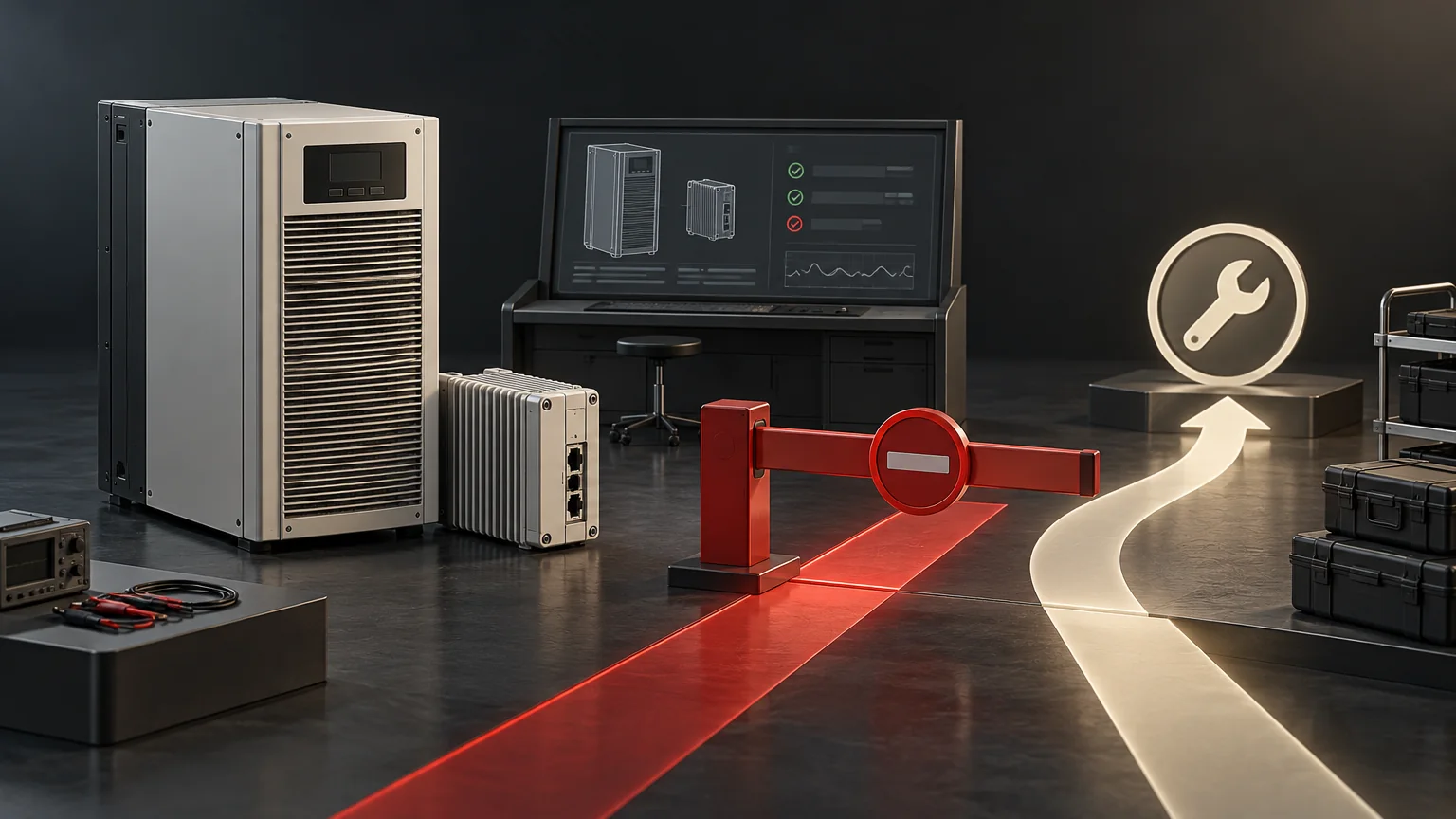
Treat a proposed host, communication-card or BMS firmware change as a specific controlled release. Confirm applicability, representative testing, expected service effects and a supported recovery arrangement before authorizing production. Do not assume updates are non-disruptive, settings can always be exported or downgrades are available.
Identify the component and reason for change
Record the current and proposed versions, exact hardware and the supplier's applicability statement. Separate the host controller, communication card and battery management system; a release for one is not evidence of compatibility with the others.
Write the reason for the change: a documented correction, required compatibility or another agreed objective. A higher version number alone does not explain the benefit or the acceptable risk.
NIST SP 800-128 provides a general configuration-management basis for reviewing baselines, impacts and controlled changes. It is not a UPS flashing manual, a model-specific compatibility list or a certification requirement. The selected supplier must provide the actual technical instructions.
Review a component-specific compatibility matrix
Use a matrix to make missing evidence visible. “Not applicable” should have a reason; unknown should remain unknown until the responsible supplier resolves it.
Review field | Evidence needed before a decision |
|---|---|
Host | Hardware/current version, supported target and expected power/control effects. |
Communication card | Applicable hardware, host compatibility and monitoring/integration effects. |
BMS or battery interface | Exact supported combination and battery-supplier requirements where relevant. |
Configuration | Supported preservation/restoration method, or another approved baseline record. |
Test evidence | Representative configuration, scope, result and remaining differences. |
Recovery | Supplier-supported action if the change fails, with people and resources available. |
Production release | Authorized window, service consequence, decision owner and stop conditions. |
This matrix grants no permission to obtain firmware from an unofficial source or to use a package on an unlisted model.
Separate laboratory evidence from production readiness
A representative test can reveal issues, but record its differences from the installed system. Host/card versions, battery arrangement, monitored points and connected service can all affect the conclusion.
For the approved scope, verify not just the reported version but the functions the change might affect. Power/control behavior, alarm semantics and receiver interpretation are different evidence areas. A successful login to the card does not establish that the protected load and all integrations are unaffected.
Actual electrical tests and update operations require the supplier's method and site authorization. This article deliberately supplies no flashing sequence, reboot instruction or command.
Do not call an unsupported downgrade a rollback plan
Suppose a hypothetical supplier confirms that a new version applies to the installed card but states that downgrade is unsupported. The site cannot list “restore old firmware” as its recovery method. It needs another supplier-supported recovery arrangement and an accepted service consequence, or the decision remains no-go.
Likewise, an unverified settings file is not proof that configuration can be restored after a failed update. Confirm format, target-version compatibility and the supported method. If export is unavailable, agree another permitted baseline record without claiming equivalent automated recovery.
This example does not prescribe a spare, transfer or replacement method. The responsible supplier and site team must determine what is supported and safe.
Issue a bounded go/no-go decision
A go decision should cite the exact configuration, approved instructions, impact assessment, evidence and recovery arrangements. A no-go decision should name the unresolved condition and owner, so urgency does not erase it later.
Keep a release record that can actually stop the change:
Decision cell | Complete for this release |
|---|---|
Baseline and proposal | Asset/component: __; current/target hardware and versions: __; reason: __; supplier applicability reference: __. |
Evidence and differences | Representative test/reference: __; untested differences: __; power/control/monitoring consequences: __. |
Recovery and stop | Supported recovery/reference: __; people/resources ready: __; stop conditions: __; unresolved owner: __. |
Rollout authority | Approved first scope/window: __; reviewer: __; go/no-go with reason: __; evidence required before any wider rollout: __. |
Completion | Actual final versions: __; required observations/results: __; deviations: __; service release owner: __. |
A wider rollout is a new hold point when the first scope leaves differences unverified. No-go remains in force until the named gap is resolved, not merely until the maintenance window arrives.
After an authorized change, retain the actual version/configuration, observation results and deviations. Do not mark the work complete solely because the update tool reports success. Reconcile the affected service and monitoring requirements under the approved plan.
Send Highidea the component/version matrix and proposed objective before requesting a release. Keep firmware-access rights under the commercial/support agreement separate from the technical authorization to change one production system.
Primary references
The references support the specific distinctions stated above. Manufacturer examples apply to their documented products; they do not establish the same capability in a Highidea model. Proposed worksheets and hypothetical examples are editorial decision tools, not approved installation or operating procedures.
NIST: SP 800-128: Guide for Security-Focused Configuration Management of Information Systems
FAQ
Frequently asked questions
Are communication-card updates always non-disruptive?
Do not assume so. Obtain the exact release's expected effects on monitoring, control and the host interface.
Can I always downgrade if the new version causes trouble?
No. Recovery must be explicitly supported for the actual component and versions.
Does a successful update message complete acceptance?
No. Verify the applicable configuration, service and integration outcomes, and retain any unresolved deviations.
Related
Products, solutions & further reading.
Put this into practice
Need help specifying the right unit?
Share the load, voltage, runtime, environment and destination for a configuration review.