UPS Fleet Asset Names and Serial Numbers: Preserve Both
By Highidea Power Engineering Team · 20 October 2026 · 4 min read
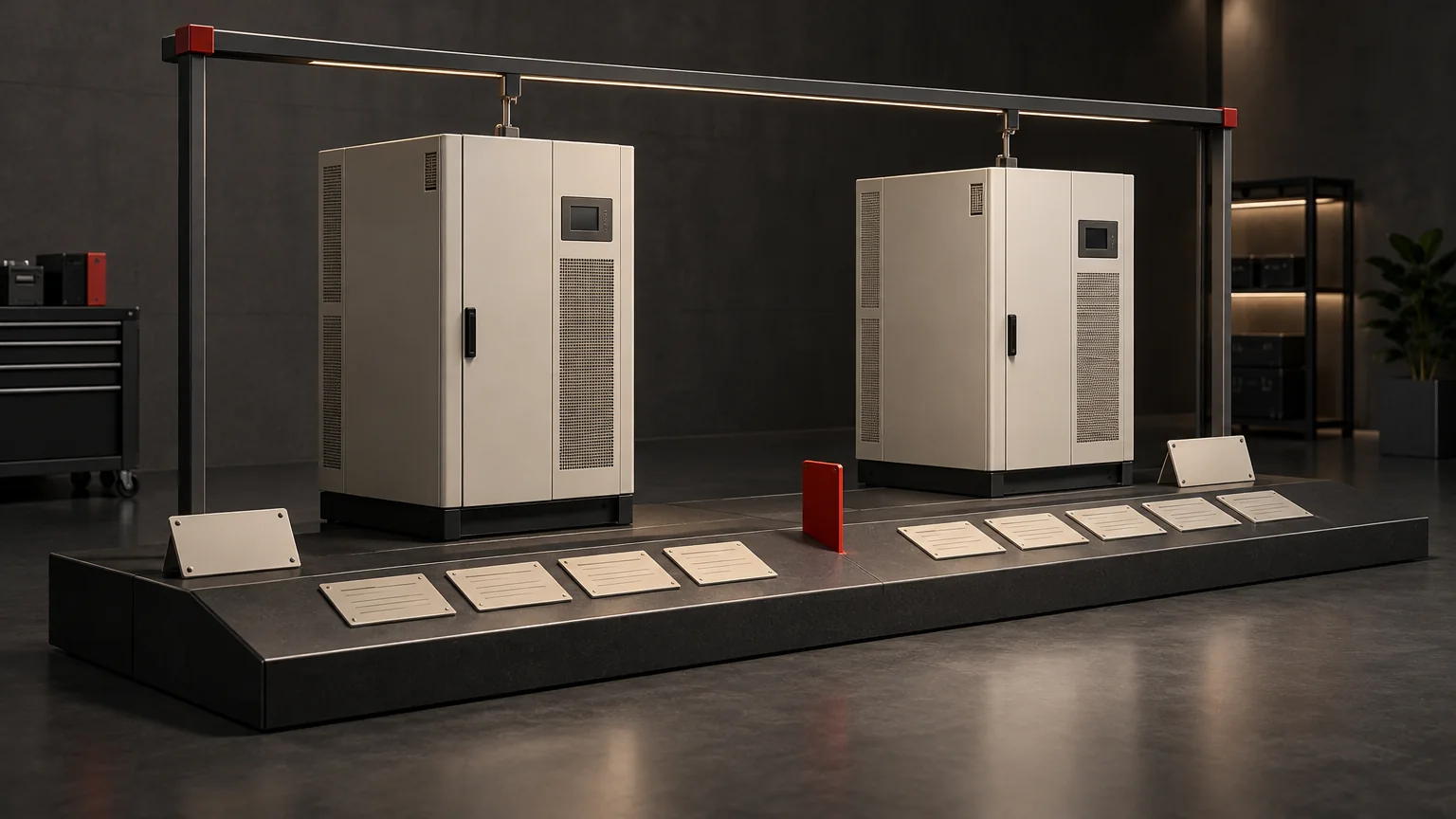
Keep the stable service or location identifier separate from replaceable hardware identities. Link the UPS serial, communication-card identity and location with effective dates, so a replacement does not inherit old incidents as if it were the same physical unit. This is a proposed records design, not a claim about a DCIM platform's built-in functions.
Give the service and hardware different identities
An operational name such as “Room A UPS” can remain useful after equipment is replaced. A serial number identifies a physical item within the manufacturer's identification scheme. Treating them as the same field makes history difficult to interpret.
Record the UPS manufacturer/model and verified serial separately from the local service identifier. A communication card can have another identity and replacement history. Its IP address or hostname may be reused, so neither should be treated as an immutable hardware identifier.
RFC 1628 includes UPS identification objects, but it does not provide a universal serial-number field for every UPS. Confirm actual manufacturer/card capabilities and reconcile them with physical or supplier records. Do not invent a standard object to fill a missing serial.
Use an effective-dated crosswalk
A crosswalk can preserve service continuity without rewriting physical history. Each link needs a start, an end where applicable and the evidence used to establish it. Record uncertain boundaries rather than inventing a precise replacement time.
Record field | Purpose |
|---|---|
Stable service ID | Identifies the protected service or managed position over time. |
Hardware identity | Manufacturer, model and verified host serial; keep card identity separate. |
Location | Actual position during the effective period, not only the current room. |
Effective interval | When the link applied, with unknown or uncertain timing explicit. |
Evidence | Work order, inspection or supplier record used for reconciliation. |
Incident link | Physical asset, service or unresolved attribution appropriate to the evidence. |
Change reference | Who approved/corrected the mapping and why. |
NIST SP 800-128's configuration-management principles support controlled records and baselines. They do not prescribe this exact UPS data model or establish that a selected platform already implements it.
Work a replacement without moving old incidents
Consider a hypothetical service SVC-01. Host serial UNIT-A serves it until a verified replacement boundary, after which UNIT-B serves it. The service name and network endpoint may remain unchanged.
An incident observed before the boundary remains associated with UNIT-A where evidence supports that attribution. A later incident belongs to UNIT-B. Both can also remain visible under SVC-01 for a service-level history. Replacing the current serial field must not make the earlier incident appear to concern UNIT-B.
For a concrete crosswalk, assume a hypothetical approved replacement record fixes the boundary at 2026-06-01T12:00:00Z. The following identifiers and dates are invented only to show the record structure, not actual Highidea assets.
Effective link | Example identity record |
|---|---|
LINK-01, closed | Service SVC-01; example manufacturer/model M; host UNIT-A; card CARD-X; location Room A; start 2026-01-01T00:00:00Z; end 2026-06-01T12:00:00Z, end excluded; successor LINK-02; evidence work record W-01. |
LINK-02, current | Service SVC-01; same example manufacturer/model M; host UNIT-B; retained card CARD-X; location Room A; start 2026-06-01T12:00:00Z, start included; end open; predecessor LINK-01; evidence work record W-02. |
Incident attribution | Event E-01 at 11:59:00Z on replacement day → SVC-01 / UNIT-A; event E-02 at 12:01:00Z → SVC-01 / UNIT-B, assuming the respective evidence confirms these event times. Card identity alone cannot distinguish them because CARD-X was retained. |
The half-open interval convention avoids double assignment exactly at the verified boundary. If timestamp precision or replacement evidence cannot support that precision, use an uncertain interval instead.
If an incident spans an uncertain replacement interval, retain its service association and mark physical attribution unresolved until further evidence is found. Do not use the current device's response to retroactively identify the old hardware.
Reconcile card changes separately
A card replacement does not necessarily mean the UPS host changed. Conversely, moving an existing card into another host can preserve its network identity while changing the managed equipment.
Retain both host and card events in the crosswalk. On a discrepancy, compare the physical/supplier evidence and authorized work record with the reported identity. A single network address should not overrule conflicting serial evidence.
Avoid duplicate records by using the actual identification scheme and provenance. A serial string without a manufacturer or model context may not be sufficient to establish global uniqueness. Keep corrections traceable rather than deleting an inconvenient historical row.
Make handover and investigation reproducible
At handover, reconcile the service, host, card and location records with the installed configuration. During later changes, close the previous effective link and establish the new one through the approved process.
Provide Highidea support with the actual unit identity relevant to the incident, not merely the current room label. Where attribution is uncertain, say so and supply the time-bounded evidence. This prevents troubleshooting for one hardware revision from being applied to a different unit because they shared a service name.
Primary references
The references support the specific distinctions stated above. Manufacturer examples apply to their documented products; they do not establish the same capability in a Highidea model. Proposed worksheets and hypothetical examples are editorial decision tools, not approved installation or operating procedures.
IETF / RFC Editor: RFC 1628: UPS Management Information Base
NIST: SP 800-128: Guide for Security-Focused Configuration Management of Information Systems
FAQ
Frequently asked questions
Can the IP address be the permanent asset identifier?
Not reliably. Addresses can be reused or changed; preserve hardware and service identities separately.
Should an old UPS record be overwritten after replacement?
Keep its historical identity and effective links. Update the current service relationship without transferring old incidents to the new physical unit.
What if the replacement date is unknown?
Record an uncertain interval and the available evidence. Do not invent an exact boundary or force a serial attribution that cannot be established.
Related
Products, solutions & further reading.
Put this into practice
Need help specifying the right unit?
Share the load, voltage, runtime, environment and destination for a configuration review.