UPS Load Priority and Shedding Plan: What Stays On During an Outage
By Highidea Power Engineering Team · 17 October 2026 · 4 min read
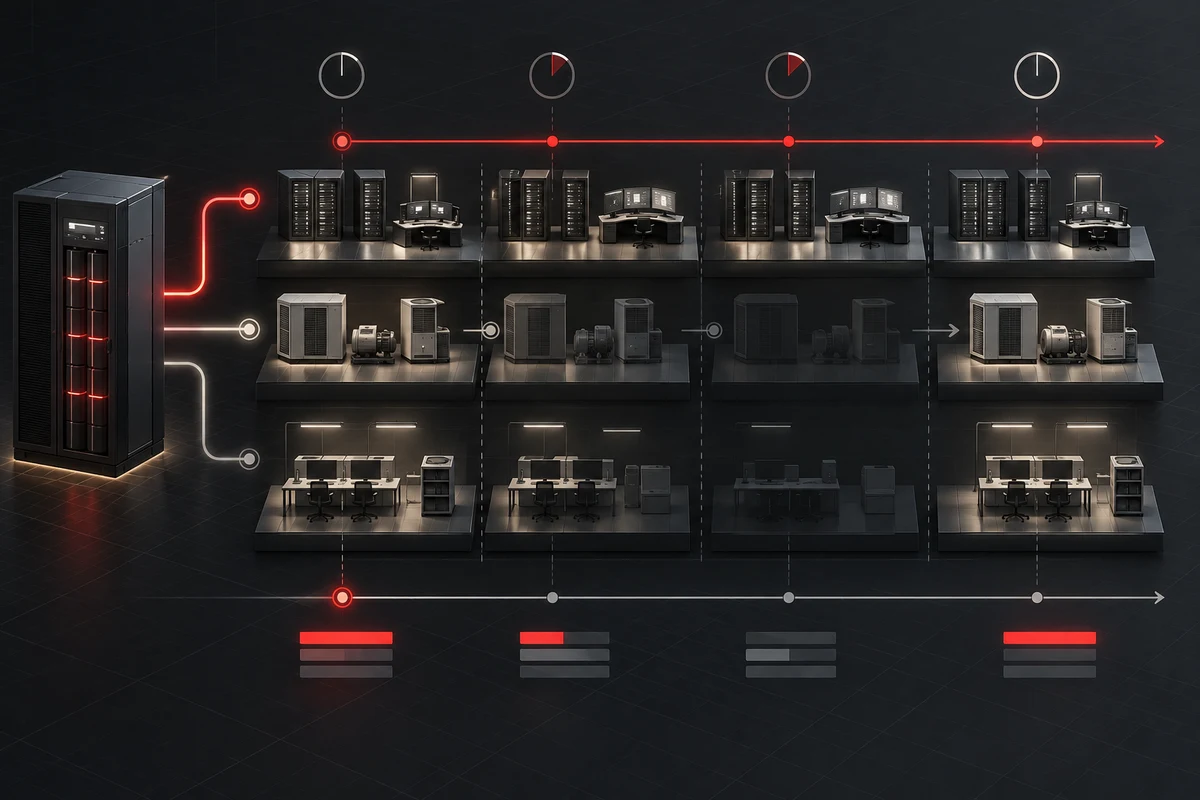
A UPS load-priority plan starts with business and safety consequences, not device size. Identify essential functions, map every electrical and control dependency, and place each load in one of three groups: must run for the full event, run only long enough for a controlled shutdown, or shed immediately. Add timing, owners and restoration rules, then test the sequence at a defined load before using it to size the UPS and battery.
Prioritize the function before the device
A small control switch can be more critical than a large convenience load when the switch enables communications or orderly shutdown. Ask what operational, safety, data or quality consequence follows if each function stops now, after five minutes or after a longer outage. Record the required outcome rather than labelling everything “critical.”
NIST criticality guidance provides a useful general principle: finite protection should follow the importance of systems and components to the mission. The site owner must translate that principle into its own safety, process and recovery priorities.
Use three service groups
Group | Purpose | Required record |
|---|---|---|
Must run | Maintain an essential function through the defined event | Load, autonomy, source path and consequence of loss |
Graceful shutdown | Preserve state or reach a safe condition before energy ends | Shutdown duration, trigger, dependencies and confirmation |
Immediate shed | Remove nonessential demand to preserve energy for higher priorities | Shedding device, trigger, fail-safe state and restart authority |
Conditional restore | Return loads without creating a new overload or process hazard | Sequence, prerequisites, delay and accountable operator |
Map hidden dependencies
- Include networks, controls, sensors, storage, pumps, cooling and communications needed by the priority function.
- Record startup or inrush events and prevent several restored loads from starting together unintentionally.
- Identify external services such as generator fuel, ventilation or operator access that limit the plan.
- Separate normal operating watts from short events and from energy needed for shutdown.
- Mark manual actions and the decision authority if automatic shedding fails.
Turn the schedule into UPS requirements
For each time band, calculate the simultaneous watts and VA that remain, then add known startup events and the approved growth case. The battery requirement follows the load-versus-time profile, starting condition, temperature and stop criterion. One headline runtime cannot represent changing load groups.
Specify monitoring and outputs needed to trigger shutdown or shedding. A dry contact, SNMP event or software command is useful only when its ownership, network path, credentials and fallback action are defined and tested.
Test failure and restoration
Run an authorized exercise that records source loss, UPS state, load transitions, alarms, output behavior, shutdown completion and remaining reserve. Stop conditions must protect people, process and equipment. A successful test applies only to the tested configuration and conditions.
Restoration deserves its own sequence. Verify source stability, battery condition and process prerequisites before reconnecting shed loads. Stagger startup where the combined inrush or process dependency requires it.
Use the plan in a Highidea enquiry
Highidea offers online UPS, specialty-voltage systems and power or telecom inverters across multiple applications. A useful proposal still depends on the buyer’s load groups, timing, voltage, environment, interfaces and acceptance plan.
Send the one-line diagram, group schedule, measured load data, expected outage or generator sequence and required monitoring. Ask the quotation to state the exact host, battery configuration, supported interfaces and test conditions.
The decision record to retain
Represent the plan as a time-based load schedule. At source loss, show the initial simultaneous load; at each trigger, show which group stops and what demand remains; at the generator or alternate-source milestone, show what may continue. This reveals whether the highest demand occurs at outage start, during a shutdown action or during restoration rather than assuming one constant load.
Assign every automatic step an observable confirmation and manual fallback. If a server command is issued, define how completion is verified; if a contactor sheds a branch, define its safe state and local indication. The acceptance record should include failed communications and delayed shutdown cases, because the plan must remain safe when one control path does not behave as expected.
Review the schedule with operations, IT or control owners, safety personnel and facilities. Each role sees a different dependency and may disagree about the consequence of early shutdown. Resolve those differences before procurement. The approved version becomes both a sizing input and an operating procedure, while later load additions must be assessed against the remaining power and energy margin. Record rejected loads and their reasons too. Keep the approval dated and signed.
Authoritative references and scope
These sources define industry, regulatory or planning context. They do not prove that every Highidea model meets every cited requirement; approve the exact product, configuration and document scope for the project.
NIST: NIST IR 8179 — Criticality Analysis Process Model
NIST: NIST SP 800-34 Rev. 1 — Contingency Planning Guide
IEC: IEC 62040-3:2021 — UPS performance and test requirements
FAQ
Frequently asked questions
Should every critical load stay on for the full battery runtime?
No. Some functions must run continuously, some need only enough time for a safe shutdown, and some should be shed immediately. The consequence and dependency analysis decides the group.
Can load priority be based only on watts?
No. Include operational consequence, control dependencies, startup demand, shutdown time, source path and restoration sequence. A low-power dependency can determine whether a larger function remains usable.
When should the shedding plan be retested?
Retest after material load, software, network, generator, UPS, battery or control changes, and at the site’s approved exercise interval.
Related
Products, solutions & further reading.
Put this into practice
Need help specifying the right unit?
Share the load, voltage, runtime, environment and destination for a configuration review.