Rack UPS Output Connection Checklist: Terminals, PDUs and Circuit Protection
By Highidea Power Engineering Team · 18 October 2026 · 4 min read
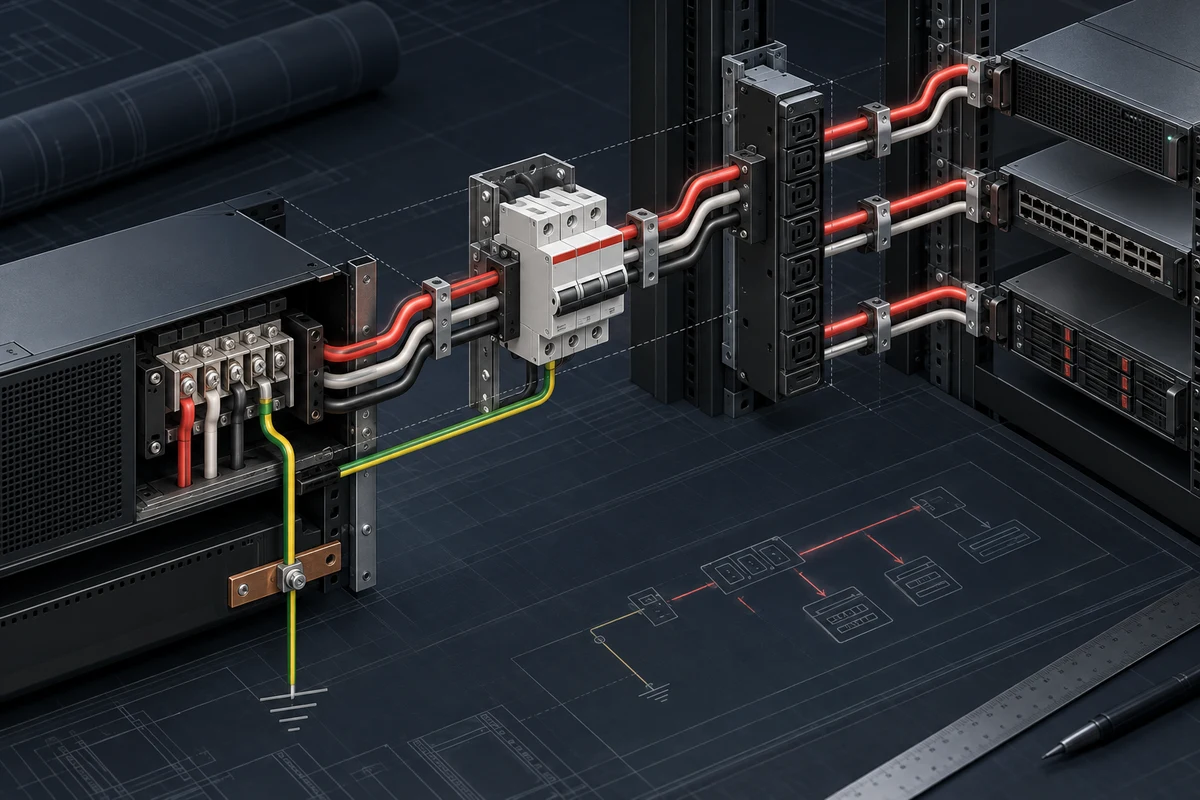
Before installing a rack UPS, verify whether its output is a receptacle, terminal block or other hardwired interface; then define voltage, phase, neutral and protective-earth arrangement, conductor and terminal ratings, downstream protection, PDU capacity, connector compatibility, cable reach and maintenance isolation. The UPS output rating does not by itself design the branch distribution to every protected device.
Identify what the UPS actually provides
Rack form factor does not guarantee a bank of familiar outlets. Highidea’s practical guidance notes that rack power UPS systems commonly use a single terminal-block output, with a rack PDU or power strip used to distribute power to several small loads. Confirm the exact model drawing and terminal data rather than inferring the connection from a product photograph.
Record output voltage, phase, frequency, current, neutral arrangement, protective-earth terminal and permitted conductor range. Also identify bypass and maintenance paths because they can affect source characteristics and isolation during service.
Coordinate the complete output path
Boundary | Design input | Approval evidence |
|---|---|---|
UPS terminal | Terminal type, conductor range, torque and access | Model manual and termination record |
Feeder | Ampacity, voltage drop, routing, temperature and grouping | Electrical design calculation and inspection |
Protection | Fault level, breaker rating, selectivity and isolation | Approved one-line and protection schedule |
Rack PDU and loads | Input plug, outlets, branch rating and phase allocation | PDU datasheet, load map and labelled connections |
Do not confuse capacity with connectivity
A UPS may have enough kW and kVA but still be unsuitable for the proposed connection when the PDU plug, terminal size, neutral, phase or protective device does not match. Conversely, an outlet shape does not prove the circuit can carry all connected loads continuously.
Build a load map showing device, normal watts and VA, startup demand, connector, branch and shutdown group. Check the PDU and upstream feeder under normal, overload, bypass and maintenance conditions defined for the project.
Plan service and change control
- Provide safe isolation and access for the UPS, PDU and downstream circuits under site rules.
- Label source, destination, phase or branch, protective device and equipment identifier at both ends.
- Control adapter leads and temporary power; they must not become an undocumented permanent distribution design.
- Reserve rack space and cable bend radius without blocking airflow or service removal.
- Update the load and connection schedule whenever equipment is added, moved or replaced.
Pre-energization and functional checks
A qualified installer should compare the installed path with the approved drawing, inspect terminations and protective conductors, verify labels and covers, and perform the measurements required by the site and manufacturer. IEC 60364-5-52 addresses selection and erection of wiring systems; local rules and the project designer determine the applicable installation details.
Energize through the approved sequence, check output and PDU indications, add representative loads in controlled steps and verify alarms, bypass restrictions and shutdown behavior. Record instruments, conditions and results.
Highidea enquiry checklist
Highidea offers rack UPS families with built-in or external LiFePO4 batteries. Output connection, rating, cable, PDU and monitoring options vary with model and configuration, so they must be stated in the quotation and installation package.
Send the rack elevation, one-line, load map, destination voltage and frequency, proposed PDU, connector list, protection concept and maintenance requirement. Ask for the exact output-interface drawing and installation instructions before releasing the design.
The decision record to retain
Create a termination schedule that names the UPS terminal, conductor, destination, protective device, PDU input and connected branch group. Include drawing revision and installer sign-off. Where the PDU is replaceable, record the permitted replacement ratings and connector rather than assuming that any unit with the same outlet count is equivalent.
The as-built package should include the one-line, rack elevation, load map, labels, inspection results and controlled photographs of completed terminations before covers are fitted where site procedure permits. Keep unused circuits and future capacity clearly marked. When the rack changes, update the schedule before moving plugs so monitoring, shutdown groups and protective coordination still describe the real installation.
Give operations a simplified rack power map that can be used without opening energized compartments. It should identify which PDU and branch feed each device, which circuits are backed up, and which action is authorized during an alarm. Keep the detailed engineering record alongside it. The two views serve different users but must share identifiers and revision control. Verify the map during commissioning by tracing a sample of circuits and observing the corresponding monitoring or shutdown group. Correct mismatches before the rack is handed to operations.
Authoritative references and scope
These sources define industry, regulatory or planning context. They do not prove that every Highidea model meets every cited requirement; approve the exact product, configuration and document scope for the project.
FAQ
Frequently asked questions
Can I connect several rack devices directly to one terminal-output UPS?
Use an approved downstream distribution method such as a correctly rated rack PDU. The electrical designer must coordinate conductor, protection, connectors, load and earthing for the whole path.
Does the UPS output breaker protect every PDU branch?
Do not assume so. Check the UPS protection function, feeder and PDU branch protection as a coordinated system against conductor and equipment ratings.
What should be requested before the rack is wired?
Request the exact model output drawing, electrical ratings, terminal data, neutral and earth arrangement, bypass information, installation manual and approved downstream one-line.
Related
Products, solutions & further reading.
Put this into practice
Need help specifying the right unit?
Share the load, voltage, runtime, environment and destination for a configuration review.