UPS Backup for Environmental Monitoring: Preserve the Sampling Chain
By Highidea Power Engineering Team · 20 October 2026 · 5 min read
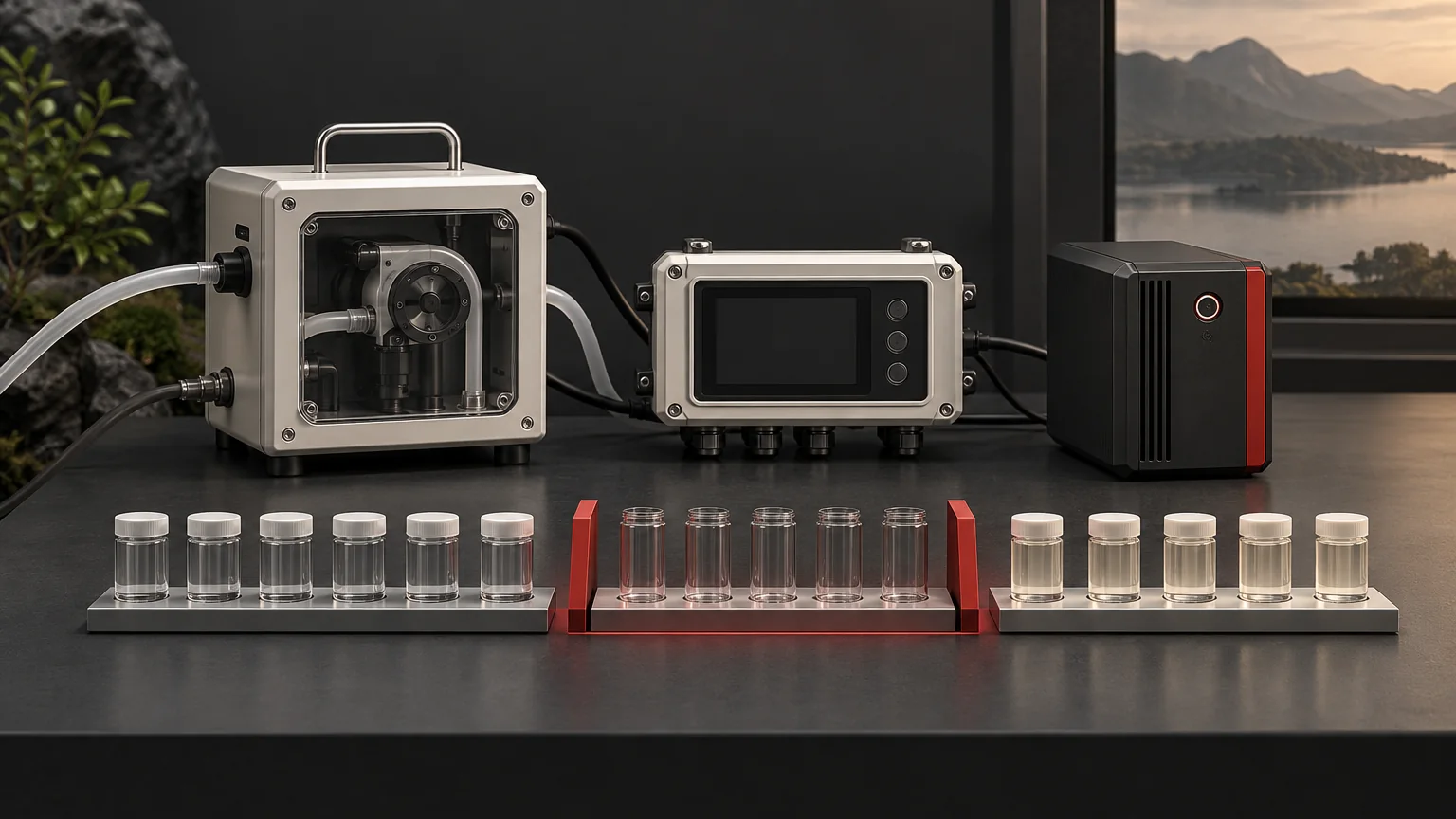
Plan backup around a valid sampling cycle and its stored record. Instrument power, sampling auxiliaries, the logger, timekeeping and communications may have different dependencies. A system can retain old data while collecting no new valid measurements, so runtime alone cannot establish measurement continuity.
Describe one complete sampling cycle
Ask the measurement owner to describe what makes a sample valid. Record the sensing or analysis step, any pump or conditioning equipment, stabilization requirements, timestamp assignment and where the result is committed. Not every monitoring station has every component; include only the dependencies of the actual method.
Highidea's documented environmental-monitoring cabinet application provides a relevant use context. It does not demonstrate that an arbitrary sensor, pump or logger will remain within its measurement requirements on a proposed UPS. Those requirements belong to the instrument and sampling-system documentation.
A useful cycle record identifies the required function, power source, operating demand, permitted interruption and consequence of interruption. The consequence might be a missing sample, an invalid sample, a restart delay or an unavailable upload. These outcomes should not be collapsed into a single “system down” status.
Distinguish retention from continued measurement
Campbell Scientific's CR1000X manual gives a concrete manufacturer example. It distinguishes primary power for operation from an internal battery that supports the clock and SRAM when primary power is absent. Its operating description also explains that measurement operations can be suspended under an unsuitable primary supply.
This shows why a retained clock or readable old record cannot prove ongoing sampling. The example applies to the documented logger; it is not evidence of a particular Highidea/logger pairing or a universal logger behavior.
Function | Question for the responsible supplier |
|---|---|
Sampling or analysis | What conditions make the next result valid after interruption? |
Auxiliary equipment | Must a pump or other dependency continue, stop safely or restart in a defined sequence? |
Logger | Does it continue sampling, buffer results, retain memory only or stop? |
Timekeeping | What clock is used, and what happens when time synchronization is unavailable? |
Communications | Can records be stored locally and uploaded later without losing their original time identity? |
Recovery | Which checks release new results as valid rather than merely showing that equipment restarted? |
Build a sample-status timeline
Use explicit sample states rather than assuming a continuous stream. This hypothetical record assumes the listed power and validity observations have been established by the measurement owner; it describes no particular instrument's tested behavior. T0 is the outage start and the intervals are illustrative.
Sample | Illustrative collection and data-path record |
|---|---|
A | Collection: T0−2 to T0−1 minutes; sampling/auxiliary power available; method validity confirmed; retained in logger; upload complete. |
B | Collection began at T0−1 and was interrupted at T0; required sampling auxiliary unavailable; invalid/incomplete under the assumed method; interruption record retained, no valid measurement uploaded. |
C | Collection: T0+1 to T0+2 minutes; required sampling/auxiliary functions confirmed available on the approved backup arrangement; method validity confirmed; retained locally, upload pending because the uplink is unavailable. |
For a real record add the actual timestamp basis, logger/storage identity, validity decision owner and upload completion time to each sample. A later upload of C does not mean C was measured at upload time.
Keep B marked missing or invalid according to the approved measurement method. Do not fill the interval with an interpolated value and describe it as a measured sample. Whether interpolation is permitted is a separate data-processing decision for the measurement owner.
For each record retain the sample identifier, collection interval, validity flag, original timestamp, storage location and upload status. Unknown timing or validity should remain unknown. A more detailed clock-normalization investigation can be handled separately; this worksheet's purpose is to preserve the sampling outcome.
Check recovery against data quality
A proposed acceptance plan should cover the agreed sampling scenario, local retention and later retrieval. It should also identify a recovery release point: who verifies the instrument is ready and when new samples can again be treated as valid.
A planned test may observe power continuity, recorded samples and communication recovery, but its electrical operations must follow an approved site procedure. Do not interrupt a live environmental or regulated monitoring process simply to demonstrate the worksheet. Some tests may require a representative nonproduction setup or a scheduled authorized window.
Close recovery with a result record the measurement owner can review. Complete it from the approved method rather than treating a restarted display as the result.
Recovery evidence | Record to complete |
|---|---|
Method readiness | Instrument/method revision: __; required sampling and auxiliary conditions: __; readiness evidence and time basis: __. |
First released result | Sample identifier and collection interval: __; method validity decision/owner: __; logger/storage record: __. |
Backlog reconciliation | Missing/invalid sample IDs: __; buffered valid records: __; upload/retrieval result: __; unresolved gaps: __. |
Scope and release | Approved scenario/procedure: __; conditions not tested: __; measurement-owner decision/date: __. |
Record untested conditions, including unusual auxiliary demand, longer outages or environmental limits. A pass under one scenario does not validate every sampling method or operating temperature.
Specify autonomy from the measurement requirement
Send the UPS supplier a load schedule tied to the cycle: continuous demand, intermittent approved auxiliaries and any controlled-stop requirement. Specify whether the objective is continued measurement, preservation of a current cycle or an orderly stop.
Highidea can assess the proposed power requirement using the selected equipment's electrical data. Instrument validity and data-release decisions remain with the measurement owner. This keeps the UPS selection useful without presenting power availability as proof of scientific accuracy.
Primary references
The references support the specific distinctions stated above. Manufacturer examples apply to their documented products; they do not establish the same capability in a Highidea model. Proposed worksheets and hypothetical examples are editorial decision tools, not approved installation or operating procedures.
Campbell Scientific: CR1000X Product Manual
FAQ
Frequently asked questions
If the logger retains its memory, is the outage harmless?
Not necessarily. Existing data may survive while sampling or an essential auxiliary has stopped.
Must the communication link stay powered throughout?
That depends on whether approved local buffering meets the requirement. Confirm the actual logger and retrieval behavior.
Should missing samples be estimated to keep the graph continuous?
Do not present estimates as measurements. Any permitted estimation method and its labeling need separate approval from the data owner.
Related
Products, solutions & further reading.
Put this into practice
Need help specifying the right unit?
Share the load, voltage, runtime, environment and destination for a configuration review.