H, HB, HT and HTT Inverters: Which Features Must Be Specified Separately?
By Highidea Power Engineering Team · 19 October 2026 · 5 min read
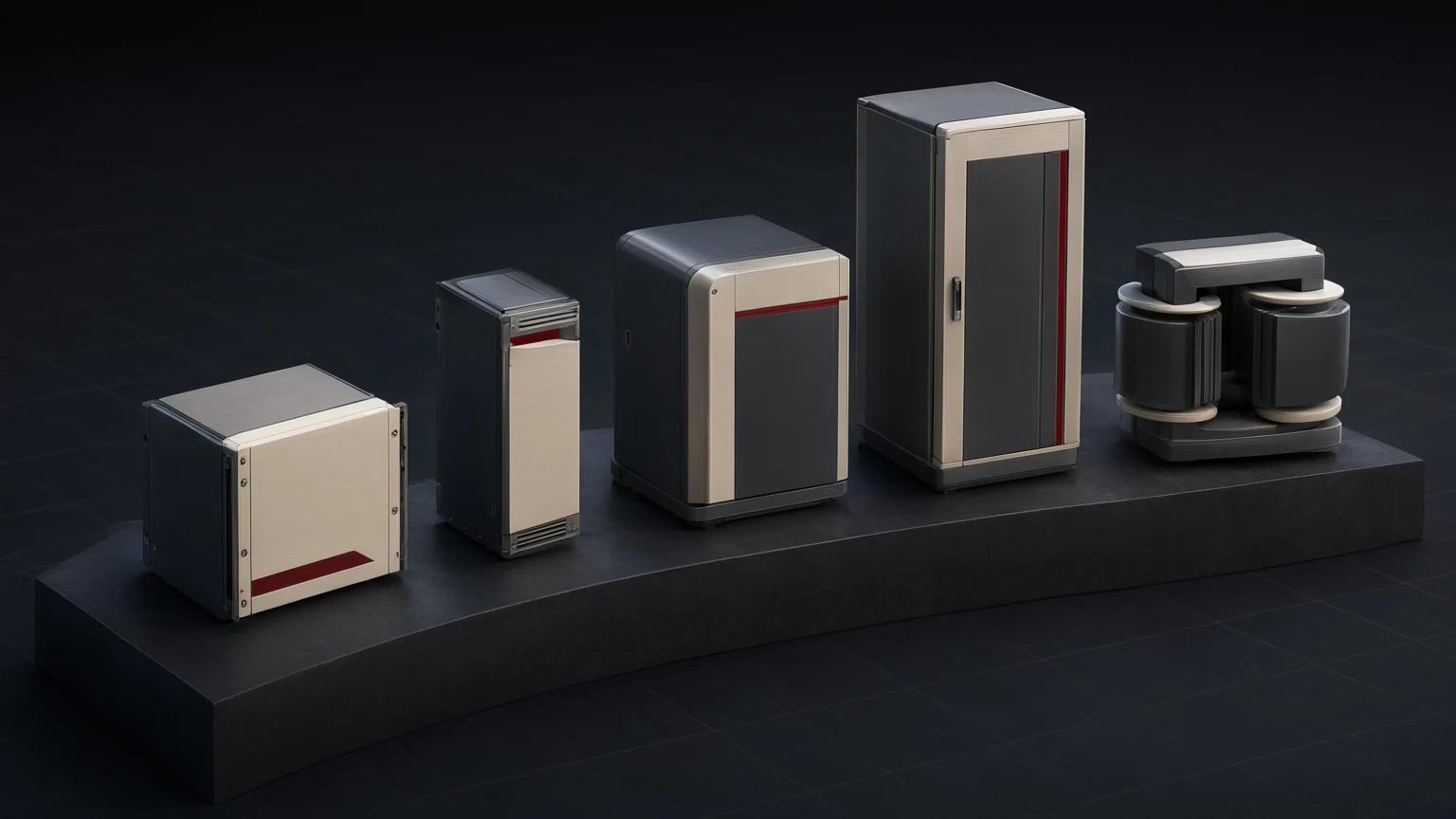
Choose a Highidea inverter by its exact variant, DC source, AC load and required power paths. H, HB, HT and HTT share a family context, but they do not share one universal transfer time, transformer arrangement, enclosure or approval. A shortlist should show what each proposed variant establishes and which project conditions still need a model-specific answer.
Start with the station source and the load
An inverter converts DC into AC. In a station with an existing battery-backed DC plant, it can supply AC equipment without creating a second independent battery system. An AC/DC dual-input arrangement adds operating paths that must be described: the normal source, the backup source and what the load sees when either becomes unavailable.
Record the actual DC operating range, not only a label such as 48 V or 220 V. Include the battery plant's charging and discharge conditions and protection thresholds. Then state the AC load in watts and VA, its starting demand, required voltage and frequency, and permitted interruption. A capacity match alone leaves source compatibility unresolved.
Keep the variant matrix bounded
The following is a family-level orientation from Highidea's product documentation. A row does not mean every listed capacity is available with every input voltage, phase arrangement or option.
HTB is a separately named backup-inverter family. It should not be treated as an alternative spelling of HT. Ask for the complete model code rather than accepting a quotation line that says only “H-series inverter.”
Variant | Details and decision |
|---|---|
H | Documented distinction: Base 1–10 kVA family; online AC/DC dual-input inverter; What needs a separate answer: Exact DC input option, operating modes and transfer conditions |
H Pro | Documented distinction: H6K-220 and H10K-220 with an external isolation transformer; What needs a separate answer: Transformer scope, placement, mounting and complete installed dimensions |
HB | Documented distinction: HB5K and HB6K documented; dual operating modes with a stated transfer below 8 ms; What needs a separate answer: Which source-change event the rating covers and load tolerance |
HT | Documented distinction: Documented 1–40 kVA industrial-frequency isolated family with single/three-phase variants; What needs a separate answer: Exact phase arrangement, transformer path and event-specific transfer behavior |
HTT | Documented distinction: Documented 10–120 kVA integrated cabinet family; What needs a separate answer: Cabinet contents, usable rating, distribution, access and installation responsibilities |
Replace a single transfer number with an event record
The base H documentation states zero-time DC/AC transfer, while HB documentation states a non-zero transfer limit. These statements are not a promise about every path through every variant. For HT, a pair of transfer figures without a clearly identified event is insufficient for deciding equipment compatibility; obtain the relevant path description before applying a number.
Testing must be planned and carried out by qualified personnel. The purpose of the record is to make the offered behavior answerable, not to encourage an operator to disconnect live supplies or defeat protection.
Event to specify | Details and decision |
|---|---|
Normal AC becomes unavailable | Question for the supplier: Which source and converter feed the load next?; Evidence to retain: Mode diagram and interruption result |
DC reaches its permitted limit | Question for the supplier: Does the output stop, change source or alarm?; Evidence to retain: Threshold definition and observed sequence |
Preferred source returns | Question for the supplier: Is retransfer automatic, delayed or manual?; Evidence to retain: Recovery conditions and load behavior |
Inverter cannot support the load | Question for the supplier: Is a bypass available, and under what conditions?; Evidence to retain: Source limits, transfer restrictions and protection coordination |
Follow isolation through the complete path
A transformer or isolation statement must be located on the drawing. H Pro explicitly identifies an external transformer; its dimensions and installation scope therefore cannot be reduced to the inverter chassis. For another variant, ask whether isolation exists on the inverter path, bypass path, both, or neither for the required configuration.
The project's grounding and protection design also needs the exact arrangement. An isolated conversion path does not automatically establish the same separation when a different source feeds the output. Likewise, “zero backflow” language in product material should not be expanded into a blanket statement about every disturbance, leakage condition or installation. Obtain the interface requirement and the manufacturer's applicable evidence.
Check physical and electrical interfaces together
Rack and cabinet products lead to different installation tasks. Reserve rail or floor support, airflow, connection space and service access for the complete assembly. Do not fill an unspecified dimension or weight from a neighboring model. An integrated cabinet may include components that would be separate line items in a rack quotation; identify them in the bill of materials.
For monitoring, distinguish the standard interface from optional dry contacts, RS485/Modbus or network functions. Request the exact protocol and alarm list needed by the site's monitoring system. A family listing for an interface does not prove that a quoted unit includes the required card or configuration.
Close the quotation with an exact configuration
Use a configuration record containing the full model and suffix, DC range, AC input if used, AC output, VA/W rating, phase arrangement, transformer and bypass drawing, event-specific performance, mounting scope and monitoring options. Put deviations beside the requirement rather than burying them in a general catalogue.
Ask for model-scoped conformity documents where required by the project. A statement associated with H3K-48, for example, should not be copied to an HTT cabinet. Product-family names help organize a discussion; final selection depends on the offered configuration and the evidence that covers it.
For a Highidea review, send the DC plant limits and the load's supply requirements first. That allows the engineer to identify a suitable H, HB, HT or HTT route without assuming that a larger enclosure or a familiar family name automatically provides the required behavior.
Sources and product context
The following primary references support the industry context. They do not establish conformity, compatibility or performance of every Highidea product. Model-specific product statements in this guide follow the cited Highidea product and application records.
Vertiv: Inverter systems supplying AC loads from DC telecom infrastructure
FAQ
Frequently asked questions
Does every H-family variant have zero transfer time?
Do not apply one family statement to every variant or operating event. Base H and HB documentation differ, and exact source-change, bypass and recovery behavior must be identified for the offered model.
Is an external transformer included in chassis dimensions?
No. A quoted H Pro arrangement identifies an external isolation transformer, so its space, mounting and connection scope must be included separately in the complete installation.
Are HT and HTB the same family?
No. HTB is a separately named backup-inverter family. Request the full model code and applicable specification rather than treating the names as interchangeable.
Related
Products, solutions & further reading.
Put this into practice
Need help specifying the right unit?
Share the load, voltage, runtime, environment and destination for a configuration review.