Why Marine & Mining Need Specialty-Voltage UPS
By Highidea Power Engineering Team · 3 June 2026 · 6 min read
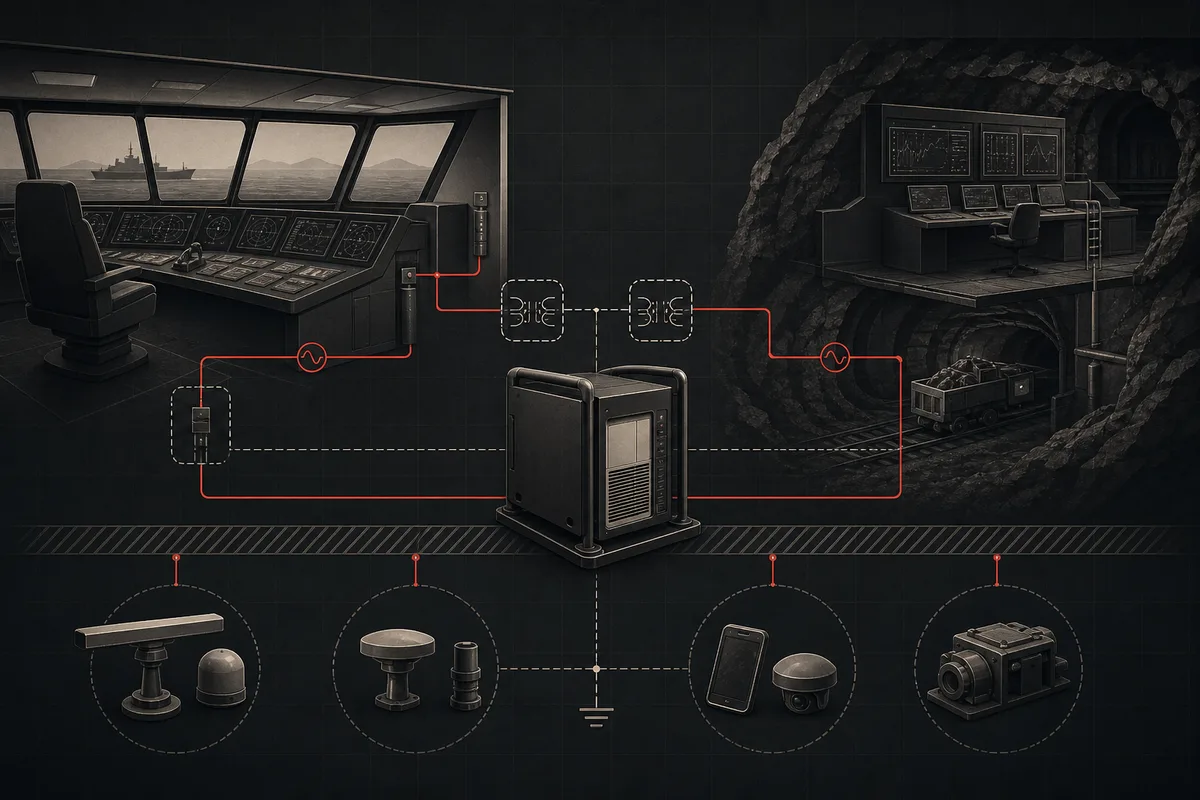
Marine and mining use specialty voltages for safety and isolation. Ships run 110 V AC/DC dual-supply systems, so a shipboard UPS must provide fully isolated input and output, three-proofing against moisture, salt-mist and mould, and 0 ms dual conversion for sensitive loads like ECDIS navigation. Coal mines use 127 V because a lower voltage reduces leakage and short-circuit risk in the damp, conductive underground environment — a safety standard — and the UPS must withstand dust, damp, vibration and EMI with fast, seamless switchover. Standard 220–240 V UPS do not meet either requirement.
Specialty voltage is a safety decision
In most settings you match a UPS to the local mains voltage. Marine and mining are different: the voltage itself is chosen for safety and isolation, and the UPS must be built for a genuinely hostile environment. That is why a standard data-centre UPS cannot simply be dropped into a ship or a mine.
Marine: 110 V, isolated, light and salt-proof
Ships and offshore platforms run 110 V AC/DC dual-supply systems, so a shipboard UPS must have fully isolated input and output. Sensitive navigation loads such as ECDIS (electronic chart display and information systems) need 0 ms AC-DC/DC-AC dual conversion. The salt-mist, humid environment demands three-proofing — protection against moisture, salt-mist and mould — plus a dedicated air-duct design, and weight must be kept low aboard ship.
In a real deployment, a vessel powered its ECDIS navigation with a compact 110 V LiFePO4 marine UPS (LT1000-110) delivering roughly 3.5 hours of runtime at about 8 kg, with more than 2,000 cycles — far lighter than a lead-acid equivalent of similar autonomy.
Mining: 127 V for leakage safety
Coal mines and underground sites use 127 V because a lower voltage reduces the risk of leakage and short circuits in the damp, conductive mine environment — a safety standard, and also a long-standing regional infrastructure norm. The UPS keeps ventilation, drainage, hoisting, safety-monitoring, personnel-positioning and communications systems running through grid faults, preventing accidents such as gas accumulation and avoiding data loss.
How to specify
- Confirm the system voltage — 110 V (marine, imported equipment) or 127 V (coal mine).
- Choose topology: online double-conversion (D-series) for sensitive 0 ms loads; line-interactive (LT/MT) for cost-sensitive, less-critical 110 V loads.
- Specify environmental protection: three-proofing for marine; dust/damp/vibration/EMI hardening for mining.
- Size the LiFePO4 pack to the runtime and weight envelope, and add remote monitoring.
FAQ
Frequently asked questions
Why do ships use 110 V isolated UPS?
Ships and offshore platforms run 110 V AC/DC dual-supply systems, so the UPS must provide fully isolated input and output and deliver 110 VAC. Sensitive navigation loads such as ECDIS also need 0 ms AC-DC/DC-AC dual conversion for uninterrupted, clean power.
Why do coal mines use 127 V UPS?
127 V is a safety voltage standard: a lower voltage reduces leakage and short-circuit risk in the damp, conductive mine environment. It is also a long-standing regional infrastructure norm. The UPS must additionally withstand dust, damp, vibration and EMI with fast, seamless switchover.
Can a standard UPS be used on a ship or in a mine?
No. Standard 220–240 V UPS do not provide the specialty voltage, full isolation or environmental hardening these settings require. Use a 110 V isolated marine UPS or a 127 V ruggedised mine UPS designed for the environment.
Related
Products, solutions & further reading.
Put this into practice
Need help specifying the right unit?
Share the load, voltage, runtime, environment and destination for a configuration review.