Does an Online UPS Also Convert Frequency?
By Highidea Power Engineering Team · 20 October 2026 · 4 min read
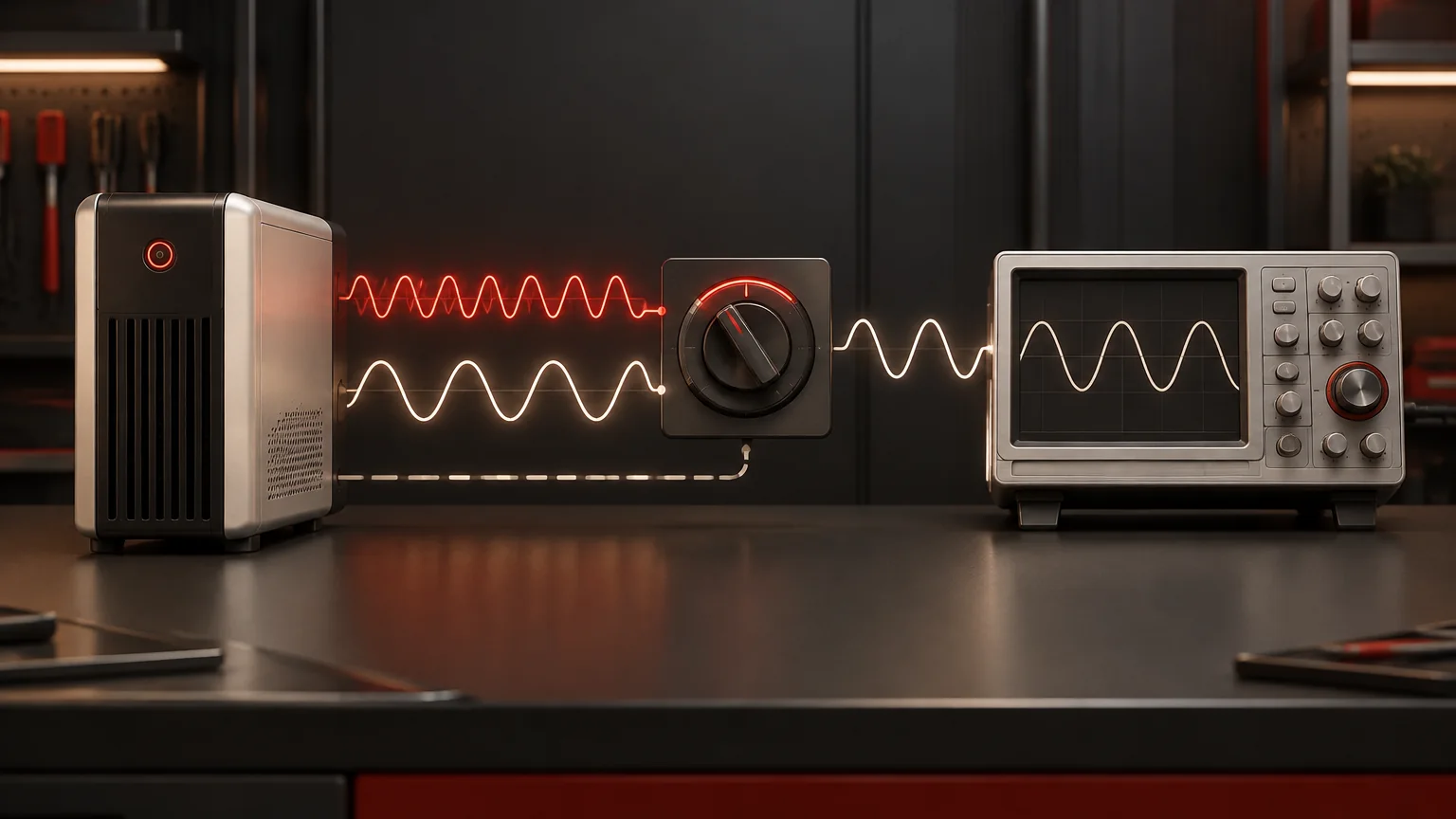
Online double conversion describes a power-conversion path, not a guarantee of fixed-frequency conversion. Automatic 50/60 Hz detection, synchronization and an explicitly supported converter mode are different behaviors. Confirm the exact mode, output limits and bypass behavior before proposing different input and output frequencies.
Separate five behaviors that sound similar
A UPS can accept a range of input frequencies without being specified to supply an independently chosen output frequency in every operating mode. Likewise, a selectable nominal frequency does not explain when that selection takes effect or which transfers remain available.
Use the following distinctions when reading a quotation. They describe questions to resolve, not a claim that one product implements every behavior.
Description | What it establishes—and what it leaves open |
|---|---|
Online double conversion | A rectifier/DC/inverter architecture in the relevant operating mode; fixed-frequency capability still needs documentation. |
Automatic frequency detection | Recognition of an input frequency; not necessarily conversion to a different frequency. |
Synchronization | The inverter follows an acceptable source for specified transfer behavior; ask about its permitted window. |
Battery-mode frequency | Output behavior while on battery; it may not describe normal or bypass operation. |
Converter mode | An explicitly documented mode for the required input/output frequency pair, with its own limits. |
Highidea's ET product information includes automatic 50/60 Hz adaptation. That statement alone is insufficient evidence for a project requiring, for example, 50 Hz input and fixed 60 Hz output.
Ask for an explicit mode statement
A useful response identifies the exact model, hardware or firmware revision where relevant, required source range and supported output frequency. Request the manual section that establishes the capability. Avoid accepting an isolated screenshot or a family-level feature list as the complete specification.
CyberPower's discontinued OL6000RT3U is a manufacturer example of the distinction: its product page lists Double-Conversion Topology and Converter Mode as separate features. The latter explicitly describes setting output frequency independently of input frequency. This historical example is not a product recommendation, nor evidence of the same capability in a Highidea model.
The supplier should also identify which configuration is approved for the connected equipment. A correct frequency does not establish correct voltage, usable power, waveform or installation compatibility.
Review bypass and usable capacity in the same matrix
If a project requires different input and output frequencies, ask how each bypass path is handled. A bypass path that exposes the load to the source cannot simply be assumed equivalent to the inverter's fixed-frequency output. Whether bypass is available, inhibited or subject to other constraints is model-specific.
Copy the following supplier-response matrix for the selected configuration. Complete input/output frequency in Hz, output voltage in V and available power in kW or kVA as applicable. Each row remains unresolved until supported by the exact model's documentation; a mode explicitly excluded from the design should be marked excluded with its approval reference.
Operating state | Supplier response to complete |
|---|---|
Normal operation | Input: __ Hz; load: __ Hz / __ V; available capacity/derating: __; transfer constraints: __; evidence/status: __. |
Battery operation | Load: __ Hz / __ V; available capacity/derating: __; transition constraints: __; evidence/status: __. |
Static bypass | Source: __ Hz; load: __ Hz / __ V; available capacity: __; permitted/inhibited conditions: __; evidence/status: __. |
Maintenance arrangement | Supply path: __; load: __ Hz / __ V; permitted capacity/interruption: __; design approval/status: __. |
Recovery | Resulting mode/frequency: __; capacity and transition constraints: __; evidence/status: __. |
An unsupported operating mode must not inherit the normal-mode rating in this record.
Any converter-mode derating must come from the selected product's documentation. Do not apply a percentage from another manufacturer or infer that bypass remains available because a bypass switch appears in a photograph.
Work the requirement before choosing a model
Suppose a hypothetical site offers 50 Hz power while an instrument supplier requires fixed 60 Hz. The first decision is whether the instrument's documented supply tolerance genuinely requires conversion. If it does, the acceptance question becomes whether the complete proposed supply chain maintains that requirement through all permitted operating states.
A proposal that demonstrates 60 Hz only while on battery has not answered the normal-operation requirement. A proposal with an unassessed maintenance path has not resolved the service scenario. These gaps call for engineering review, not an improvised setting change.
Record the instrument requirement, required operating states, mode evidence and each remaining limitation on one page. No live source transfer or menu changes are needed to establish that the paperwork is incomplete.
Freeze a configuration, not a phrase
Send Highidea the required input/output voltage and frequency pair, load demand, equipment tolerance and permitted interruption. Ask for a written configuration response identifying supported modes and exclusions.
If the evidence does not establish the required conversion, keep the proposal open or evaluate a supplier-approved alternative. Do not treat “online,” “automatic” or “50/60 Hz” as substitutes for the missing mode specification.
Primary references
The references support the specific distinctions stated above. Manufacturer examples apply to their documented products; they do not establish the same capability in a Highidea model. Proposed worksheets and hypothetical examples are editorial decision tools, not approved installation or operating procedures.
CyberPower: OL6000RT3U product features (discontinued model)
FAQ
Frequently asked questions
Does a transformer change 50 Hz into 60 Hz?
An ordinary voltage transformer changes voltage, not frequency. A required change from 50 Hz to 60 Hz needs a separate, explicitly specified frequency-conversion solution.
Can battery operation prove converter-mode suitability?
Not by itself. The required normal, battery, bypass and service states must be assessed separately.
Should I enable a hidden converter setting to check?
No. Obtain the exact model's approved configuration and test procedure before changing settings or exposing a load to a different supply.
Related
Products, solutions & further reading.
Put this into practice
Need help specifying the right unit?
Share the load, voltage, runtime, environment and destination for a configuration review.