Does a UPS Replace Building-Level Surge Protection?
By Highidea Power Engineering Team · 20 October 2026 · 4 min read
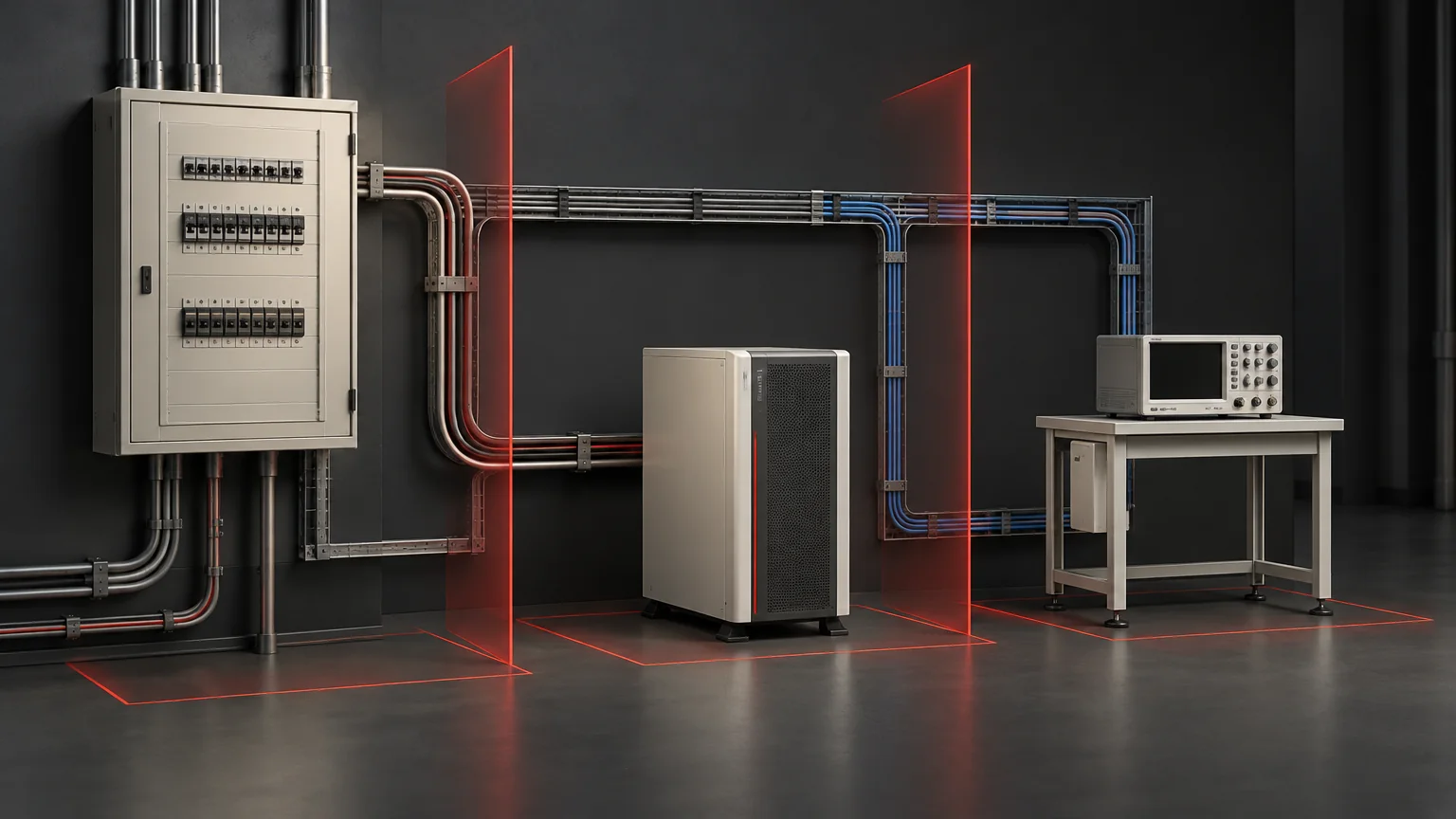
Buying a UPS does not by itself complete a building's surge-protection design. Separate continuity, the UPS's documented internal protection, distribution-level surge protective devices and any relevant data-line paths. The responsible designer must review their coordination and the actual installation; a UPS name is not a lightning-immunity claim.
Give continuity and surge protection different questions
A UPS is selected in part for what it supplies when input conditions change or disappear. Surge protection addresses transient overvoltages within a designed protection arrangement. A product can include a surge-related feature without replacing every other protective measure upstream or downstream.
Highidea product information contains model-specific protection descriptions. Read their scope and supporting documents rather than turning a feature phrase into a site-wide guarantee. Online topology alone does not establish the building's complete protective arrangement.
Schneider Electric's FAQ on selecting an SPD for an entire installation discusses installation requirements, device characteristics and coordination, and points readers to its design and installation guides. This supports treating surge protection as an installation design issue. A manufacturer's guide is not proof of the latest law in every destination market.
Draw protection boundaries by path
List the relevant power and signal paths and assign each a design owner. A network or external signal path should not disappear from consideration merely because the main power passes through a UPS.
Boundary | Evidence request for the responsible designer or supplier |
|---|---|
Building incoming/distribution power | Applicable site protection design and its coordination basis. |
UPS input and internal protection | Exact model documentation and the stated scope/conditions of protection. |
Bypass and service paths | Whether the design remains suitable in each permitted operating arrangement. |
UPS output to the load | Relevant downstream equipment requirements and coordination assessment. |
External signal/data paths | Whether additional protection is required for the actual interfaces and exposure. |
Installation and maintenance | Responsible qualified party, approved drawings and inspection obligations. |
This is a responsibility matrix, not an SPD selection or wiring schedule. It gives no universal device type, rating, conductor size or installation distance.
Find the gap between two reassuring statements
Consider a hypothetical project in which the UPS quotation says it includes surge protection, while the installer assumes the buyer has approved the building-level design. Both statements might be accurate within their own narrow scope, yet neither party has documented the actual interface.
The gap is closed by identifying who evaluates the complete path, what documents they use and which requirements remain unresolved. It is not closed by repeating a component rating from a brochure.
Keep an interface issue assigned until the responsible parties agree its disposition. If a bypass arrangement or building supply changes, review the affected protection boundary rather than relying on the original UPS quotation.
Ask for evidence without inventing a universal recipe
Provide the installation designer with the site and equipment information needed for the actual assessment. Request the applicable local requirements, selected-device documents and coordination decision. Ask the UPS supplier for the selected model's relevant characteristics and permitted operating arrangements.
Do not infer immunity from a joule figure or a marketing lightning-protection description. Nor should a general article direct someone to open a panel, install an SPD or modify bonding. Such work requires competent design and authorized qualified installation.
If the evidence is unavailable, describe the protection arrangement as unverified. Absence of a document is not proof that an installed protective device is absent, but it is a reason not to claim the design is complete.
Keep acceptance tied to the approved installation
The final handover should identify the equipment and drawing revisions, design responsibility and required inspection records. Distinguish the UPS supplier's product evidence from the site designer's installation approval.
When approaching Highidea, send the power requirements and protection-interface questions together. The useful commercial outcome is a clear statement of product scope that the installation designer can evaluate—not a promise that the UPS makes every connected path immune to transients.
Primary references
The references support the specific distinctions stated above. Manufacturer examples apply to their documented products; they do not establish the same capability in a Highidea model. Proposed worksheets and hypothetical examples are editorial decision tools, not approved installation or operating procedures.
Schneider Electric: How to select an SPD - Surge Protection Device or surge arrester for an entire installation?
FAQ
Frequently asked questions
Does double conversion guarantee lightning protection?
No. Topology does not establish complete surge coordination or immunity under every event.
Can I choose an SPD from the UPS kVA rating alone?
No. The actual installation and applicable requirements need a qualified design assessment.
Does a UPS protect an unassessed data cable entering the system?
Do not assume so. Include relevant non-power paths in the responsible designer's boundary review.
Related
Products, solutions & further reading.
Put this into practice
Need help specifying the right unit?
Share the load, voltage, runtime, environment and destination for a configuration review.