Will This Rack UPS Fit Your Cabinet?
By Highidea Power Engineering Team · 20 October 2026 · 5 min read
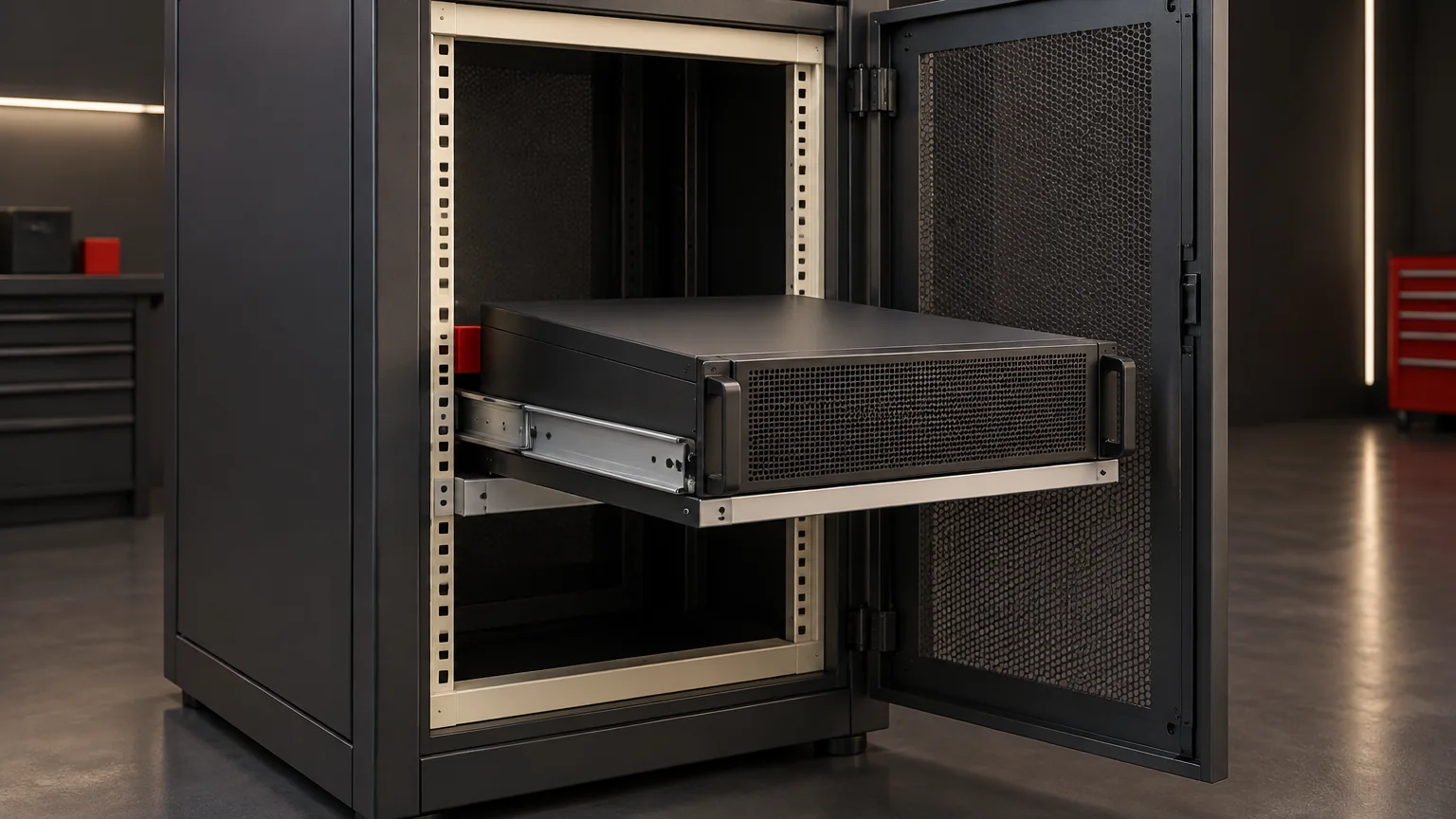
A 19-inch label does not establish cabinet fit. Approve the exact UPS, mounting hardware and cabinet together, using mounting-plane spacing, supported mass, connector space and service access. Chassis depth describes the enclosure; it does not include every space needed to install, cable and remove it.
Measure the mounting planes, not the cabinet label
A cabinet's outside depth and the distance between its mounting posts are different measurements. Doors, vertical power distribution units and cable managers can reduce the usable envelope further. Record dimensions from a defined reference plane rather than collecting unrelated numbers from catalogues.
Highidea's ET1-3KR documentation illustrates why the exact variant matters: ET1KR is listed at 440 × 88 × 300 mm, while ET2KR and ET3KR are listed at 440 × 88 × 540 mm. These are chassis dimensions for the named configurations, not minimum cabinet depths. Confirm the ordered revision and its drawing before using them in an installation plan.
Ask the cabinet owner for a measured drawing with the front and rear mounting planes, closed-door positions and permanent obstructions. A photograph is useful context but cannot replace dimensions or a support rating.
Verify the support system separately
The mounting ears, rails, shelf and cabinet frame do different jobs. Obtain the UPS manufacturer's approved support arrangement and check it against the cabinet manufacturer's permitted mounting configuration. Include the host, installed batteries and any separate battery modules in the mass schedule; do not assume all weight rests on the same support.
CyberPower's Smart App Sinewave series manual provides an instructive manufacturer example: it distinguishes two-post, four-post and tower arrangements and their accessories. Those instructions belong to the listed CyberPower models. They demonstrate the need for an exact mounting method; they do not approve a rail kit for Highidea equipment.
Copy this fillable fit record for one exact pairing. Enter values and units from the named drawings; an empty evidence field means the decision remains open.
Decision cell | Complete for this pairing |
|---|---|
Identity and datum | UPS/revision: __; cabinet: __; drawing: __; front reference plane: __. |
Mounting-post span | Measured span: __ mm; approved rail adjustment range: __ to __ mm; evidence: __; result: __; owner: __. |
Rear envelope | Available behind datum: __ mm; chassis rearward projection: __ mm; connection allowance: __ mm; total required: __ mm; evidence: __; result: __; owner: __. |
Front door | Available from datum to closed door: __ mm; required front projection/access: __ mm; evidence: __; result: __; owner: __. |
Supported mass | Installed mass on this support: __ kg; permitted mass in this arrangement: __ kg; support reference: __; result: __; owner: __. |
Cooling and service | Supplier-required envelope: __; measured available envelope: __; units/drawing: __; result: __; owner: __. |
Release | Confirmed/failed/awaiting evidence: __; ordering hold: __; supplier/cabinet-owner decision references: __. |
Reserve an envelope beyond the chassis
Mark the connector and cable envelope on the same drawing. Rear plugs, terminal covers, strain relief and cable bend requirements can occupy space behind a shallow enclosure. Cooling clearance and removal access are additional requirements, not spare space available for cabling.
Treat each constraint independently. Passing a depth check does not establish sufficient airflow, cabinet stability or a safe service route. The installer and equipment supplier must approve those requirements for the actual product; this guide supplies no universal clearance or fastening specification.
Work a fit rejection before placing the order
Consider a hypothetical pairing with 600 mm available behind the front mounting plane. For this example only, the drawing is assumed to show a 540 mm chassis projection rearward from that same mounting plane, plus an approved 80 mm rear connection envelope. The combined requirement is 620 mm, so the pairing fails that envelope check by 20 mm even though the cabinet is advertised as deeper externally.
The 80 mm allowance and 600 mm available space are illustrative assumptions, not Highidea installation limits. A different connector arrangement might change the assessment, but it requires a revised approved drawing. Do not solve the mismatch by bending cables more tightly, leaving a door open or substituting unsupported rails.
Extend the fit review to a short-depth three-phase proposal
A shallow electrical room needs a complete installed-envelope review, not only a shorter host. Highidea lists an ET 10–40K short-depth rack online UPS route with external batteries, three-phase input/output and 380/400/415 VAC output choices. Use that family identity to begin a configuration discussion; obtain the selected model's dimensioned drawing before deciding that the room fits.
Do not substitute the ET1KR or ET2KR chassis figures above for a three-phase host. Likewise, do not transfer dimensions, battery limits or parallel capability from 33ET to another family with a similar capacity label.
Layout item | Add to the same drawing |
|---|---|
UPS position | Selected host drawing, support arrangement, terminals and cable/service envelope. |
External storage | Approved battery arrangement, full enclosure dimensions and mass, connections and access. |
Room and delivery route | Closed doors, installed obstacles, movement path and the required working/service spaces. |
Cooling | Equipment airflow and heat information matched to the complete room arrangement. |
For a hypothetical room, moving batteries outside the host may reduce the host depth yet leave the total installation larger. Compare the full layout and the delivery route before selecting the alternative. An empty battery-space or clearance field is an open design decision, not usable spare room.
Send Highidea the room drawing, required input/output, load and runtime target. Request a proposed host-and-storage layout with the exact drawings and installation requirements so the supplier and site designer can make one pairing-specific decision.
Issue a pairing-specific fit decision
Return a single fit sheet to the UPS supplier and cabinet owner. Give each requirement a status of confirmed, failed or awaiting evidence; attach the drawing that supports it. Identify who resolves each open item and whether ordering or installation must wait.
Keep the approval tied to one equipment-and-cabinet pairing. A later battery addition, PDU relocation or cabinet change can invalidate it. Send Highidea the completed drawing and support requirements so the recommendation addresses the installed envelope, rather than only rack width or U-height.
Primary references
The references support the specific distinctions stated above. Manufacturer examples apply to their documented products; they do not establish the same capability in a Highidea model. Proposed worksheets and hypothetical examples are editorial decision tools, not approved installation or operating procedures.
CyberPower: Smart App Sinewave UPS Series User Manual: PR750RT2UC–PR3000RT2UC and PR750RTXL2UC–PR3000RTXL2UC
FAQ
Frequently asked questions
Does a two-unit height establish cabinet compatibility?
No. Height does not establish mounting depth, supported mass, cable clearance, cooling or service access.
Can I reuse the rails from an older UPS?
Only with explicit compatibility evidence for the replacement equipment and cabinet. Similar dimensions are not sufficient approval.
Does this worksheet authorize installation?
No. It organizes the evidence for the responsible supplier, cabinet owner and qualified installer to approve the actual arrangement.
Related
Products, solutions & further reading.
Put this into practice
Need help specifying the right unit?
Share the load, voltage, runtime, environment and destination for a configuration review.