Regenerative Loads Need More Than a Larger UPS Rating
By Highidea Power · 23 October 2026 · 3 min read
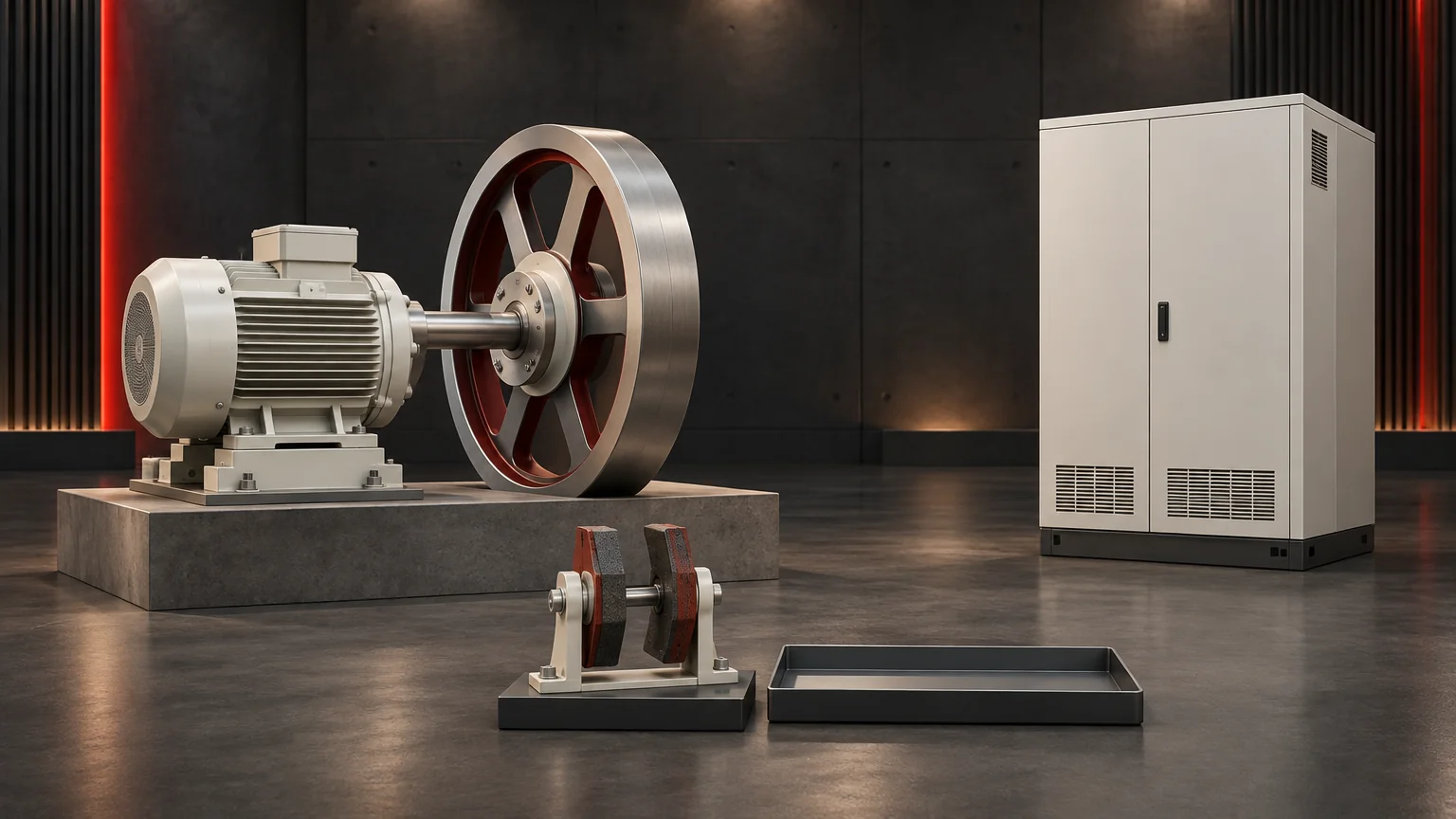
A load can return energy as well as consume it. A regenerating drive during deceleration poses a different question from motor-start inrush: where can the reverse energy go in each permitted supply state? A larger forward kVA rating does not establish that a UPS can absorb the event. Obtain a system-level response from the drive and UPS suppliers before accepting the pairing.
Draw the energy direction for each event
For normal motoring, the drive and motor consume energy from the supply. During a supported regenerative operating event, mechanical energy can return through the drive's power-conversion arrangement. The exact path depends on the drive design and any installed braking or regeneration equipment.
A rectifier front end, a regenerative front end and a drive with a specified braking arrangement should not be treated as identical loads. Record the actual configuration instead of deciding from the word “motor.” The load manufacturer must identify which events return energy toward the supply and which manage it elsewhere.
Riello describes regenerative energy reaching a UPS DC bus and causing overvoltage, shutdown or bypass transfers if it is not properly managed. Its dedicated absorber is a product-specific solution. That example supports asking about reverse energy; it does not establish a Highidea absorption capability or authorize adding a similar device.
Build an event description the supplier can answer
Event input | Information to obtain |
|---|---|
Direction and boundary | Where reverse power is reported or measured, and which converter stages are between that boundary and the UPS. |
Magnitude and time | Reverse-power profile, event energy, duration, repetition and evidence source. |
Supply state | Normal source, battery operation, any permitted bypass and restoration conditions. |
Existing management | Exact supported braking/regeneration equipment, its duty and the load manufacturer's requirements. |
Required outcome | Permitted voltage behavior, process response, protection action and verification scope. |
Keep forward starting demand in the same project file, but in a different event row. An acceptable startup does not answer a braking event.
Explain why power and energy both matter
For an invented constant event, 2 kW returned for 3 seconds represents 2 × 3/3,600 ≈ 0.00167 kWh, or about 1.67 Wh. That small energy number does not make the event harmless: the receiving path must still accommodate its power, timing and voltage behavior.
A short high-power pulse and a longer lower-power event with equal energy can impose different constraints. Repeated events can also create a duty that a single-event demonstration does not establish. Real waveforms and the supplier's applicable limits replace this simple calculation.
These figures are explanatory, not a suggested test, a permitted reverse-power limit or a Highidea result.
Check the unavailable-source case explicitly
A solution that depends on exporting energy to an upstream source needs that source and export path to be available under the required conditions. Ask what changes when the UPS is battery-supported or the external source is absent. Do not assume that the UPS battery will absorb the returned energy; charging permission, topology and controls must support such a claim.
Bypass is also not a generic remedy. Its availability and the load's resulting supply conditions require separate approval. A transfer that preserves energization but violates the process requirement is not automatically an acceptable outcome.
Release the complete arrangement, not an isolated component
Have the machine/drive owner, electrical designer and UPS supplier identify their respective limits and the supported overall configuration. Retain the event profile, approved management arrangement, source-state matrix, protection response and authorized verification method.
Do not remove braking equipment, force regenerative events on production machinery, alter safety functions or install an absorber from a generic diagram. Testing and modifications require the exact equipment procedures and responsible approvals.
Send Highidea the forward and reverse event profiles through our contact page. The engineering discussion can then distinguish an ordinary starting-capacity request from a genuinely bidirectional system question.
References
Related reading
FAQ
Frequently asked questions
Does every motor return energy to the UPS?
No. The drive topology, operating task and installed energy-management arrangement determine the path. Obtain the actual load documentation.
Does more battery capacity prove absorption capability?
No. Storage quantity does not establish an approved reverse-energy route or charging behavior.
Can a successful mains-fed test cover battery operation?
Only if its evidence genuinely covers the required state. A changed upstream energy destination can change the result.
Put this into practice
Need help specifying the right unit?
Share the load, voltage, runtime, environment and destination for a configuration review.