Solar-Station Auxiliary UPS vs Grid-Storage Functions
By Highidea Power · 23 October 2026 · 3 min read
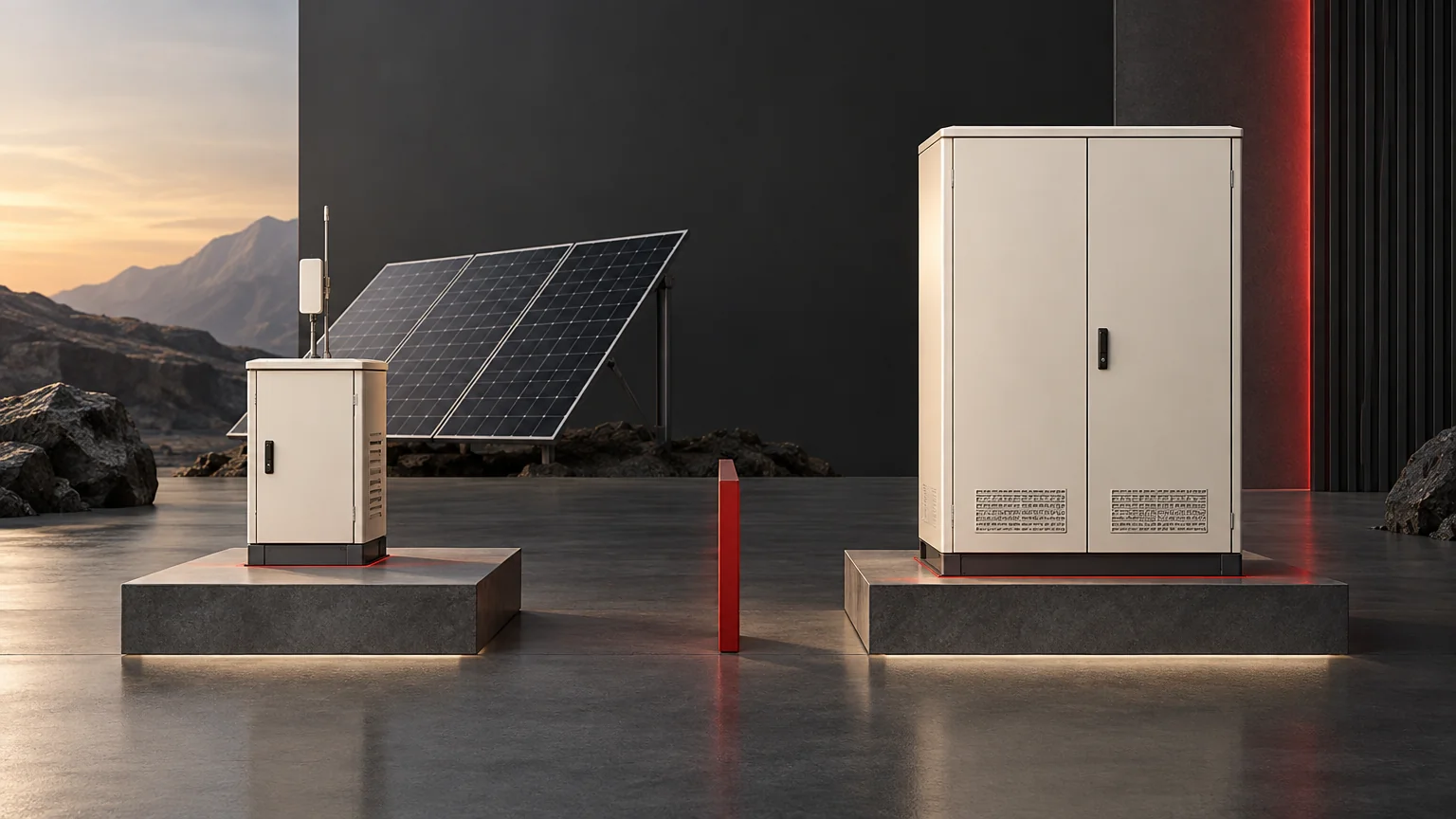
Define a solar site's backup task by the service it must retain. Keeping controls, communications or an approved actuator available is an auxiliary-power task. Exporting generation, charging a storage plant, supporting grid services or forming an island are different functions. A UPS or inverter name alone does not establish that one product performs all of them.
Name the service before naming the cabinet
A solar site can contain devices with very different power responsibilities. A data-acquisition cabinet may need enough time to retain records and report an event. A control system may depend on field supplies and communications. A storage power-conversion system may have charging, dispatch and grid-interface duties.
List each required function and its inputs, outputs, energy source and authorized operating states. The physical location in the same station does not make those functions interchangeable. A battery in an auxiliary UPS is not automatically part of the site's dispatchable storage capacity.
The U.S. Department of Energy describes conversion, grid services and grid-following versus grid-forming behavior separately. Those concepts explain the functional boundaries. They do not approve a particular station architecture or establish those capabilities in a Highidea product.
Use a function-boundary matrix
Intended function | Requirement that needs its own evidence |
|---|---|
Auxiliary controls and communications | Identified W/VA, dependencies, duration, allowed interruption and controlled restoration. |
Generation export | Approved generation/grid interface and the applicable operating and protection conditions. |
Storage charging and dispatch | Supported battery interface, bidirectional conversion and control requirements for the actual system. |
Islanded operation or grid forming | Explicitly supported source-reference, protection, transition and operating architecture. |
Field action | The particular actuator, supply, task duration and process/safety authorization. |
A quotation for the first row must not silently inherit the other rows. Conversely, a large storage plant does not by itself prove that a small control device has a protected supply through every required event.
Trace energy and information separately
For the auxiliary task, identify the source feeding its power converter or UPS, the stored-energy arrangement and the devices that remain energized. Beside that, trace the communications and control path. A live controller with an unpowered network dependency may fail its task even while its screen remains on.
If the proposal draws from a station DC bus, retain other loads sharing that source. Dedicated AC conversion does not create an independent battery reserve. Our station inverter and telecom architecture guides develop that shared-energy point.
This is a functional review, not a connection diagram. No output should be connected to a grid or another inverter based on a generic architecture sketch.
Compare two hypothetical site duties
Site A requires a controller, network link and logger to remain available long enough to save and communicate records after an upstream outage. Its enquiry needs the complete auxiliary load, energy duration, communication dependency and recovery evidence.
Site B requires the facility to continue energizing a local island while generation and storage are coordinated. That enquiry needs a supported island architecture and the corresponding control, protection and operating approvals. Demonstrating Site A's task cannot establish Site B's capability.
Neither case specifies a Highidea implementation. They show why “backup for a solar station” is too broad to form one equipment requirement.
Set separate acceptance results
For auxiliary continuity, agree which service is observed, for how long, under which source event and with which safe method. For grid or storage functions, use the responsible system designer's separate applicable acceptance and regulatory requirements.
Record unavailable equipment, untested modes and interface assumptions. Do not convert a successful UPS runtime result into a claim of anti-islanding performance, grid compliance or black-start capability.
Send Highidea the auxiliary function map, actual source, protected-load schedule and required autonomy through our contact page. We can discuss the relevant UPS or DC-to-AC route while the grid/storage design remains with its responsible suppliers and engineers.
References
Related reading
FAQ
Frequently asked questions
Does an auxiliary UPS increase the station's export capacity?
No such conclusion follows from its backup rating. Export capacity belongs to the approved generation and grid-interface design.
Can a grid-following inverter necessarily form an island?
Do not infer that. Obtain explicit capability and system documentation for the required operating task.
Does a powered control PC prove the solar task continues?
Its field devices, network, controls and authorized process state also need to remain available for that task.
Put this into practice
Need help specifying the right unit?
Share the load, voltage, runtime, environment and destination for a configuration review.