Choosing a Transformer-Based UPS for Noise-Sensitive Rooms
By Highidea Power · 23 October 2026 · 4 min read
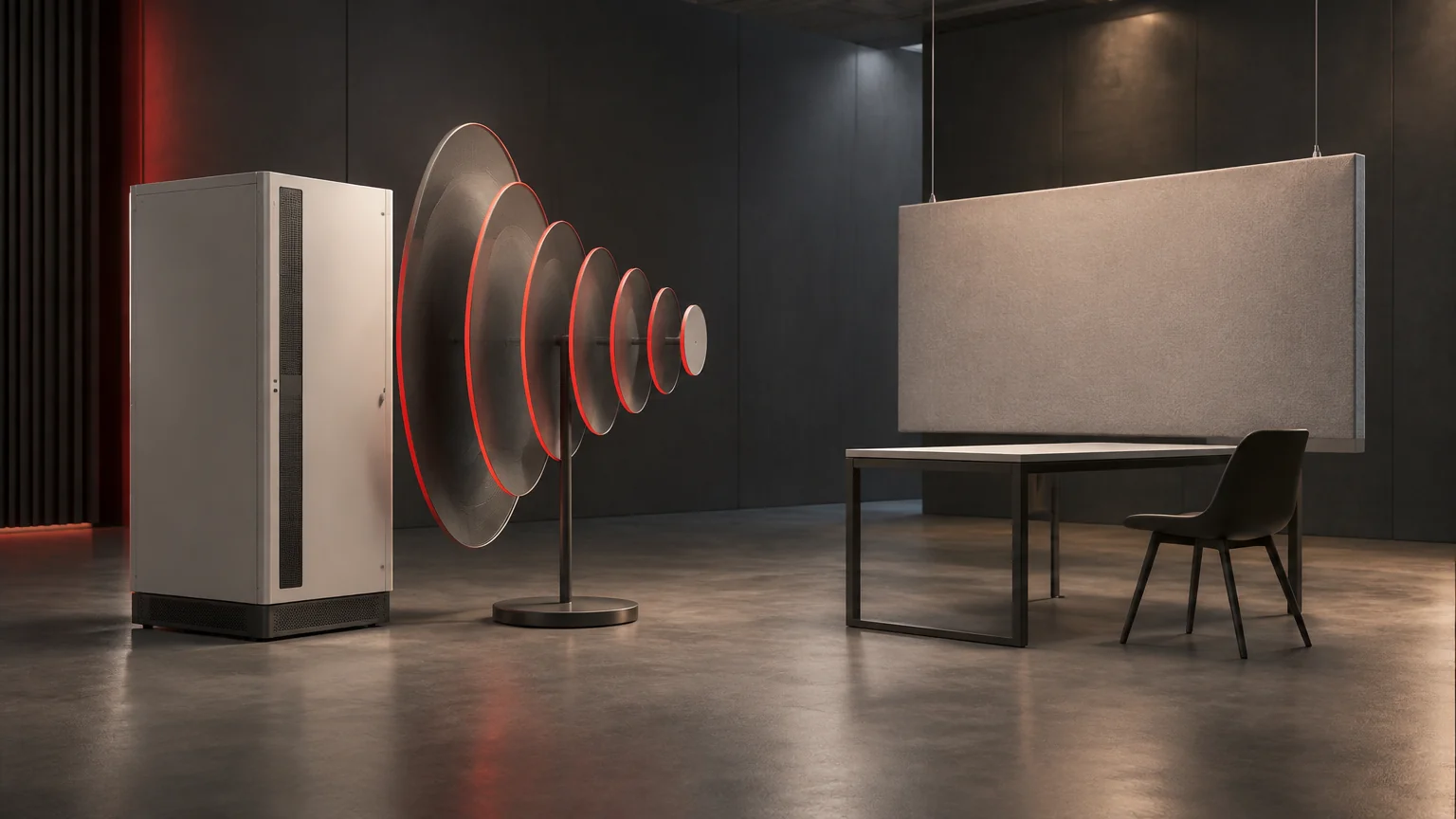
Compare UPS sound specifications only after matching the acoustic quantity, measurement conditions and operating state. Then assess the proposed room and listening positions separately. Highidea’s transformer-based UPS ranges provide options for industrial power requirements; identifying an occupied-room noise requirement early helps us discuss the equipment and installation together.
Define the room requirement before ranking machines
A control room, laboratory workspace and separate equipment room have different users and activities. Record where people work, when the UPS operates and which tasks require quiet. Give the project designer the room dimensions, equipment locations, major surfaces and existing sound sources. These inputs are more useful than an unexplained request for a “silent UPS.”
Distinguish ordinary running sound from audible alarms and from a new or abnormal noise. This guide addresses equipment selection under intended operating conditions. An unexpected mechanical sound requires the applicable support procedure; it should not become a reason to adjust internal fans or continue an unsafe inspection.
The project's acoustic requirement also needs an identified metric and assessment position. A limit for a particular room or workplace must come from the responsible project requirements, rather than a generic comfort number copied from another installation.
Identify sound pressure and sound power
Sound power describes acoustic energy emitted per unit time. Sound pressure describes the pressure variations at a position in the sound field. Brüel & Kjær’s Sound Intensity primer explains why distance and room absorption influence sound pressure. A machine’s sound-power declaration and a sound-pressure reading beside a desk therefore answer different questions.
When a datasheet supplies only “dB,” ask for the quantity, reference, frequency weighting and measurement method. A weighting such as A-weighting is part of the result, not optional decoration. Two values with different measurement positions or sound fields cannot support a straightforward quietest-product ranking.
Decibels use logarithmic relationships. Do not subtract two published numbers and describe the difference as the same percentage reduction in noise. Nor should a free-field distance rule be applied automatically inside a reflective room with other sources.
Put the operating state beside the sound value
UPS cooling demand can vary with operating conditions. The load, mode, ambient conditions and battery state should accompany the relevant noise specification. Ask whether a value describes a defined condition, a maximum under stated conditions or a range.
Legrand’s UPSaver datasheet lists separate audible-noise values for different modes. Eaton’s 93E G2 datasheet distinguishes equipment size groups. These manufacturer examples show why product family and state belong in the comparison; they do not establish the sound level of another UPS.
Comparison field | What to obtain | Why it matters |
|---|---|---|
Acoustic quantity | Sound pressure or sound power, with reference | Avoids comparing different quantities |
Weighting and method | Declared weighting and measurement method | Keeps the interpretation consistent |
Position and field | Distance, location and test environment | Connects the number to its conditions |
Equipment identity | Model and configuration | Prevents a series-level assumption |
Operating state | Load, mode, ambient and battery state | Identifies the relevant running condition |
Room requirement | Metric, location and responsible assessor | Connects selection to the occupied space |
Use unmatched quotations constructively
Imagine one quotation gives a sound-pressure value at a specified distance while another supplies an unspecified noise number. The first action is to request the missing conditions, not declare either machine quieter. Once equivalent equipment data are available, the acoustic designer can assess what those sources mean at the occupied positions.
Keep two decisions visible: which UPS satisfies the electrical duty, and which installation arrangement satisfies the acoustic requirement. A favorable equipment number cannot settle the room question by itself. Existing ventilation, other machinery and reflective surfaces may still dominate the result.
Preserve cooling while improving the installation
Equipment location and suitable room treatment may be part of an acoustic solution, but they must retain the UPS’s ventilation, access and environmental requirements. Covering vents or altering a fan to reduce noise compromises the equipment arrangement rather than completing its selection.
Our GD and GX33 industrial-frequency UPS ranges are relevant starting points for transformer-based requirements. Discuss the required load, room use and preferred arrangement with Highidea, and request information for the selected configuration. The isolation-path guide and site-condition guide address separate electrical and environmental choices that should remain in the project review.
Primary references
- Brüel & Kjær: Sound Intensity, sound pressure and sound power, foundational acoustic explanation.
- Legrand: UPSaver datasheet.
- Eaton: 93E G2 datasheet.
FAQ
Frequently asked questions
Does transformer-based construction determine the room noise level?
No. The exact design, cooling system, operating state and installation all matter; the topology label is insufficient for an acoustic ranking.
Can a room measurement replace manufacturer sound data?
It describes that room and measurement condition. Keep manufacturer source information and the room assessment connected but distinct.
Should a quiet mode be selected only for its sound rating?
Review its electrical operating behavior and suitability for the load as well. The selected mode must satisfy the complete power-protection task.
Related
Products, solutions & further reading.
Put this into practice
Need help specifying the right unit?
Share the load, voltage, runtime, environment and destination for a configuration review.