Locate Delays in a UPS Alarm Notification Chain
By Highidea Power · 22 October 2026 · 3 min read
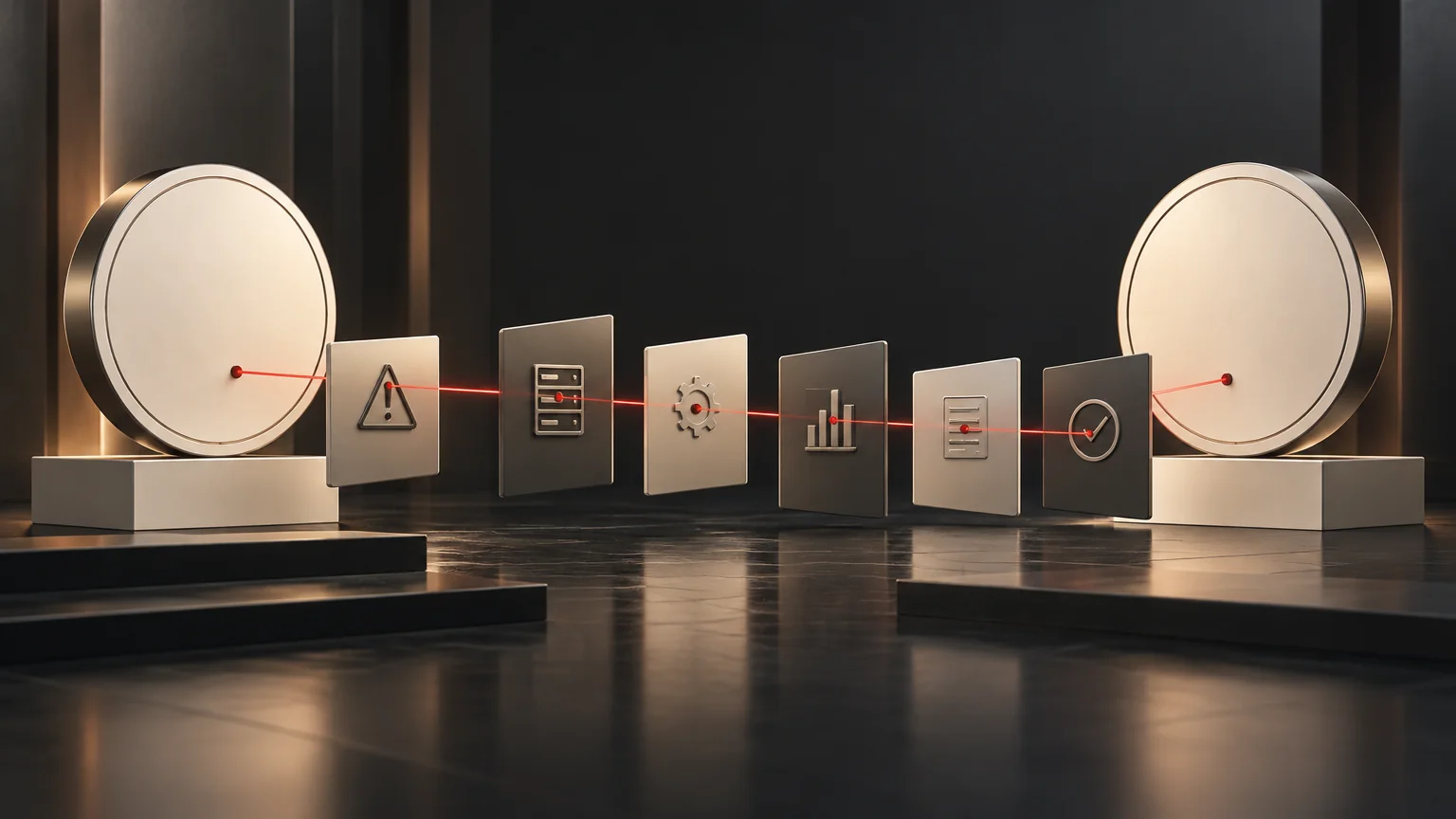
To investigate a late UPS alarm, separate the device event, collection, rule processing, delivery and operational acknowledgement. Establish what each timestamp means and whether the clocks are comparable before calculating delays. A device time subtracted from an inbox time can produce a precise-looking number that includes clock error rather than actual transport delay.
Highidea offers monitoring options for compatible equipment. A segmented timing record helps you specify and investigate the complete notification service, including the receiving systems and people beyond the UPS.
Name five observation points
Point | Evidence to retain, where available |
|---|---|
Device event | Raw event identity, condition, timestamp meaning and equipment/card identity. |
Collection | When the collector observed or received it; polling and message paths are different. |
Rule processing | Rule match, pending, grouping or suppression state and the time a notification became eligible. |
Delivery | Sending attempt, receiving-service evidence, retry history and final destination. |
Response owner | When the intended person or workflow accepted responsibility, separately from technical receipt. |
If the installed system exposes no timestamp at a boundary, mark that segment unknown. Do not manufacture a five-part timeline from one email header.
Normalize time before subtracting
Keep raw records and define offset as device clock minus reference clock. Under that convention, estimated reference time equals device time minus offset. Preserve time zones, resolution and uncertainty; a current clock comparison may not reconstruct the offset during an earlier incident.
For a hypothetical example, a device logs an event at 10:00:12Z and a receiver logs receipt at 10:00:20Z. A nearby valid observation establishes the device clock is 10 seconds ahead of the reference, while the receiver is on that reference. The normalized event estimate is 10:00:02Z, giving an estimated 18 seconds to receipt, not the raw difference of 8 seconds.
If the normalized event uncertainty is ±2 seconds and receipt uncertainty ±1 second, the elapsed interval is 15–21 seconds. Those assumed bounds must include the relevant timestamp limitations. This example sets no permitted delay or synchronization tolerance.
Investigate the segment the evidence identifies
A long event-to-collection interval points the review toward detection, polling, connectivity or collection behavior; it does not by itself prove which one caused it. A prompt collection followed by a later notification may involve processing rules, grouping, delivery attempts or destination availability.
Prometheus Alertmanager is one receiving-system example: its documentation distinguishes group waiting, subsequent group updates and repeat notifications. Those settings explain how intentional batching can affect a notification. They are not Highidea cloud defaults or universal values to copy.
Human acknowledgement is another segment. A receiving server accepting a message does not establish that a person saw it or took responsibility.
Use a scoped investigation card
Record incident/configuration identity; intended service objective; available raw timestamps and their meanings; normalization evidence; each segment's estimate or unknown; observed retries/suppression; proposed cause and supporting evidence; owner; and approved verification.
Compare against the site's agreed requirement. Do not shorten every timer at once: that may increase noise, change grouping or conceal which change mattered. Verify the affected path under a safe authorized arrangement, retaining the difference between a synthetic delivery check and an actual source-event check.
Discuss monitoring requirements with Highidea
Share the required events and integration, the intended receiver, response objective and equipment identities. Our clock-alignment guide supports the time-basis work; our commissioning guide explains test coverage. Together they help define a usable monitoring option and the downstream responsibilities.
Receiving-system references
- Prometheus Alertmanager concepts.
- Alertmanager configuration: notification timing. Product-specific examples do not establish the installed UPS/card's features.
FAQ
Frequently asked questions
Does a negative calculated delay mean the alarm traveled backward?
It signals incompatible or insufficient timing evidence, event mismatching or another record problem. Resolve those before drawing a physical conclusion.
Is the email's displayed time enough?
Identify what it represents and its time basis. Display, service receipt and device occurrence may be different events.
Should the original timestamp be overwritten after normalization?
Keep it. Retain the source timestamp, time-zone or clock-basis information, applied correction and normalized value as distinct fields. This allows another reviewer to reconstruct the sequence and identify uncertainty. A convenient common timeline should not erase the raw evidence or imply greater timing precision than the sources support.
Related
Products, solutions & further reading.
Put this into practice
Need help specifying the right unit?
Share the load, voltage, runtime, environment and destination for a configuration review.