UPS Delivery Route Survey: Check the Path Before Arrival
By Highidea Power Engineering Team · 20 October 2026 · 4 min read
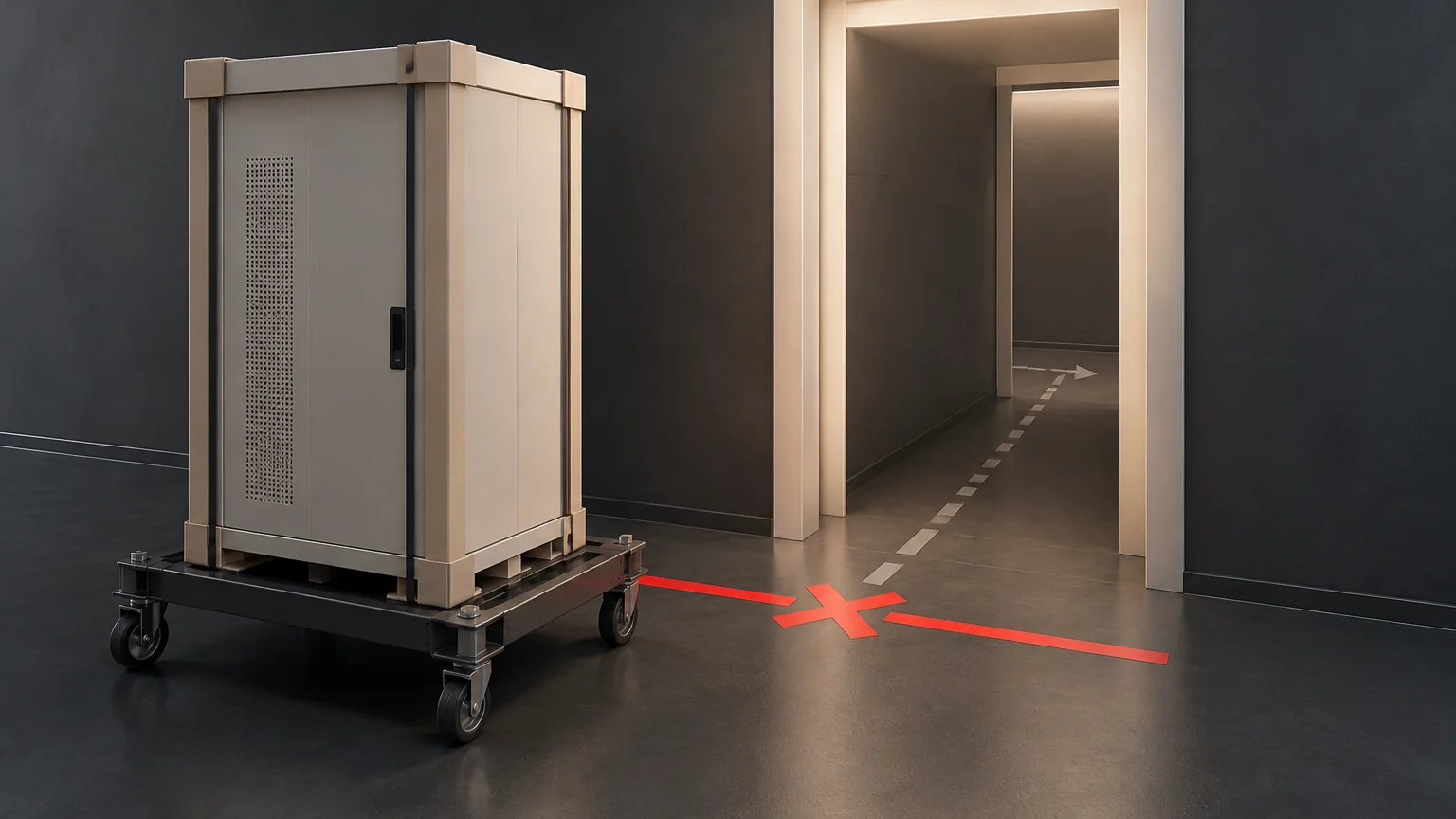
Survey the route for the actual packaged equipment, handling method and site constraints before delivery. Check every doorway, turn, lift and final approach, with competent parties responsible for floor and handling approval. A chassis that fits the electrical room may still be impossible to deliver safely through the building.
Freeze the delivery condition
Request shipping dimensions, mass, orientation restrictions and the manufacturer's handling instructions for each item. Distinguish the UPS host, battery cabinets and accessories. Packed and unpacked dimensions answer different questions.
Do not assume packaging can be removed at the loading bay or batteries removed to reduce mass. Either change may introduce handling, storage, warranty or safety consequences that require explicit instructions and approval.
Highidea lists both compact equipment and larger industrial/three-phase product families. That portfolio context does not establish the shipping dimensions, approved lifting points or route limits of an offered configuration. Obtain its actual documents.
Divide the route into segments
Start at the vehicle unloading point and continue to the final installed position. Assign an owner to each segment rather than asking a driver to resolve surprises on arrival. Include temporary obstacles, access permissions, security arrangements and the availability of the approved handling team.
The proposed record below is a coordination tool, not a heavy-equipment handling standard or a structural assessment.
Segment record | Evidence or decision required |
|---|---|
Entry and unloading | Agreed delivery condition, access window and handling responsibility. |
Doorways and passages | Measured clear opening and obstructions for the approved equipment orientation. |
Turns and level changes | Route drawing and competent assessment of the proposed handling method. |
Floor and lift | Applicable load/size approval from responsible site and structural parties. |
Final approach | Space for placement and the approved installation sequence. |
Route release | Named approvers, document revisions and unresolved hold points. |
Manufacturer rack/tower manuals, such as CyberPower's cited series manuals, emphasize product-specific installation and handling cautions. Small-unit instructions do not establish a lifting method or load-bearing rule for a heavy UPS. The responsible professionals must approve the actual route and equipment.
Compare the package with the limiting opening
Suppose a hypothetical doorway has a verified 900 mm clear opening and the approved delivery condition is a package 950 mm wide. The proposed route fails that width comparison, even if the unpacked host is narrower. Do not treat the 50 mm difference as a problem the crew can resolve by tilting or squeezing the package.
An alternative delivery condition or route may be possible, but it requires documented approval. The example is only arithmetic; doorway width alone cannot establish turning clearance, floor capacity or safe movement.
Keep the rejected option in the record with its reason. This prevents a later quotation or delivery instruction from reverting to the original unsuitable assumption.
Use one fillable record for each limiting segment. Dimensions and ratings must come from the measured route and the responsible parties' approved documents.
Survey cell | Complete before route release |
|---|---|
Segment and delivery condition | From/to: __; package/equipment ID: __; orientation/handling-method reference: __. |
Envelope | Equipment/package width × depth × height: __ mm; measured clear opening: __ mm; turn/approach drawing: __; result: __. |
Mass and support | Actual delivery mass: __ kg; floor/lift assessment reference: __; competent approver: __; decision: __. |
Access and custody | Access window: __; handling lead: __; receiving custodian: __; approved holding location: __. |
Hold/release | Unresolved constraint: __; owner: __; approved alternative/reference: __; stop/dispatch decision: __. |
An empty structural or handling approval field is a hold point, not permission to derive a safe load from this form.
Agree what happens if the room is not ready
Identify a receiving or holding location that the responsible parties approve for the equipment and batteries. Agree custody, environmental requirements, inspection responsibility and any manufacturer preservation obligations before the shipment arrives.
A transport-damage inspection is a different decision from route approval. Capture required delivery evidence through the receiving process, but do not continue moving damaged or unstable equipment merely to reach the planned room. Follow the site's safety arrangements and qualified support direction.
Likewise, a storage plan does not authorize energizing or charging equipment in an improvised location. Use the selected model's instructions and the site's approved arrangements.
Release a route, not an assumption
Before dispatch, reconcile the equipment's final shipping data with the signed route record. Recheck any change in packaging, battery scope, site access or handling method. Name the party who can stop delivery when a critical approval is missing.
Send Highidea the route constraints with the order requirements so mechanical limitations are considered before shipment. Keep the carrier, site owner, equipment supplier and competent handling team aligned on the approved condition. A successful quotation is not proof that the equipment can reach its operating position.
Primary references
The references support the specific distinctions stated above. Manufacturer examples apply to their documented products; they do not establish the same capability in a Highidea model. Proposed worksheets and hypothetical examples are editorial decision tools, not approved installation or operating procedures.
CyberPower: Smart App Sinewave UPS Series User Manual: PR750RT2UC–PR3000RT2UC and PR750RTXL2UC–PR3000RTXL2UC
CyberPower: Smart App Sinewave UPS Series User Manual: PRL1500RT2UC / PRL3000RT2UC
FAQ
Frequently asked questions
Can the supplier's net dimensions be used for route planning?
They are only one input. Use the dimensions of the approved delivery/handling condition, including packaging where applicable.
Does this survey replace a floor-loading assessment?
No. Structural and lift suitability require approval from the responsible competent parties.
Can the crew decide to remove batteries on arrival?
Not based on this guide. Battery handling and equipment changes require the actual manufacturer's instructions and appropriate authorization.
Related
Products, solutions & further reading.
Put this into practice
Need help specifying the right unit?
Share the load, voltage, runtime, environment and destination for a configuration review.