World Voltage Standards: Choosing 110V vs 220–240V UPS for Export
By Highidea Power Engineering Team · 28 May 2026 · 6 min read
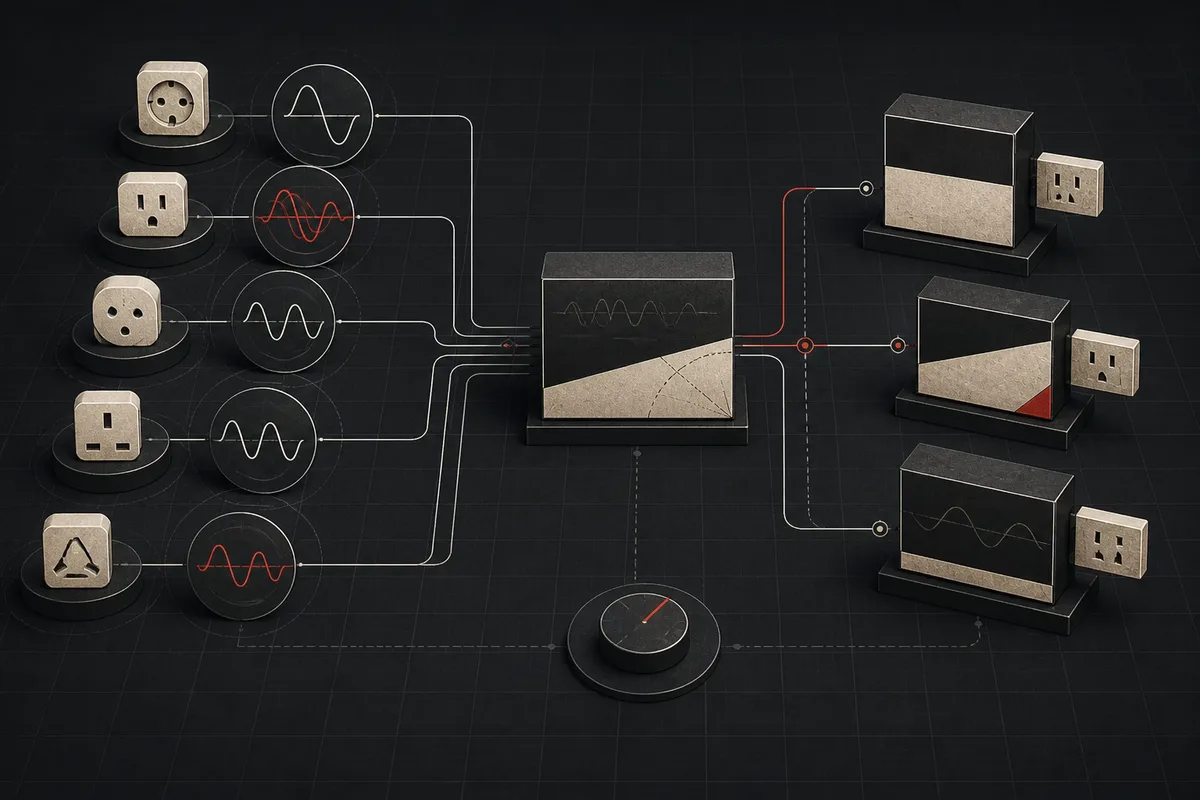
Choose UPS output voltage and frequency to match the destination grid. The world splits into two families: 110/120/127 V at 60 Hz (the Americas and Japan) and 220–240 V at mostly 50 Hz (Europe, the UK, and most of Asia, Africa and Oceania). For 220–240 V markets, a UPS with selectable 208/220/230/240 V output and automatic 50/60 Hz adaptation serves nearly everywhere. For the Americas, Japan, marine and mining, use specialty 100/110/120/127 V models. Frequency self-adaptation lets one unit run correctly on either 50 Hz or 60 Hz grids.
Two voltage families, one decision
Mains supply around the world falls into two broad families. Getting the UPS output voltage and frequency right for the destination is the single most important export-fit decision — a unit set for the wrong voltage or frequency simply will not serve the load correctly.
Voltage & frequency by region
| Region / country | Voltage | Frequency |
|---|---|---|
| USA | 120 V | 60 Hz |
| Canada | 120 V | 60 Hz |
| Mexico | 127 V | 60 Hz |
| Japan | 100 V | 50 / 60 Hz |
| Continental Europe | 220–230 V | 50 Hz |
| United Kingdom | 230 V | 50 Hz |
| Most of Asia / Africa / Oceania | 220–240 V | 50 Hz |
How to choose UPS output voltage
Highidea Power’s online UPS support selectable 208/220/230/240 VAC output with automatic 50/60 Hz, so a single model serves most 220–240 V regions. For the Americas, Japan, marine and mining, the D-series provides specialty 100/110/120/127 V output.
What frequency self-adaptation does
Frequency self-adaptation means the UPS automatically tracks the input frequency and delivers a stable output frequency, so connected equipment runs correctly whether the grid is 50 Hz or 60 Hz. It is implemented in the internal DSP controller, and it is what lets one model serve both 50 Hz and 60 Hz markets without customisation — a practical advantage for exporters who do not want a separate SKU per frequency.
FAQ
Frequently asked questions
Which countries use 110/120/127 V?
The Americas and Japan: the USA and Canada use 120 V at 60 Hz, Mexico 127 V at 60 Hz, and Japan 100 V at 50/60 Hz. Most other regions — Europe, the UK and most of Asia, Africa and Oceania — use 220–240 V, mostly at 50 Hz.
Can one UPS serve both 50 Hz and 60 Hz markets?
Yes — a UPS with frequency self-adaptation automatically tracks the input frequency and delivers a stable output, so the same model runs correctly on either 50 Hz or 60 Hz grids. Highidea online UPS also offer selectable 208/220/230/240 V output.
When do I need a 110 V UPS instead of 220–240 V?
For the Americas and Japan, for imported equipment designed at 100/110/120 V, and for marine systems (110 V) and coal mines (127 V). Highidea’s D-series provides these specialty voltages.
Why is 127 V used in coal mines?
127 V is a safety voltage standard: a lower voltage reduces leakage and short-circuit risk in the damp, conductive underground environment. It is also a long-standing regional infrastructure norm.
Related
Products, solutions & further reading.
Put this into practice
Need help specifying the right unit?
Share the load, voltage, runtime, environment and destination for a configuration review.