Choose a Load Bank for the UPS Acceptance Question
By Highidea Power · 23 October 2026 · 3 min read
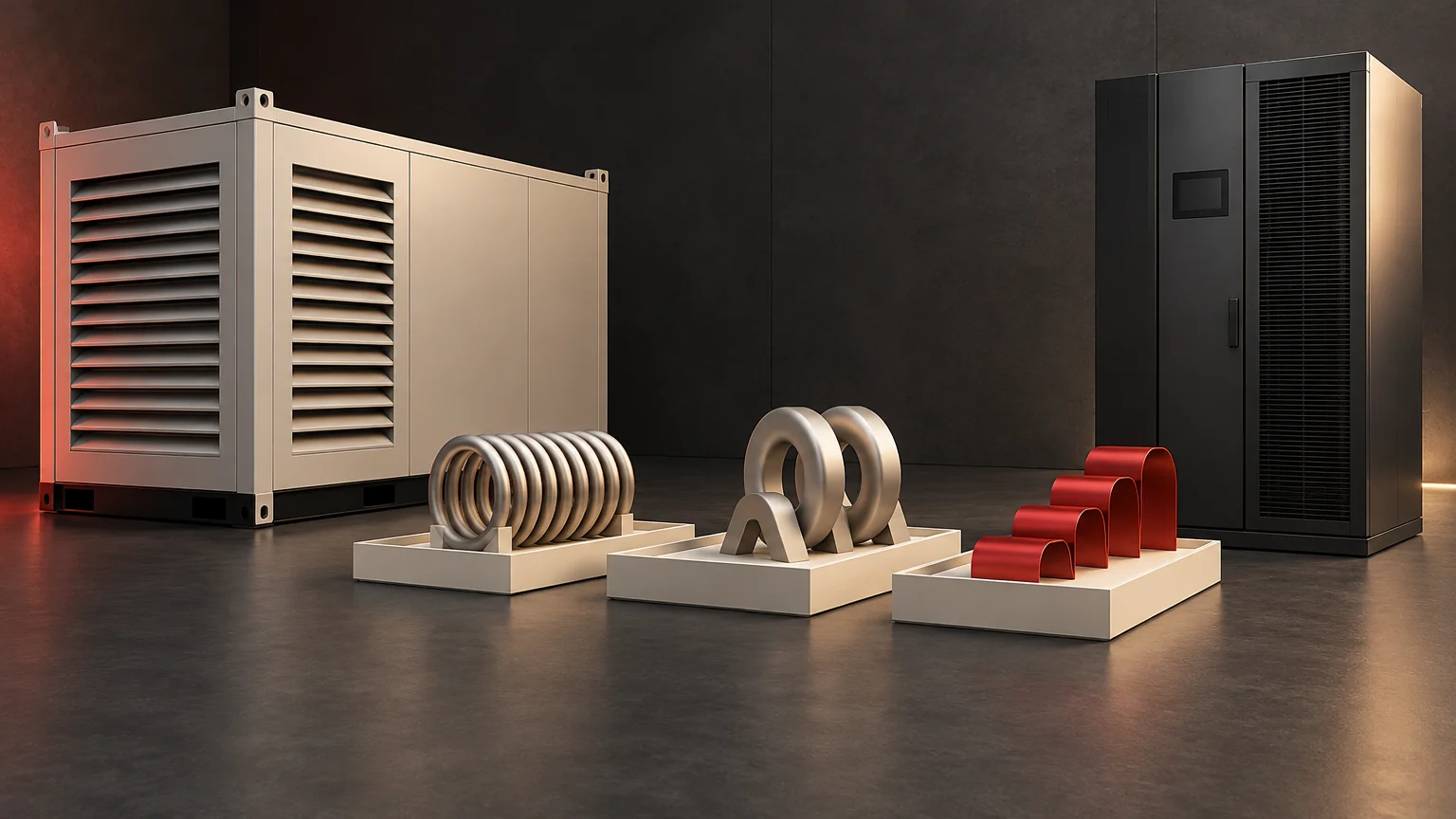
Choose a load bank against the result the acceptance test must establish. Matching its headline kW to the UPS rating is insufficient: voltage, frequency, phase arrangement, power factor, steps, dynamic behavior and supporting services can change what is demonstrated. A resistive runtime test can support a defined energy-delivery result without proving compatibility with every electronic or motor load.
Start with the claim you intend to accept
A runtime question asks whether the supplied system supports a defined demand until an agreed endpoint. A steady-capacity question asks about continuous operation at specified W and VA. A dynamic question asks how the system responds to a changing event. A real-load compatibility question can include waveform sensitivity, startup, controls and recovery.
Write these as separate claims. One rented unit or one successful demonstration may cover some of them and leave others open. Acceptance should identify those exclusions before the equipment arrives.
For three-phase projects, the load arrangement and per-phase requirement also matter. A balanced three-phase demonstration does not establish every permitted unbalanced operating condition.
Match the electrical task, not just the size
Acceptance task | Load-bank capability and remaining limit |
|---|---|
Defined steady W and duration | Sustained suitable loading and recording; the result belongs to that demand and endpoint. |
W and VA at a specified power factor | Appropriate resistive/reactive capability; kW alone does not establish the VA task. |
A specified load change | Suitable step size, timing and response; a slow manual change cannot stand in for every transient. |
Electronic-load compatibility | Relevant waveform and event behavior; a simple resistance is not an automatic equivalent. |
Per-phase requirement | Supported phase connection/loading arrangement and separate observations under the approved plan. |
Trystar's RL documentation separately states voltage, frequency, phase, power factor, resolution, airflow and protection. It illustrates why these are individual selection fields. Its ratings and advertised applications do not approve a pairing with a Highidea UPS.
Use a small arithmetic check to expose a mismatch
For a hypothetical single-phase steady test, 8 kW at unity power factor corresponds to 8 kVA. If the required task is instead 8 kW at power factor 0.8, the apparent power is 8/0.8 = 10 kVA. A test demonstrating the former has not demonstrated the latter merely because the real watts match.
This arithmetic does not define the waveform of the actual load. A resistive/reactive combination with a chosen displacement relationship also does not automatically reproduce a nonlinear device's pulsed current, startup or control behavior. Preserve the actual equipment requirement and ask the responsible test designer how it will be represented.
Include everything needed to run the test
Identify the load bank's auxiliary supply, controls, cooling and heat rejection. Record whether auxiliary demand is inside or outside the measured UPS output boundary. If it is included, it belongs in the actual load record; if supplied separately, do not claim it was battery-supported.
Confirm permitted placement, ventilation, cable/protection design, access, instrumentation and emergency arrangements through the equipment documents and qualified site team. A test can be invalid or unsafe even when electrical capacity appears adequate. This guide does not supply connection or switching instructions.
Keep an approved stop and recovery plan, including battery recharge and final readiness. Do not use production equipment as an improvised load bank or deliberately overload a live system to discover its limit.
Issue a claim-by-claim result
Retain the acceptance claim, actual host/storage and load-bank identities, configuration, observed demand, duration, method, evidence and exclusions. Record supported, failed or not demonstrated for each claim rather than a single “UPS passed” label.
Send Highidea the intended acceptance claims and load/source conditions through our contact page. Agree the configuration evidence and responsible test design before choosing the rental equipment.
References
Related reading
FAQ
Frequently asked questions
Does a larger load bank always make a better test?
No. Its usable steps, operating range and behavior must fit the required task. Excess capacity cannot compensate for unsuitable resolution or voltage.
Can one test establish battery lifetime?
A recorded run establishes its defined conditions. It does not prove future capacity, cycle life or every later load profile.
Should a changed load bank be treated as equivalent automatically?
Compare the capabilities and test boundary again. Retain any changed method or uncovered claim in the final record.
Put this into practice
Need help specifying the right unit?
Share the load, voltage, runtime, environment and destination for a configuration review.