Vehicle-Mounted UPS and Battery Restraint: Follow the Load Path
By Highidea Power · 23 October 2026 · 3 min read
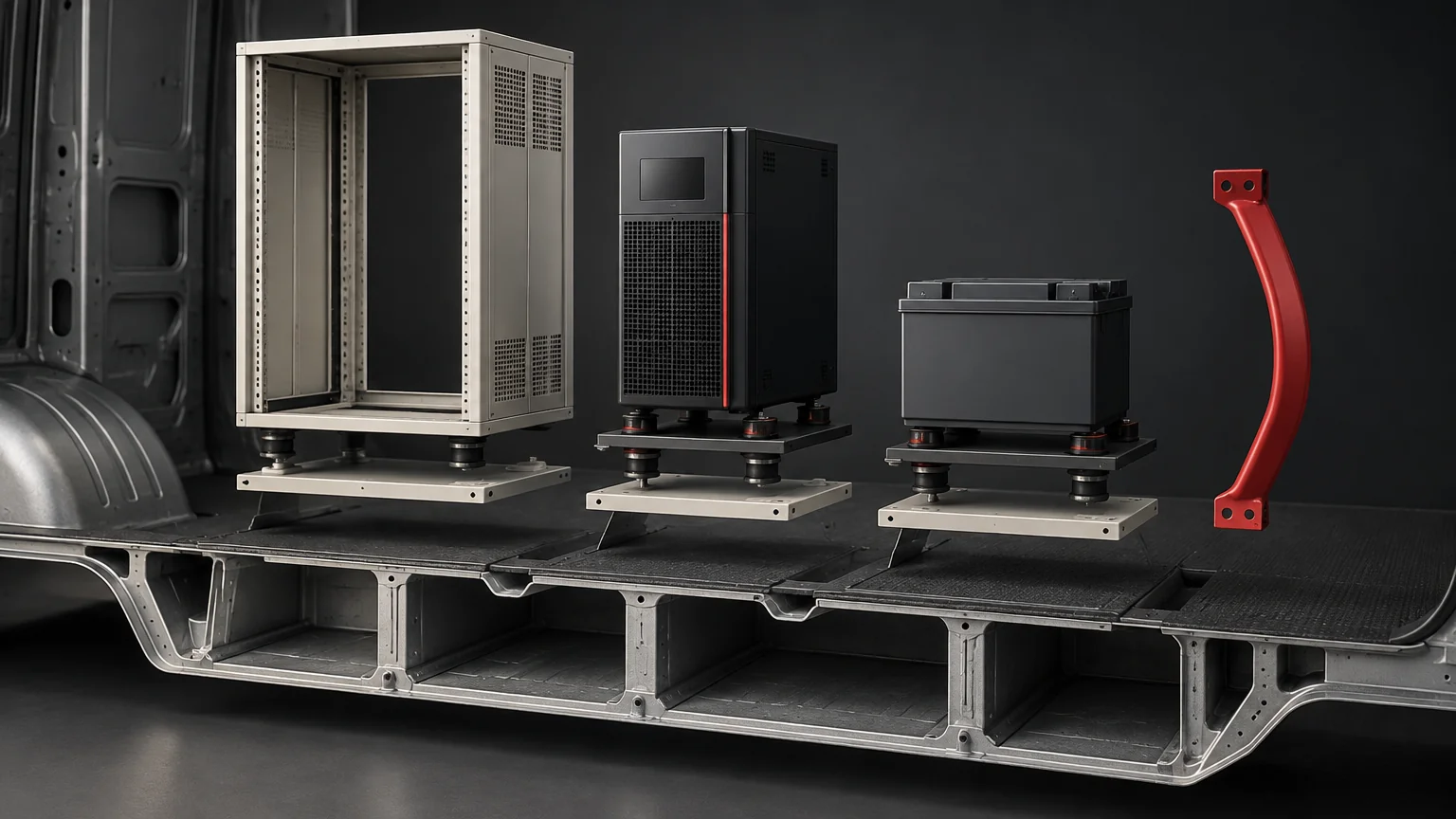
A UPS that fits inside a vehicle cabinet still needs an approved mechanical restraint arrangement. Review the complete path from equipment and batteries through supports, cabinet and attachments into the vehicle structure. Include the moving, parked and service states. A shelf's static load rating or a set of rack ears cannot establish the whole arrangement's suitability for vehicle operation.
Separate support from restraint
Support carries the installed equipment in its intended position. Restraint addresses the movements and forces considered in the vehicle design. A component can be supported against gravity while still having an unresolved movement path.
Obtain the actual host, batteries and accessories, their installed masses, center-of-gravity information where required, approved support points and manufacturer mounting restrictions. Shipping mass, an empty enclosure weight and the complete installed assembly are different inputs.
Do not assume that a handle is a restraint point or that a front panel is designed to carry a vehicle load. The equipment and vehicle integrator must establish the intended interfaces.
Follow four connected mechanical boundaries
Boundary | Question for the responsible party |
|---|---|
UPS or battery to its support | Which points and supports are approved for the exact equipment and orientation? |
Support to cabinet | What loading and attachment conditions does the cabinet arrangement support? |
Cabinet to vehicle | Which structural attachments and operating load cases are approved by the integrator? |
Cables and service connections | How are weight, movement, bend limits and access controlled without loading equipment terminals? |
The last boundary is easy to overlook. A cabinet that remains in position can still leave a heavy cable pulling on a connector. Conversely, cable ties are not automatically a substitute for equipment restraint.
Victron's wiring guidance discusses cable slack and strain relief in vibration-exposed installations. Its specific hardware and recommendations are not universal UPS installation instructions. Use the selected equipment's connection and support documentation.
Define the operating states the approval must cover
Transport with the system inactive, parked operation and operation while moving may have different requirements. Confirm whether the load equipment itself is permitted to operate in each state. Mechanical installation approval does not authorize an analytical instrument's moving operation.
Include the battery service task: required access, temporary support, handling and permitted electrical state. A part removed for maintenance changes the arrangement. Do not assume that travel restraints remain an approved service support or that service clearances may block an essential escape path.
Keep the actual vehicle configuration in the record. Moving the cabinet or adding battery mass can change the approved load path even when the UPS model is unchanged.
Use general load-security principles in their proper scope
UK DVSA cargo guidance requires attachment points suitable for expected loads and emphasizes the weakest component in a restraint system. That illustrates the whole-path principle. It is cargo guidance, not certification of a permanently installed UPS, a crashworthiness test or a substitute for applicable vehicle requirements.
Do not borrow lashing counts, force factors or fastener details from a general article. The responsible integrator must identify the relevant load cases, design method and required evidence for the actual vehicle and jurisdiction.
This review does not provide drilling, bracket fabrication or live battery-handling instructions. Installation and inspection require the appropriate qualified personnel and approved method.
Retain a configuration-specific release
Keep the equipment list, masses, support and attachment drawings, manufacturer restrictions, vehicle assessment, service method and inspection/approval responsibility together. Mark unanswered interfaces as open before dispatch or use; an attractive completed cabinet photograph cannot close them.
Highidea has documented mobile-laboratory application context, which supports a technical discussion rather than universal vehicle approval. Send the vehicle integrator's constraints, exact load task and requested mechanical data through our contact page so the proposed UPS arrangement can enter the complete review.
References
Related reading
FAQ
Frequently asked questions
Does an indoor rack rating establish vehicle suitability?
No. It belongs to its stated arrangement and loading conditions. Vehicle operation requires the applicable complete assessment.
Can heavy cables be left hanging from battery terminals?
Use the exact connection and strain-relief requirements. Equipment restraint does not independently address cable forces or movement.
Can a later battery addition reuse the original release?
Have the responsible parties assess the changed mass, location, support and service states before relying on the previous approval.
Related
Products, solutions & further reading.
Put this into practice
Need help specifying the right unit?
Share the load, voltage, runtime, environment and destination for a configuration review.