Does a Sealed VRLA UPS Battery Still Need Ventilation?
By Highidea Power · 24 October 2026 · 4 min read
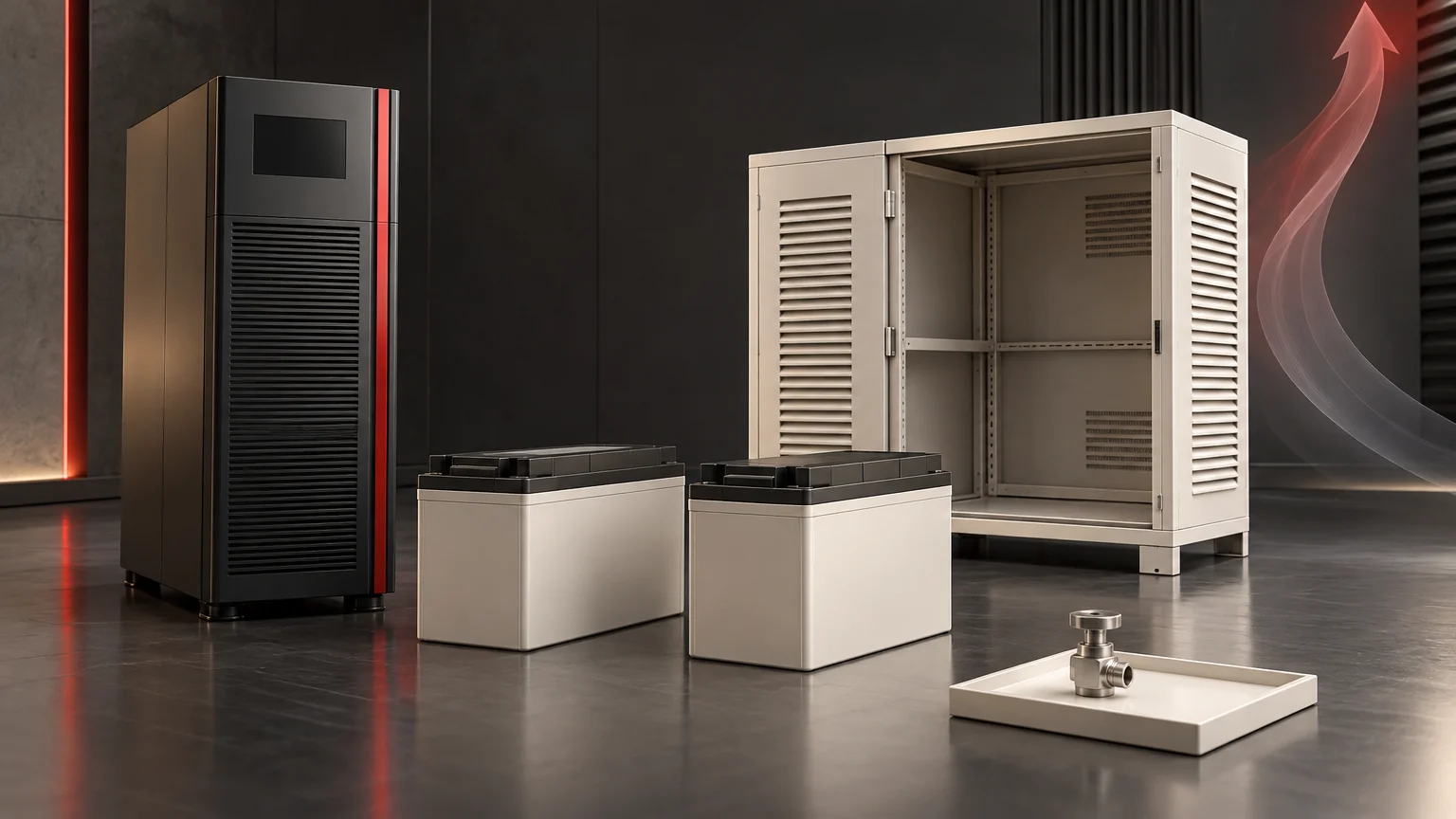
Treat sealed or maintenance-free VRLA battery wording as a description of the battery technology, not permission to place the system in an airtight enclosure. Valve-regulated lead-acid batteries can release gas, and the actual battery, charger, cabinet and room need a coordinated installation review. Highidea’s C-series online UPS uses internal VRLA batteries. For a C configuration or a separate battery enclosure, plan the surrounding conditions alongside the required backup duty.
Understand what valve-regulated means
VRLA stands for valve-regulated lead-acid. A valve has a pressure-release function; the word sealed should not be read as permanently gas-tight. Yuasa’s EN80-6 manufacturer datasheet describes a low-pressure valve that permits gas to escape and then reseals. Its gas-release warning states that VRLA batteries release hydrogen, which can form explosive mixtures in air, and cautions against a sealed container.
That document is a March 2011 datasheet. The principle explains why enclosure planning matters; its historical product ratings and charging values are not a design basis for a current Highidea installation. Use the actual supplied battery’s current safety and installation information for the project.
Maintenance-free also should not be read as a promise that the complete system needs no inspection or service planning. Follow the selected equipment’s supported maintenance requirements. Do not open battery valves, add water or remove covers to investigate how the battery operates.
Give heat and gas their own questions
Cooling removes heat produced inside the installation boundary. Gas management addresses possible accumulation and the applicable ventilation requirements. Both interact with the enclosure, but a satisfactory room-temperature reading cannot by itself close the gas question.
Ask the battery and UPS suppliers for the conditions relevant to the installed arrangement, including charging operation. Give the project’s qualified designer the actual battery identity, quantity, charger information and location. The designer needs the applicable manufacturer requirements and site rules to establish the required provision.
A generic number of air changes, a fan selected by appearance or a calculation borrowed from another battery bank is not a complete answer. This guide does not prescribe ventilation rates, hydrogen concentration limits or a universal arrangement. Those depend on the actual system and applicable requirements.
Follow the battery through three boundaries
An internal UPS battery, a separate battery cabinet and the room around them are different boundaries. Identify which manufacturer supplies each part and which instructions govern the installed combination.
Highidea’s C1K–C10K range contains internal VRLA batteries. Highidea also lists lead-acid battery products and separate battery enclosures. A shared name or suitable-looking cabinet does not establish an approved expansion arrangement. Our C-series and battery-cabinet guide helps keep those quotation identities distinct.
Use the following record to connect the thermal review with the gas/ventilation review without merging their conclusions.
Planning boundary | Separate information and decisions |
|---|---|
Battery and charging | Actual battery model/quantity, supported charge conditions and current safety instructions |
UPS or battery cabinet | Supplied enclosure, permitted installation, openings/access and manufacturer’s ventilation requirements |
Room or outer enclosure | Heat-removal arrangement and separately established gas/ventilation provision |
Responsibility | Battery/UPS supplier information, project design approval and qualified installation scope |
Change control | Which review must be revisited after battery, charging or enclosure changes |
Retain an owner and an open/closed result for each requirement. “Cooling checked” and “ventilation requirements confirmed” should have their own supporting records, even when one coordinated design serves both tasks.
Review an airtight-cabinet proposal before purchase
Consider a hypothetical buyer placing a tower UPS inside a closed outer cabinet to keep dust away. The cabinet may change heat removal and the space in which any released gas could accumulate. A successful temperature check at one load does not establish the complete suitability of that enclosure.
Start by comparing the proposed arrangement with the UPS and battery instructions. Ask the cabinet and project designers how protection, heat removal and ventilation will be achieved together. If the required information is missing, resolve it before ordering or enclosing the equipment.
Do not improvise openings, defeat environmental protection or use a portable fan as proof that an unsuitable installation is now acceptable. Smoke, abnormal heat, unusual odor or other dangerous signs require the site’s safety response first. Do not approach, open, trial-charge or continue testing the equipment to obtain more evidence.
Compare battery choices without changing the task
Highidea offers both C-series online VRLA and ET-series online LiFePO4 routes. The ET/C comparison keeps chemistry separate from power-conversion topology.
Changing chemistry requires its own complete configuration review. The VRLA gas-release discussion is not a claim that a lithium system has no gas, fire or ventilation considerations. Obtain the applicable requirements for the exact chemistry, host and installation you intend to buy.
The rack cooling guide develops the heat and airflow task. Use it with the battery-specific information, keeping the protected load, backup duration and installation layout consistent across both reviews.
Prepare the Highidea installation enquiry
Send the UPS model, intended battery arrangement, load, required autonomy and room or cabinet conditions through our contact page. State whether the UPS will stand in its intended room or inside another enclosure.
We can discuss the C-series configuration and applicable equipment information, while the project’s responsible designer closes the site ventilation and installation requirements. This gives the order a clear equipment-and-environment basis.
Manufacturer reference
- Yuasa: EN80-6 VRLA datasheet, V2 March 2011, manufacturer safety text hosted by Blue Box Batteries; valve and gas-release principles only.
FAQs
FAQ
Frequently asked questions
Does maintenance-free mean no checks are needed?
Use the actual UPS and battery maintenance requirements. The wording does not remove inspection, service access or the need to review abnormal conditions.
Can a room cooling result establish adequate gas ventilation?
It establishes the observed thermal result under its conditions. Gas accumulation and the applicable ventilation requirements need their own assessment.
Does choosing LiFePO4 remove the installation review?
No. Review the selected lithium configuration under its own safety, environmental and installation requirements instead of carrying a VRLA conclusion across chemistries.
Related
Products, solutions & further reading.
Put this into practice
Need help specifying the right unit?
Share the load, voltage, runtime, environment and destination for a configuration review.