Insights
UPS selection, standards & application guides.
Practical engineering guidance for specifying lithium UPS and power inverters, covering selection logic, voltage standards, topology and real application requirements.
Battery and Runtime guides.
Showing 1–12 of 16 guides

VRLA Battery Ripple Voltage and Ripple Current: Keep Both Boundaries
Keep VRLA ripple voltage and current distinct, then match battery and charging-source requirements by measurement basis, location and operating state.

VRLA Battery Ah vs Watts per Cell: Compare the Discharge Conditions
Read VRLA Ah and watts-per-cell ratings by duration, endpoint, temperature and boundary before comparing complete UPS backup proposals.

VRLA Battery Ohmic Readings: Useful Trends, Not a UPS Capacity Certificate
Interpret VRLA ohmic trends with the right method, baseline and conditions, then choose the capacity or UPS runtime assessment your service decision needs.

Does a Sealed VRLA UPS Battery Still Need Ventilation?
Understand VRLA sealed and maintenance-free wording, then review heat removal and gas ventilation as separate installation requirements.
Specifying DC Protection for an External UPS Battery
Specify external UPS battery protection using actual DC voltage, current and fault conditions, with clear protection and isolation responsibilities.
External UPS Battery Cables: Review the Complete Voltage-Drop Loop
Review the full external UPS battery cable loop for voltage drop, heat and charge/discharge conditions, without guessing cable size or settings.
Lithium UPS in Cold Weather: Separate Charge and Discharge Limits
Check lithium UPS charge and discharge temperature permissions separately, including sensor location and readiness after cold-weather outages.

Battery State of Charge vs Actual UPS Runtime
Separate charge estimates, usable battery capacity and the actual load before converting a full-charge indication into a UPS runtime expectation.

Specify UPS Runtime for a Time-Varying Load
Specify a changing load as a sequence of simultaneous watts, VA and durations.

Mixing New and Older UPS Battery Packs: What Must Be Approved?
Purchase date alone does not decide whether new and older UPS batteries can be used together.
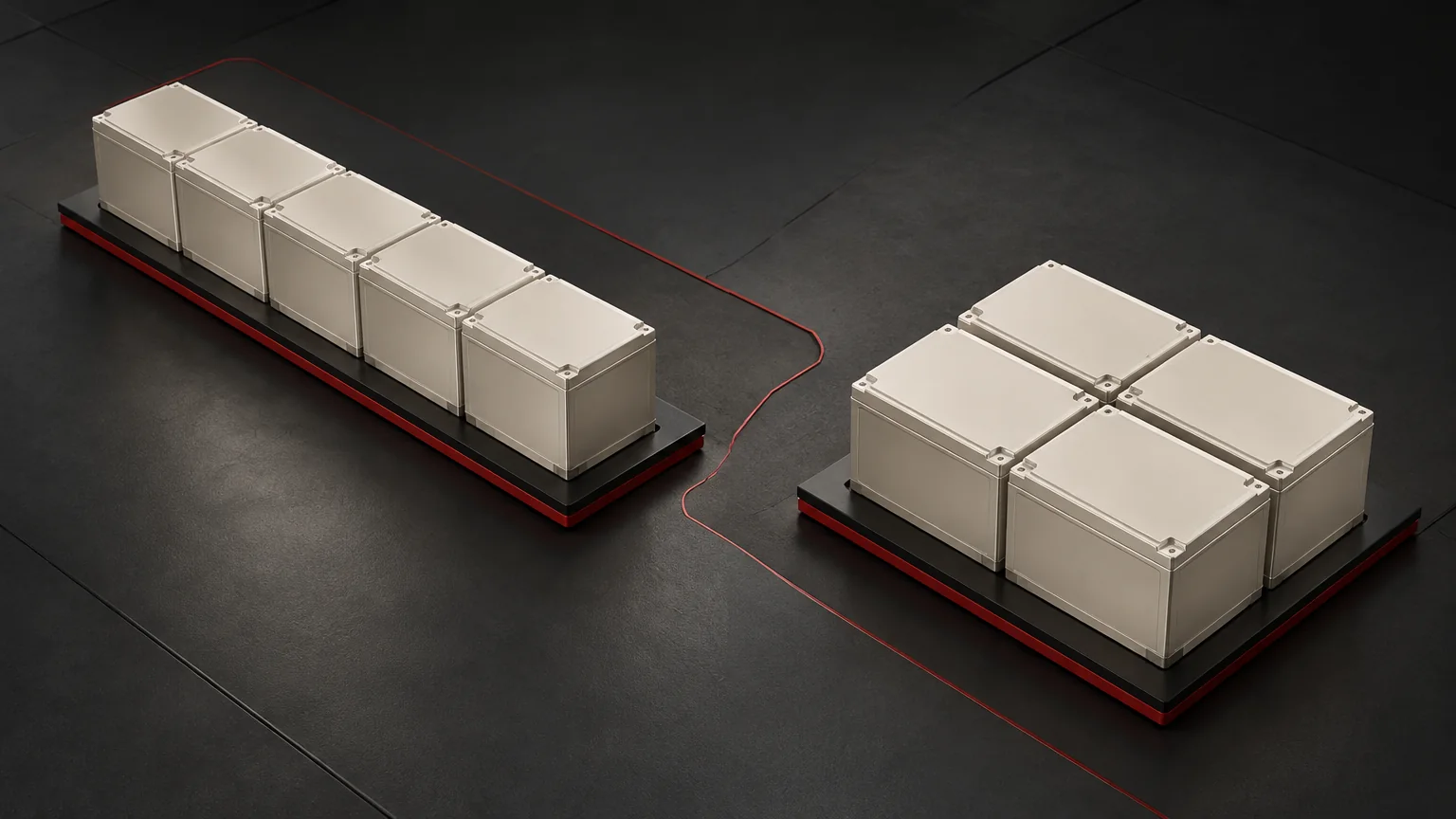
Series vs Parallel Batteries in a UPS Design Review
Compare nominal voltage, amp-hours and watt-hours in series and parallel battery arrangements, with matched-unit assumptions and configuration checks.

Battery Protection Trip vs UPS Low-Battery Shutdown
A battery protection action and a planned low-battery shutdown serve different purposes.
Engineering guidance
Make a better power-system decision.
Every article answers a real buyer question — which battery chemistry, which topology, which voltage, which model for which environment — with the parameters and trade-offs an engineer needs to decide. Each links through to the relevant products and solutions.
Have a specific question?
Tell us your load and we'll advise.
Use these guides to frame the requirement, then send the load, voltage, runtime and destination for a configuration review.